Volkswagen has shown the facelifted Virtus, and every article since has filled in the rest from expectation. That matters more than usual here, because the car on sale today is a good one at a price you can negotiate, and the new one arrives with a price nobody has published.
So this is two things: a clear list of what Volkswagen has actually put on the record, and the buying question that follows from it.
The Short Answer
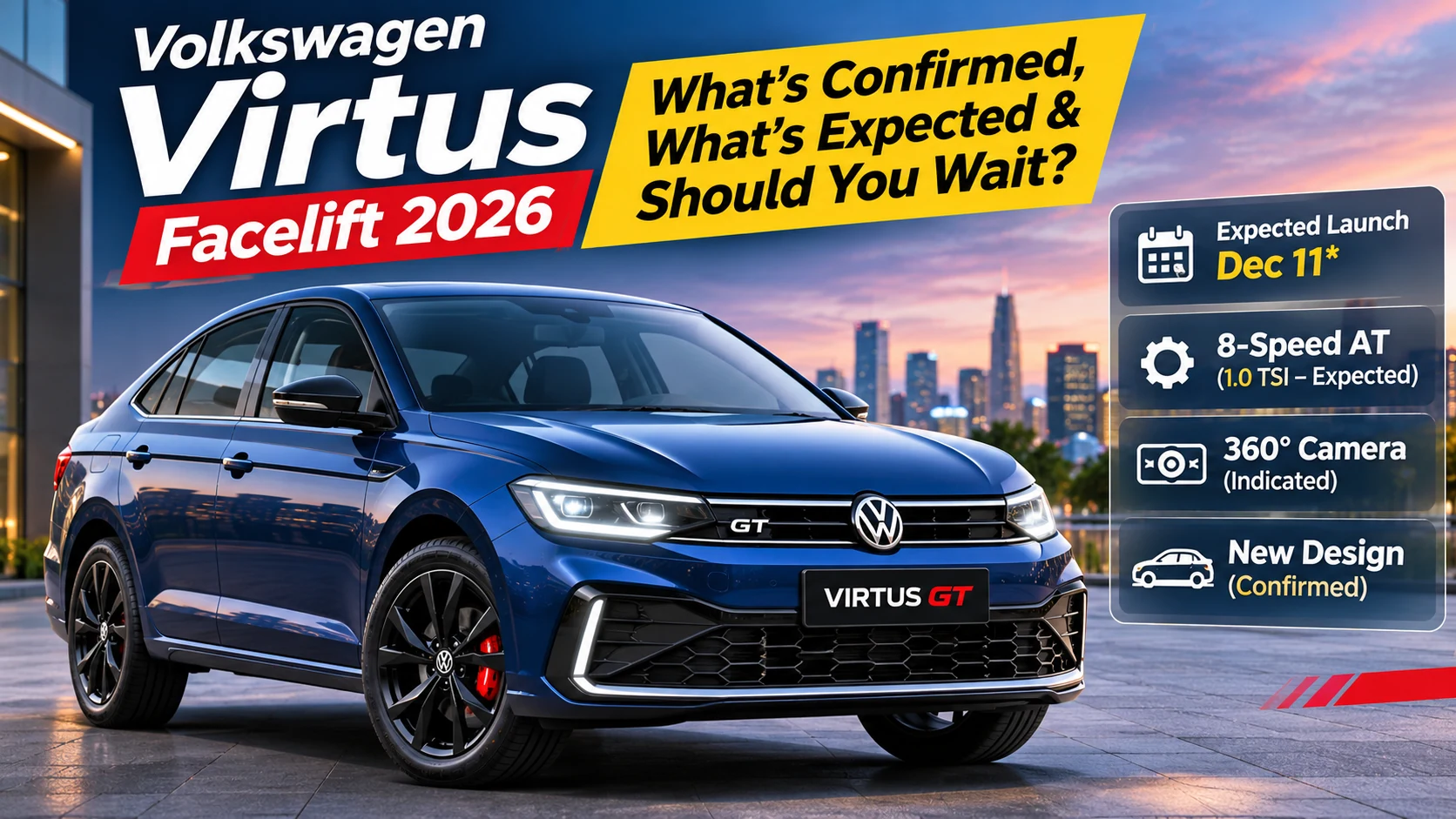
Volkswagen has officially revealed the facelifted Virtus from the outside, after a teaser, and it is widely reported for a December launch with 11 December the date in circulation. Volkswagen itself has not put its name to that date publicly, and it has not shown the cabin, confirmed a single feature or announced a price. The current Virtus sells from about ₹10.7 lakh to ₹19.2 lakh. If you want the car this year and a discount matters more to you than a new bumper, buy now. If you want the newer kit, be ready to buy in January at a price you can't see yet, in a month when the industry is signalling increases.
Confirmed or Expected: The Honest List
| What you'll read | Where it actually stands |
|---|---|
| The exterior design | Confirmed. Volkswagen has revealed it officially, on the GT variant, a day after its own teaser |
| Launch on 11 December | Widely reported, and plausible, but no Volkswagen statement carries that date. Treat it as a date to watch, not a commitment |
| A 360-degree camera and a digital driver's display | Expected. Volkswagen said the cabin and feature list would follow in the coming days and had not shown them at the time of writing |
| A new eight-speed automatic on the 1.0 TSI | Expected, and the most interesting change if it happens. Volkswagen has shared no mechanical details |
| Prices of ₹10.50 lakh to ₹19 lakh | An estimate built on current prices. No official figure exists |
| The engines carry over | Expected rather than stated, though it would be the normal pattern for a mid-life update |
That list is the whole reason to read this before a launch-day article. Four of those six lines are guesses, and two of them, the price and the gearbox, are the ones that decide whether the facelift is worth waiting for.
What Changes on the Outside
This part is settled, because the car has been shown. The revisions are modest, which is normal for a mid-life update on a model that already sells well.
- A new front bumper: Mesh detailing and smaller fog lamp housings, with the headlamp clusters and their integrated LED daytime running lamps carrying over largely as they are.
- New wheels and GT detailing: Black alloys with red front brake calipers, GT badging on the grille and the front doors on the variant shown.
- A new blue, and dual-tone: A new shade of blue, with black mirrors, a lip spoiler and a black roof on the dual-tone cars.
- Smoked tail lamps and a revised rear bumper: Plus a lip spoiler on the boot lid.
If you were hoping for a redesign, this isn't one. The silhouette is unchanged and so is most of the hardware you can see. That is worth knowing before you pay a premium for the newer car.
The One Mechanical Change Worth Caring About
The 1.0-litre TSI currently pairs with a six-speed torque converter automatic. The change expected on the facelift is an eight-speed unit in its place, with the 1.5-litre TSI carrying on with its seven-speed dual-clutch gearbox.
If that happens, it is the single most useful thing about this update, and more useful than every cosmetic change put together. Two extra ratios on a small turbo-petrol automatic usually means better part-throttle response in traffic and slightly better efficiency on the highway. It is also the one change you cannot retrofit or ignore.
My advice: if the eight-speed is the reason you're waiting, wait for Volkswagen to confirm it rather than for a launch date. It has shared no mechanical details at all so far, and a gearbox is exactly the sort of thing that gets reported ahead of time and then doesn't arrive.
What the Virtus Costs Today
The current car runs from about ₹10.71 lakh to ₹19.20 lakh ex-showroom, across eleven variants and six trim levels from Comfortline up to GT Plus. Two engines: a 1.0-litre turbo-petrol making 115hp, with a manual or an automatic, and a 1.5-litre turbo-petrol making 150hp, now automatic only.
| Specification | Current Virtus |
|---|---|
| Price, ex-showroom | About ₹10.71 lakh to ₹19.20 lakh |
| Engines | 1.0 TSI, 115hp, manual or automatic. 1.5 TSI, 150hp, dual-clutch automatic |
| Claimed mileage | 18.7 to 20.19 kmpl depending on engine and gearbox |
| Boot space | 521 litres |
| Length and wheelbase | 4,561 mm long, 2,651 mm wheelbase |
| Safety | Five stars at Global NCAP for adult and child occupants, six airbags as standard |
Treat the price as a planning band and confirm it at the dealership, because ex-showroom figures move and the listings don't always agree with each other on the opening variant.
Buy Now or Wait? The Part Nobody Is Doing the Maths On
Here is the argument you won't find in the launch coverage. Waiting for the facelift does not just cost you a few weeks, it moves your purchase across a date that matters.
- Year-end stock is when discounts are at their best: A car built in 2026 gets harder for the dealer to move every week of December, which is the entire reason year-end offers exist. Keep the add-ons off the invoice while you are negotiating. The facelift arriving makes that stock older still, in the dealer's eyes.
- But the offers may be thinner than usual this year: The industry has been signalling price increases rather than discounts, and at least one large carmaker has reported its discounting falling rather than rising after the festive season. Do not assume December will behave the way it did last year.
- January is when increases usually land: Carmakers have been open about planning further increases on commodity costs. So the realistic comparison is a discounted December car against a January car at a price that has not been announced and in a month when prices tend to move up.
- The December-built car has a resale cost: A car built in late 2026 and registered in January starts its life a model year behind on paper. That shows up when you sell, and it is worth weighing against the discount you were offered.
So the decision splits cleanly. If you want the car and the current one suits you, December is a good month to negotiate hard and a reasonable month to buy, as long as you check the build date and have the financing questions settled before you sign. If the eight-speed automatic or the new cabin is genuinely what you want, wait, but go in knowing you will be buying at an unannounced price without the year-end bargaining room.
Where It Sits Against the Competition
| Model | From, ex-showroom | Boot | Safety |
|---|---|---|---|
| Skoda Slavia | About ₹10.0 lakh | 521 litres | Five stars, Global NCAP |
| Volkswagen Virtus | About ₹10.5 lakh | 521 litres | Five stars, Global NCAP |
| Hyundai Verna | About ₹11.0 lakh | 528 litres | Five stars, Global NCAP |
| Honda City | About ₹11.95 lakh | 506 litres | Four stars, Global NCAP |
Starting prices only, and they move, so use them to place the cars rather than to budget, and our compare tool will put any two side by side on specification. The Slavia is the one to understand properly: it shares its platform and both engines with the Virtus, so the choice between them is about styling, dealer experience and the deal in front of you rather than engineering. The Verna counters with the only genuinely powerful engine in the group, a 160hp turbo, and the City with a hybrid nobody else here offers.
Conclusion
The facelifted Virtus looks like a sensible update to a car that did not need rescuing. The exterior is real and modest, the cabin and the gearbox are expectations rather than facts, and the price is nobody's number yet. That combination argues for patience about believing the details and impatience about the purchase: if the current car suits you, December is the month with the bargaining room in it.
Want to drive the current car before the facelift lands? Book a test drive and we will connect you with your nearest authorised dealer.
FAQs
1. When is the Volkswagen Virtus facelift launching in India?
A December launch is widely reported, with 11 December the date in circulation, but Volkswagen has not publicly attached its name to that date. It has revealed the exterior and said the cabin and feature list would follow.
2. What has Volkswagen actually confirmed about the facelift?
The exterior, which it revealed officially after its own teaser. It has not shown the interior, confirmed any feature, shared mechanical details or announced a price.
3. What changes on the outside?
A new front bumper with mesh detailing and smaller fog lamp housings, new black alloy wheels with red front calipers, GT badging on the grille and doors, a new shade of blue, dual-tone options, smoked tail lamps and a revised rear bumper. The headlamps and the silhouette carry over.
4. Will the facelift get a new gearbox?
An eight-speed automatic replacing the current six-speed on the 1.0-litre TSI is expected, with the 1.5-litre continuing on its seven-speed dual-clutch. Volkswagen has confirmed nothing mechanical, so treat it as a report rather than a specification.
5. How much does the Volkswagen Virtus cost right now?
About ₹10.71 lakh to ₹19.20 lakh ex-showroom across eleven variants and six trims. The facelift's price has not been announced, and the figures in circulation are estimates built on current prices.
6. Should I buy the current Virtus or wait for the facelift?
If the current car suits you, December is the month where you have the most room to negotiate on existing stock. If you want the new cabin or the expected eight-speed automatic, wait, but accept that you will be buying at an unannounced price in a month when the industry is signalling increases rather than discounts.
7. Is the Virtus safe?
The current car holds five stars at Global NCAP for both adult and child occupant protection and comes with six airbags as standard. A facelift does not automatically carry a rating over, so check the applicability once the new car is on sale.
8. Virtus or Skoda Slavia?
They share a platform and both engines, so this is not an engineering decision. Choose on styling, on the service experience you expect locally, and on which dealer gives you the better deal in the week you are buying.