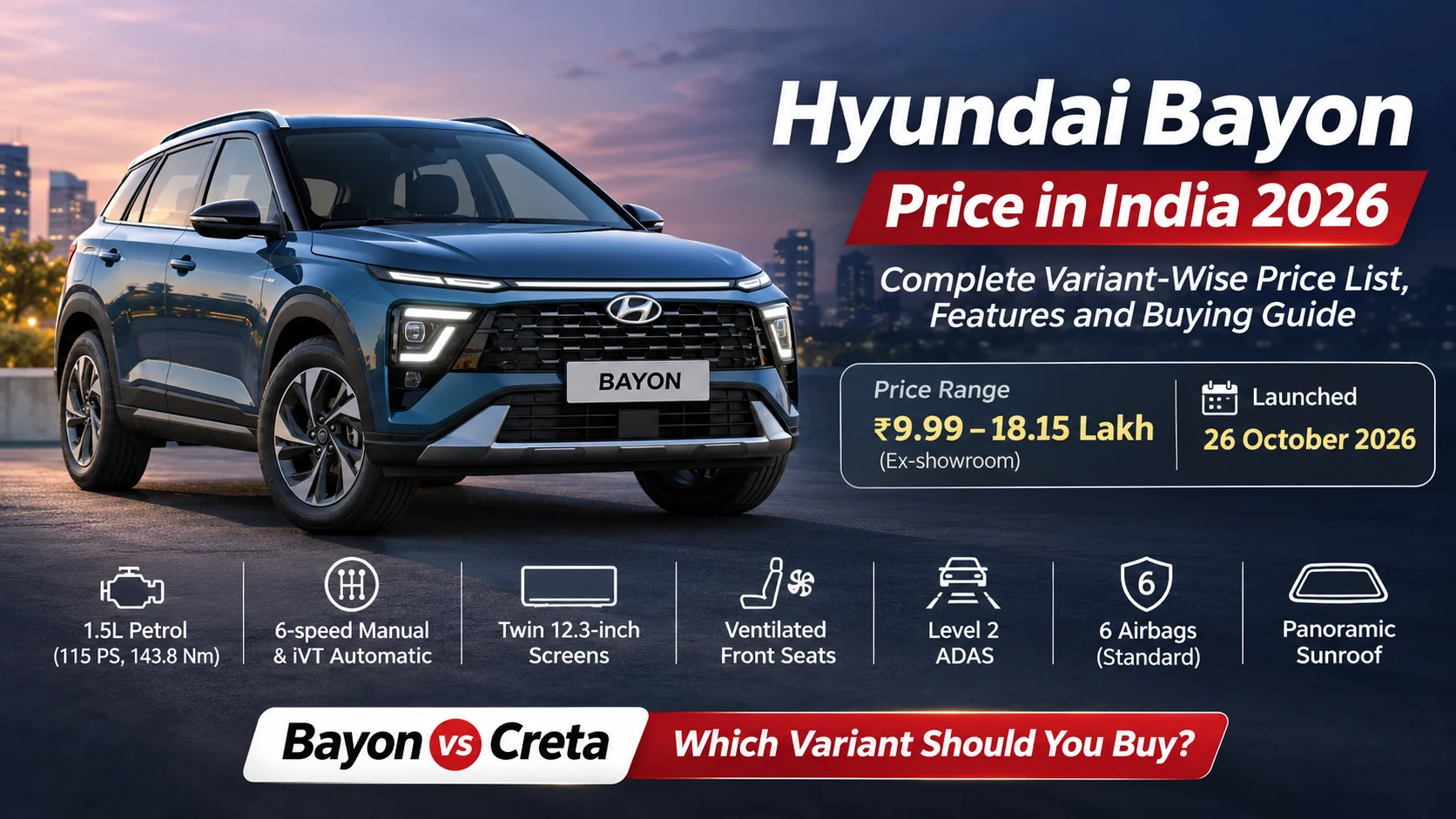
Bookings opened ahead of the launch at ₹11,000. Hyundai launched the Bayon on 26 October at an introductory ₹9,99,900 ex-showroom, and that is the figure every headline has carried. It's also the figure that tells you the least about this car.
The full price list runs from ₹9.99 lakh to ₹18.15 lakh across eleven variants. That upper end is where it gets interesting, because it takes the Bayon straight through the Creta's territory and out the other side. Here is the complete list, what each end of it actually buys, and the question a buyer at ₹13 lakh now has to answer.
The Short Answer
The Bayon starts at ₹9,99,900 and runs to ₹18,14,900 ex-showroom, with a 1.5-litre naturally aspirated petrol engine making 115 PS, a six-speed manual across the range and an iVT automatic from the HX5 variant upwards. Only the two cheapest variants sit below where the Creta starts, which means seventeen of the nineteen price points overlap Hyundai's own best-selling SUV. The entry price is real but it buys the base car, so the variant to look at is the one your budget actually lands on, and at most budgets you will be choosing between a loaded Bayon and a plainer Creta.
Hyundai Bayon at a Glance
- Launched: 26 October 2026, at an introductory ex-showroom price of ₹9,99,900.
- Price range: ₹9.99 lakh to ₹18.15 lakh ex-showroom across eleven variants.
- Engine: 1.5-litre naturally aspirated MPi petrol, 115 PS and 143.8 Nm, shared with the Creta.
- Transmissions: Six-speed manual on every variant, iVT automatic from HX5 upwards, with Eco, Normal and Sport modes.
- Cabin: A 10.25-inch touchscreen with dual integrated displays from HX3, rising to twin 12.3-inch screens on HX10, plus connected car features, a generative AI voice assistant, an electric sunroof from HX3+ and ventilated front seats from HX8.
- Safety: Six airbags, electronic stability control, hill-start assist, tyre pressure monitoring and ISOFIX anchors across the range, with the surround-view camera and rear disc brakes arriving at HX8.
- Driver assistance: Level 2 ADAS, with autonomous emergency braking, adaptive cruise control and lane-keeping assistance. It is fitted to the HX10 only, which starts at ₹16.65 lakh.
- Not confirmed: A CNG version has been reported for early 2027 but Hyundai has not announced it, and there is no crash rating yet.
Hyundai Bayon Price List, Variant by Variant
Eleven variants, two gearboxes and a dual-tone option that costs ₹15,000 on the trims where it is offered. All figures are introductory ex-showroom prices.
| Variant | 6-speed manual | iVT automatic |
|---|---|---|
| HX2 | ₹9,99,900 | Not offered |
| HX3 | ₹10,89,900 | Not offered |
| HX3+ | ₹11,79,900 | Not offered |
| HX5 | ₹12,44,900 | ₹13,84,800 |
| HX5 DT | ₹12,59,900 | ₹13,99,800 |
| HX6 | ₹13,56,900 | ₹14,96,800 |
| HX6 DT | ₹13,71,900 | ₹15,11,800 |
| HX8 | ₹15,09,900 | ₹16,53,900 |
| HX8 DT | ₹15,24,900 | ₹16,68,900 |
| HX10 | ₹16,64,900 | ₹17,99,900 |
| HX10 DT | ₹16,79,900 | ₹18,14,900 |
Two things in that table deserve a second look. The automatic is a ₹1.40 lakh step up wherever it is offered, which is a steep premium even by current standards, and it is not available at all on the three cheapest variants. So a buyer who wants an automatic Bayon is starting at ₹13.85 lakh, not at ₹9.99 lakh.
The other is the dual-tone roof. It costs ₹15,000 and it is the cheapest thing on this list that changes how the car looks. Whether that is worth it is personal, but it is worth knowing it exists as a separate choice rather than being bundled into a higher trim.
What Each Variant Actually Gets You
Prices only mean something next to equipment, and on a range this wide the equipment story is the whole decision. Here is where the things people care about first appear.
| Variant | What it adds over the one below |
|---|---|
| HX2 | Six airbags, stability control, hill-start assist, LED projector headlamps, 16-inch steel wheels with covers, rear AC vents, 505-litre boot |
| HX3 | 10.25-inch touchscreen and dual integrated displays, wireless phone mirroring, rear camera, electrically adjustable mirrors |
| HX3+ | Electric sunroof with voice control, roof rails, 17-inch styled steel wheels |
| HX5 | Automatic climate control with air purifier, connected car tech, wireless charger, cruise control, automatic headlamps, paddle shifters on the automatic |
| HX6 | 17-inch diamond-cut alloys, dual LED projector headlamps, keyless entry with push-button start, rear wiper and defogger, auto-folding mirrors |
| HX8 | Ventilated front seats, surround-view camera, rear disc brakes, leatherette upholstery, rear armrest, 64-colour ambient lighting, rear sunshades |
| HX10 | Level 2 ADAS, 12.3-inch touchscreen with a 12.3-inch digital cluster, auto high beam, blind view monitor, powered driver's seat, Bose audio, electronic parking brake |
The first is HX2. Six airbags, stability control, hill-start assist and LED projector headlamps are all there on the ₹9.99 lakh variant, so the cheapest Bayon is not a stripped-out safety compromise. What it lacks is convenience, not protection.
The second is HX10. Level 2 driver assistance sits on the top variant only, which starts at ₹16.65 lakh. If you came for the ADAS, your entry price is not ₹9.99 lakh, it is ₹16.65 lakh, and that is the single most expensive assumption a Bayon buyer can make. The screens are a gentler version of the same story: a 10.25-inch touchscreen and dual integrated displays arrive early, at HX3, and HX10 upgrades both to 12.3 inches.
There is a third line worth noticing, and it is HX8. Ventilated front seats, the surround-view camera and rear disc brakes all arrive together at that trim, which makes it the point where the Bayon stops feeling like a well-equipped small car and starts feeling like a complete one. If your budget can stretch to it, that is the step that changes the car most.
The Number Nobody Is Printing: It Overlaps the Creta Almost Entirely
Hyundai has positioned the Bayon between the Venue and the Creta. The price list tells a different story.
The Creta starts at roughly ₹10.9 lakh ex-showroom. Of the nineteen Bayon price points in the table above, exactly two sit below that figure: the HX2 at ₹9.99 lakh and the HX3 at ₹10.89 lakh. Every other variant costs more than a Creta does to get into, and the top Bayon lands about ₹7.2 lakh above where the Creta range begins.
That isn't a criticism of the car, and it's how most ranges work once you climb them. It does change the question you should be asking in the showroom. The Bayon is not a cheaper alternative to the Creta except at the very bottom of its range. At almost every other budget, the two are direct competitors inside the same dealership.
Where the two actually differ is worth seeing side by side, because the assumption that the Creta is simply the bigger car does not survive the specification sheet.
| Bayon | Creta | |
|---|---|---|
| Starting price | ₹9.99 lakh | About ₹10.91 lakh |
| Engine | 1.5 petrol, 115 PS, 144 Nm | Same 1.5 petrol, 115 PS, 144 Nm |
| Other engines | None | Turbo-petrol and diesel |
| Length | 4,245 mm | 4,330 mm |
| Width | 1,810 mm | 1,790 mm |
| Boot | 505 litres | 433 litres |
| Certified mileage, manual | 17.2 kmpl | 17.4 kmpl |
The boot is the line that should stop you. The Bayon carries 505 litres against the Creta's 433, so the smaller, cheaper car takes 72 litres more luggage, and it is 20 mm wider too. The Creta is longer and taller and keeps the advantages that matter to plenty of buyers: a choice of engines including a diesel, more rear legroom, and a resale reputation the Bayon has not had time to build. But on the base engine the two are mechanically identical, and on boot space the Bayon simply wins.
So the real decision looks like this:
- Around ₹10 lakh: The Bayon HX2 is clearly cheaper than anything the Creta offers, and this is where the positioning works exactly as intended.
- Around ₹13 to ₹15 lakh: You are choosing between a well-equipped Bayon and a Creta in a lower trim. More features in a smaller car, or fewer features in a bigger one.
- Above ₹16 lakh: A top Bayon is competing with a mid-spec Creta that has the same engine, more space and a stronger resale reputation. The Bayon has to win this on equipment and on how it looks.
Our compare tool will put the two side by side on specification. My take: get both on-road quotes from the same dealer on the same day, for the exact variants you are considering, and compare the feature lists side by side rather than the trim names. The badge difference matters less than the two lists do.
Is the iVT Automatic Worth ₹1.40 Lakh?
This is the biggest single decision inside the price list, and it's worth more thought than most buyers give it.
The automatic adds between ₹1.35 lakh and ₹1.44 lakh depending on where you take it. It is cheapest on the HX10 at ₹1.35 lakh and dearest on the HX8 at ₹1.44 lakh, with the HX5 and HX6 sitting at ₹1.39 lakh. On the HX5 that takes you from ₹12.44 lakh to ₹13.85 lakh. On the HX10 DT it is the difference between ₹16.80 lakh and ₹18.15 lakh. That is not a small options box, it is a significant share of the car's price, and because the automatic only starts at HX5, you cannot buy it on the three cheapest variants at all.
Three things argue for it. An automatic is worth real money in daily city traffic, where a clutch pedal in a two-kilometre crawl is the single most tiring part of driving. Automatics also tend to sell faster in the used market in metro cities, so some of that premium comes back at resale. And an iVT with Sport mode and paddle shifters is a more involving thing than a plain torque converter.
The case against is narrower but real. A continuously variable automatic paired with a naturally aspirated engine is at its least impressive under hard acceleration, which is exactly where this engine is already working hardest. If most of your driving is open highway, you're paying ₹1.40 lakh for something you'll appreciate least of the time.
There is one argument for the automatic that nobody makes, and it is the only one with a number attached. The iVT's 18.6 kmpl against the manual's 17.2 means the automatic is the cheaper car to fuel. At petrol of ₹102.12 a litre and 12,000 km a year, that gap is worth about ₹5,400 a year, or roughly ₹27,000 over five years.
Treat that as an offset, not a payback. Fuel alone would take more than two decades to recover the premium, so the automatic claws back about a fifth of its cost over a normal ownership period. An illustration at a fixed fuel price, so run it against your own driving.
My advice: if your commute is stop-start and you drive it yourself every day, the automatic is one of the better ways to spend ₹1.40 lakh on a car. If you mostly drive out of town, put that money into a higher trim instead and keep the manual.
Which Variant Makes Sense at Which Budget
With eleven variants and two gearboxes, the range is wide enough that picking badly costs real money. A rough guide, based purely on where the prices land:
- Up to ₹11 lakh: HX2 or HX3. This is the only part of the range with no Creta competing against it, which makes it the cleanest value proposition the Bayon has.
- ₹12 to ₹13 lakh: HX3+ or HX5 manual. The sensible middle, and the point at which you should start pulling Creta quotes for comparison.
- ₹14 to ₹15 lakh: HX5 or HX6 automatic, or an HX8 manual. Here the choice stops being about the Bayon and starts being about which Hyundai you want.
- ₹16 lakh and above: HX8 or HX10. Worth it only if you want the full feature list, because at this money a bigger car with the same engine is sitting in the same showroom.
One rule applies across all of them. Decide your on-road budget first and then find the variant, rather than falling in love with a trim and stretching to it. The gap between HX6 and HX8 is about ₹1.50 lakh, and that's a lot of money for a step you weren't planning to take.
It Isn't Only Fighting the Creta
Inside the Hyundai showroom the Bayon's problem is the Creta. Outside it the problem is bigger, because the upper half of this price list walks into a segment full of established mid-size SUVs.
At ₹14 lakh and above it is cross-shopped against the Maruti Victoris and Grand Vitara, the Toyota Hyryder, the Kia Seltos, the Honda Elevate, the Skoda Kushaq and the Volkswagen Taigun. Several offer turbo-petrol engines and a couple offer strong hybrids the Bayon's naturally aspirated 1.5 cannot match on economy.
That doesn't make it a bad buy at that money, but the feature list has to carry the argument, because on engine choice the Bayon isn't going to win. Decide which matters to you before you walk in.
One note on budgeting: the ₹8.15 lakh gap between the cheapest and dearest Bayon widens on the road, because registration and insurance both scale with price.
Mileage, Boot Space and the Numbers Buyers Ask For
The figures that decide most shortlists, in one place.
| Specification | Figure |
|---|---|
| Certified mileage, manual | 17.2 kmpl |
| Certified mileage, iVT automatic | 18.6 kmpl |
| Boot space | 505 litres |
| Length, width, height | 4,245 mm, 1,810 mm, 1,605 mm |
| Wheelbase | 2,600 mm |
| Ground clearance, unladen | 205 mm |
| Fuel tank | 43 litres |
Two of those numbers are more interesting than they look. The automatic is the more efficient of the two gearboxes, at 18.6 kmpl against the manual's 17.2, which is the reverse of what most buyers assume. And 505 litres is a large boot for a car of this length, which is where the Bayon's upright tail earns its keep.
At 4,245 mm the Bayon sits above the four-metre mark, so it is taxed like a larger car rather than like a compact one. That is part of why the entry price lands where it does and not closer to a Venue's.
One Engine, No Diesel, No Turbo
One engine does the whole range, and it is the Creta's.
A naturally aspirated 1.5 in a car this size is a relaxed, uncomplicated engine. It is smooth at city speeds, simpler than a small turbo to live with, and usually cheaper to maintain. What it isn't is quick, and that shows up in exactly one place: an overtake on a two-lane highway with four people on board.
If a turbo-petrol rival is on your shortlist, drive both back to back on a road where you would actually need to pull out and pass something. That single stretch will tell you more than any specification sheet.
Safety and Driver Assistance: What to Check Before You Sign
The safety kit is covered variant by variant in the table above, with one point worth repeating: rear disc brakes are not fitted across the range, they start at HX8. The useful thing here is not the list but the two caveats that sit behind it.
First, a long safety list in a brochure is a range-level list. What decides your car is which variant each item starts from, and on a range this wide that gap can be several lakh rupees. Ask for the variant-wise feature sheet, not the brochure, and confirm in writing that the car you are paying for has the items you are paying for.
Second, the Bayon does not have a crash rating yet. Hyundai says the car is engineered to meet five-star standards, which is a statement of intent rather than a result. No independent crash test result has been published for it yet, so if a star rating is central to your decision, that is a reason to wait for the test rather than to read the claim as one.
Should You Buy Now or Wait?
Deliveries began with the festive season, so the first wave of allocations is still working through. A few things are worth settling before you commit.
- Ask whether the introductory price has an end date: Launch pricing in this segment often applies for a limited window or a limited number of bookings. Get the terms in writing rather than assuming the price holds.
- Ask for the variant-wise feature list: The range spans more than ₹8 lakh, so the difference between two trims is the whole decision. Brochure features are not variant features.
- Get the on-road breakup, not the ex-showroom figure: Insurance, registration and any dealer package should appear as separate lines before you sign anything.
- Compare against a Creta at the same on-road price: Not at the same trim level, at the same money. That is the comparison that actually decides it.
If you want the base HX2 at ₹9.99 lakh, you are buying into the cleanest part of this range and the positioning works. If your budget is ₹14 lakh or above, slow down and do the Creta comparison properly before you pick a side.
Conclusion
The Bayon is sharply styled and heavily equipped, with one easy engine and a price list far wider than the launch headline suggests. The ₹9.99 lakh figure is real and it buys the entry variant. The features the car is being sold on sit much higher up.
Before you decide, write down two numbers: the on-road price of the Bayon variant you want, and the on-road price of the Creta you could have for the same money. Put the two feature lists beside them. That page, not the launch headline, is what should make the decision.
Want to drive both before deciding? Book a test drive and we will connect you with your nearest authorised dealer.
FAQs
1. What is the price of the Hyundai Bayon?
The Bayon launched on 26 October 2026 at an introductory ₹9,99,900 ex-showroom for the HX2 manual. The range runs to ₹18,14,900 for the HX10 DT with the iVT automatic, across eleven variants.
2. Which Bayon variants get the automatic gearbox?
The iVT automatic is offered from HX5 upwards and is not available on HX2, HX3 or HX3+. It costs about ₹1.40 lakh more than the manual on every variant where it is offered, so the cheapest automatic Bayon is ₹13,84,800.
3. What engine does the Hyundai Bayon have?
A 1.5-litre naturally aspirated petrol engine producing 115 PS and 143.8 Nm, shared with the Creta, paired with a six-speed manual or an iVT automatic. There is no diesel or turbo-petrol option.
4. Is the Hyundai Bayon cheaper than the Creta?
Only at the bottom of its range. The Creta starts at roughly ₹10.9 lakh, and just two of the Bayon's nineteen price points sit below that. Every other Bayon variant costs more than it takes to get into a Creta.
5. Does the Bayon get ADAS?
Yes, but on one variant. Level 2 ADAS, with autonomous emergency braking, adaptive cruise control and lane-keeping assistance, is fitted to the HX10 only, which starts at ₹16.65 lakh. No variant below it offers it.
6. Does the Hyundai Bayon have a crash rating?
Not yet. Hyundai says the car is engineered to meet five-star standards, but no independent crash test result has been published. If a star rating matters to your decision, wait for the actual result rather than relying on the claim.
7. Will there be a CNG version of the Bayon?
A CNG variant has been reported for early 2027, but Hyundai has not announced it. Treat it as unconfirmed and ask your dealer rather than planning a purchase around it.
8. What is the mileage of the Hyundai Bayon?
The certified figures are 17.2 kmpl for the six-speed manual and 18.6 kmpl for the iVT automatic, so the automatic is the more efficient of the two. Real-world mileage will be lower and depends heavily on how much of your driving is city traffic.