Search for the JSW iCar V23 and you'll find a price, a launch date and a full variant list. Almost none of it comes from JSW. The company has not announced a price, a variant line-up, a booking date or a launch date for this car, and everything in circulation is either a portal's estimate or a reading of Chinese market pricing.
That doesn't make the car uninteresting. It makes the difference between what is confirmed and what is invented the most useful thing an article can tell you, so that is what this one does.
The Short Answer
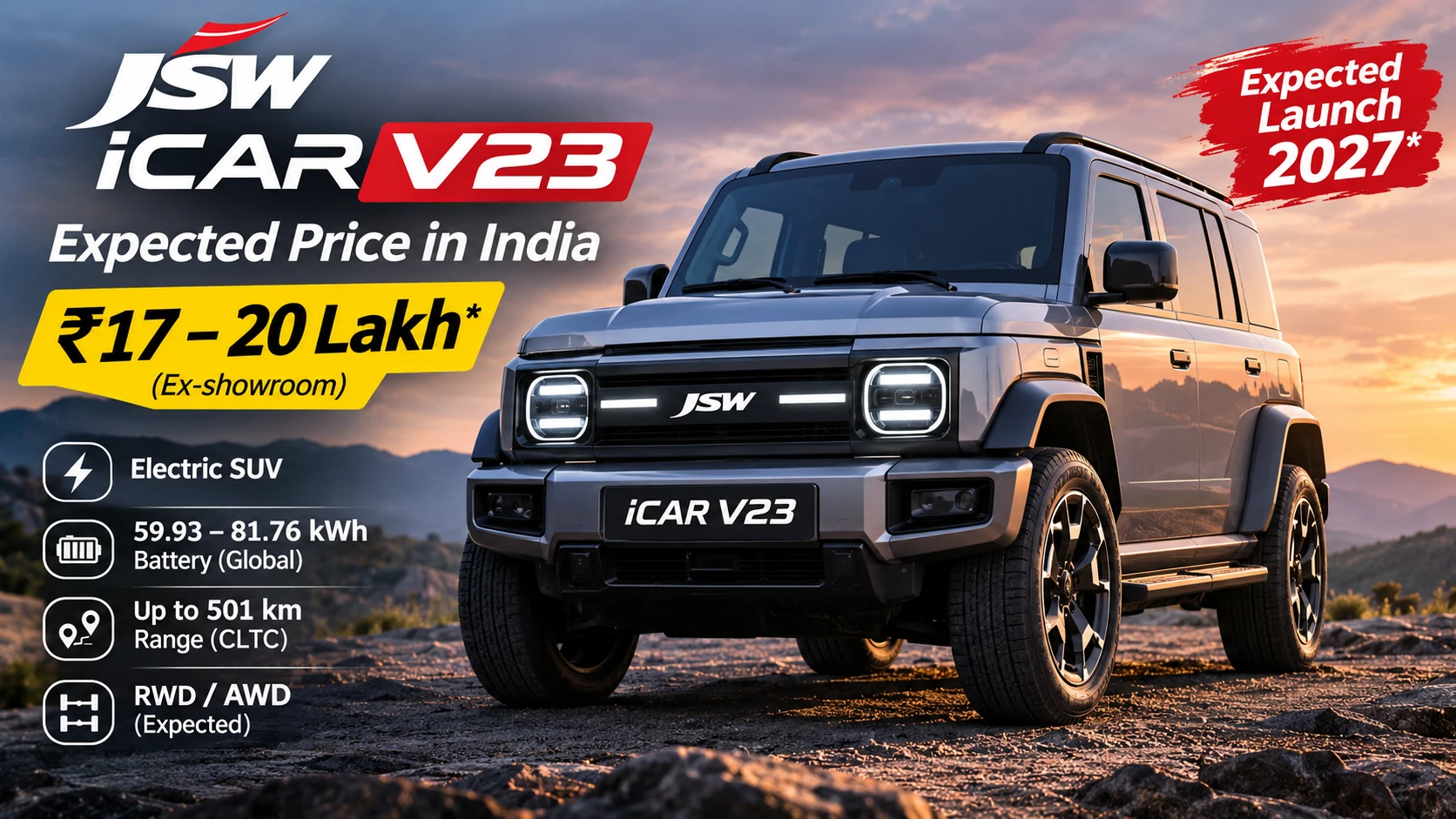
The JSW iCar V23 is expected to cost somewhere around ₹17 lakh to ₹20 lakh ex-showroom for an entry version, with higher figures quoted for an all-wheel-drive model, and is widely reported as a 2027 launch. Both are press expectations, not announcements. JSW has not stated a launch date for this car at all. What is documented is that the design has been registered in India, that a test car has been photographed on Indian roads without camouflage, and that the company's own stated ambition is to sell in the ₹15 lakh to ₹30 lakh band. If you need an electric SUV in the next six months, buy one that exists. If you like the boxy shape and can wait, the date to watch is 4 December 2026, when JSW unveils its first car.
What the iCar V23 Actually Is, and Who Is Selling It
The V23 is a small, boxy, retro-styled electric SUV from iCar, Chery's electric sub-brand, sold in some export markets as iCaur. It is about 4.2 metres long, which puts it in Nexon and Brezza territory on length while looking nothing like either.
JSW Motors is the part people get wrong. It is a standalone car brand from the JSW Group, and it is not the same thing as JSW MG Motor India, which is the joint venture that sells MG cars. JSW Motors has a separate licensing and component arrangement with Chery to sell Chery-group vehicles in India under a JSW badge. Its first car is reported to be assembled at the group's plant in Chhatrapati Sambhajinagar, Maharashtra, and the V23 is expected to follow the same route, though JSW has confirmed no production details for this model.
Its first car is the JSW Combat, a plug-in hybrid SUV based on the Jetour T2, which the company unveils on 4 December 2026. The V23-based electric SUV and a Jaecoo J5-based model are both reported to follow in 2027.
That 2027 date deserves one caveat, and it is the most useful thing in this article. The same round of reporting that produced it also said JSW's first car would arrive before Diwali 2026. It did not. The unveil moved to December, and the car is not on sale yet. A timeline that has already slipped once, for a brand still building its first plant output, dealer network and homologation record, is not a date to plan a purchase around.
Confirmed or Guesswork: A Straight List
This is the table most articles on this car should have led with.
| What you'll read | Where it actually stands |
|---|---|
| Price of about ₹17 to ₹20 lakh | An estimate for an entry version. No JSW figure exists for this car. Published guesses run from ₹17 lakh to ₹35 lakh depending on which battery and drivetrain each one assumes |
| Launch in 2027 | Press expectation only. No JSW official has been quoted giving a date for this model, and the same reporting had the brand's first car arriving before Diwali 2026, which slipped to a December unveil |
| It will wear a JSW badge | Expected and very likely, given the Chery arrangement, but the India name has not been announced |
| Dual-motor all-wheel drive | Reported as under consideration. Not confirmed, and the battery pack India gets is unknown |
| The specification table | Those are the international car's figures. India-spec battery, range and equipment are unconfirmed |
| The design is settled | A design was registered in India in September 2026 and the images show an India-specific version. A filing protects a design, it does not guarantee the production car matches it |
What the iCar V23 Could Cost, and Why That Number Is Soft
The figure in widest circulation is ₹17 lakh to ₹20 lakh ex-showroom for an entry version. It is built on two assumptions: that the car arrives as a locally assembled kit rather than a fully built import, which keeps duty down, and that JSW prices sharply because it is a new brand with no service network. Neither assumption has been confirmed for this model.
The only pricing statement actually attributable to the company is much broader. JSW's managing director has said the brand aims to play in the ₹15 lakh to ₹30 lakh price point. That is a positioning statement for the whole range, not a price for the V23, and the fact that it spans ₹15 lakh is a fair measure of how open this question still is.
Here is the argument against taking the ₹17 lakh figure at face value, and you will not find it elsewhere. JSW's first car, the Combat, is widely expected to be a premium product, with press estimates running from about ₹30 lakh to ₹50 lakh. A brand that opens at that level and then lands its second car at ₹17 lakh is making a very large jump in a single year. It is possible, because the two cars are built on different platforms for different buyers, but it means the ₹17 lakh figure deserves more scepticism than it usually gets.
Add roughly three to four percent for registration, insurance and tax collected at source for an on-road figure. Many states still reduce or waive road tax on electric vehicles and the policy changes often, so check your own state when you book.
Specifications, With the Caveat That These Are the International Car
| Parameter | International iCaur V23 |
|---|---|
| Length, width, height | 4,220 mm, 1,915 mm, 1,845 mm |
| Wheelbase | 2,735 mm |
| Rear-wheel-drive version | 59.93 kWh battery, 136 hp, 180 Nm |
| All-wheel-drive version | 81.76 kWh battery, 211 hp, 292 Nm |
| Claimed range | 401 km and 510 km on China's CLTC cycle |
| DC fast charging | 85 kW to 104 kW depending on the pack |
Read the range figures carefully. CLTC is China's test cycle and far more generous than Indian certification, so an Indian number would be lower and a highway number lower again. Until an Indian rating exists, treat 401 km as a comparison tool against other CLTC figures, not as a distance you can drive. What it costs to run once you own it is a separate calculation, and we have worked that one through here.
The India design filing does show real intent. It covers a revised grille, a new alloy wheel design, a panoramic sunroof the international car does not get, and an extra panel between the rear pillars, while the circular LED headlamps, side steps and flared arches carry over. Treat it as the design JSW wants protected rather than a photograph of the showroom car, because registrations are routinely filed for versions that change before production or never reach it at all.
What It Would Be Competing Against
By price it lands among electric crossovers. As listed in November 2026, the Mahindra XEV 9S runs from ₹19.95 lakh to ₹29.45 lakh ex-showroom, the Tata Harrier EV from roughly ₹21.8 lakh to ₹29.3 lakh, and the Kia Carens Clavis EV from ₹17.99 lakh. The Mahindra BE 6 and VinFast VF7 sit in the same territory, and our compare tool will put any two of them side by side on specification.
Confirm those figures with a dealer before you use them. Electric SUV prices here move often, through introductory periods, battery pack revisions and running offers, and published listings disagree with each other by a lakh or more on the same variant. The ranges above are ARAI figures while the V23's are CLTC, so the two cannot be compared directly.
| Rival | Ex-showroom | Battery and claimed range |
|---|---|---|
| Mahindra XEV 9S | ₹19.95 to ₹29.45 lakh | 59, 70 and 79 kWh packs, 521 to 679 km ARAI |
| Tata Harrier EV | About ₹21.8 to ₹29.3 lakh | 65 and 75 kWh packs, up to 627 km ARAI |
| Kia Carens Clavis EV | From ₹17.99 lakh | 42 and 51.4 kWh packs, 404 and 490 km |
But by shape it has no rival at all, and that is the more interesting point. Nothing else sold here is small, boxy, upright and electric. The cars it looks like, the Thar Roxx and the Gurkha, are diesel off-roaders. The cars it is priced like are smooth electric crossovers. A buyer who wants the toy-like shape with an electric drivetrain currently has nothing to buy, which is the entire commercial case for this car.
The case against it is just as clear. Its claimed range looks lower than the Mahindras' and the Tata's, though the two sets are measured on different cycles and cannot be set side by side until an Indian figure exists for the V23. And it would arrive from a brand with no service history, no resale record and a dealer network being built from scratch. On a ₹20 lakh purchase, that is not a small consideration.
Should You Wait for It?
- If you need a car within six months: No. Buy something that has a price, a warranty and a workshop. The V23 has none of the three.
- If you specifically want the boxy electric shape: Waiting is reasonable, because nothing else offers it. Accept that your wait has no end date anyone has committed to, and that 2027 is a reported expectation rather than a promise.
- If you are mainly chasing a low price: Be careful. The ₹17 lakh figure is the most optimistic estimate in circulation, not a quote, and a new brand's first prices are often higher than the rumours that preceded them. If you are financing it, the questions to ask before signing a car loan matter more than a few thousand rupees of ex-showroom difference.
- If you are watching for a signal: The 4 December unveil of the Combat is the real one. How JSW prices it, what warranty it offers and how many cities it opens with will tell you far more about the V23 than any price estimate will.
My advice is to put a reminder on the December unveil, drive an XEV 9S or a Harrier EV in the meantime so you have a reference point, and decide nothing until a price exists. Treat any dealer or website claiming to take iCar V23 bookings today as a reason to walk away.
Conclusion
The iCar V23 is a genuinely different idea in a segment full of similar-looking crossovers, and if it lands near ₹20 lakh with a usable real-world range it will have no direct competition. Every word of that is conditional, because JSW has confirmed no price, no date and no India specification. Watch December, and buy on what is announced rather than on what is estimated.
Want to drive the electric SUVs that are on sale today? Book a test drive and we will connect you with your nearest authorised dealer.
FAQs
1. What is the expected price of the JSW Chery iCar V23 in India?
Estimates cluster around ₹17 lakh to ₹20 lakh ex-showroom for an entry version, with higher figures quoted for an all-wheel-drive model. JSW Motors has not announced any price, so every figure in circulation is a projection.
2. When will the JSW iCar V23 launch in India?
There is no official date and no JSW statement naming one for this model. Press reporting points to 2027, with published guesses spanning late 2026 to 2028. Read that with one fact in mind: the same reporting had the brand's first car launching before Diwali 2026, and it slipped to a December unveil.
3. Is JSW Motors the same company as JSW MG Motor India?
No. JSW MG Motor India is the joint venture that sells MG cars. JSW Motors is a separate standalone brand from the JSW Group that has partnered with Chery to sell JSW-badged Chery-group vehicles.
4. How much range will the iCar V23 offer?
The international car claims 401 km with the 59.93 kWh battery and 510 km with the 81.76 kWh battery, both on China's CLTC cycle. An Indian certified figure would be lower and real-world range lower still. Which battery India gets is unconfirmed.
5. Will the India-spec V23 get all-wheel drive?
It has been reported as under consideration, which would make it unusual at this size and price. It is not confirmed, and neither is the battery pack that would come with it.
6. Will the iCar V23 be made in India?
It is expected to be assembled locally at JSW's plant in Chhatrapati Sambhajinagar, Maharashtra, from imported kits. That assumption is what makes the lower price estimates plausible, but JSW has not published production details for this model.
7. Can I book the iCar V23 now?
No. There is no official booking channel, no announced price and no confirmed launch date. Treat any dealer or website offering to take a booking or a token amount for this car as a warning sign.
8. What should I buy instead if I cannot wait?
In the same money, the Mahindra XEV 9S from ₹19.95 lakh, the Tata Harrier EV from roughly ₹21.8 lakh and the Kia Carens Clavis EV from ₹17.99 lakh are all on sale with established service networks. None of them offers the V23's boxy shape, which is the one thing you would be waiting for.