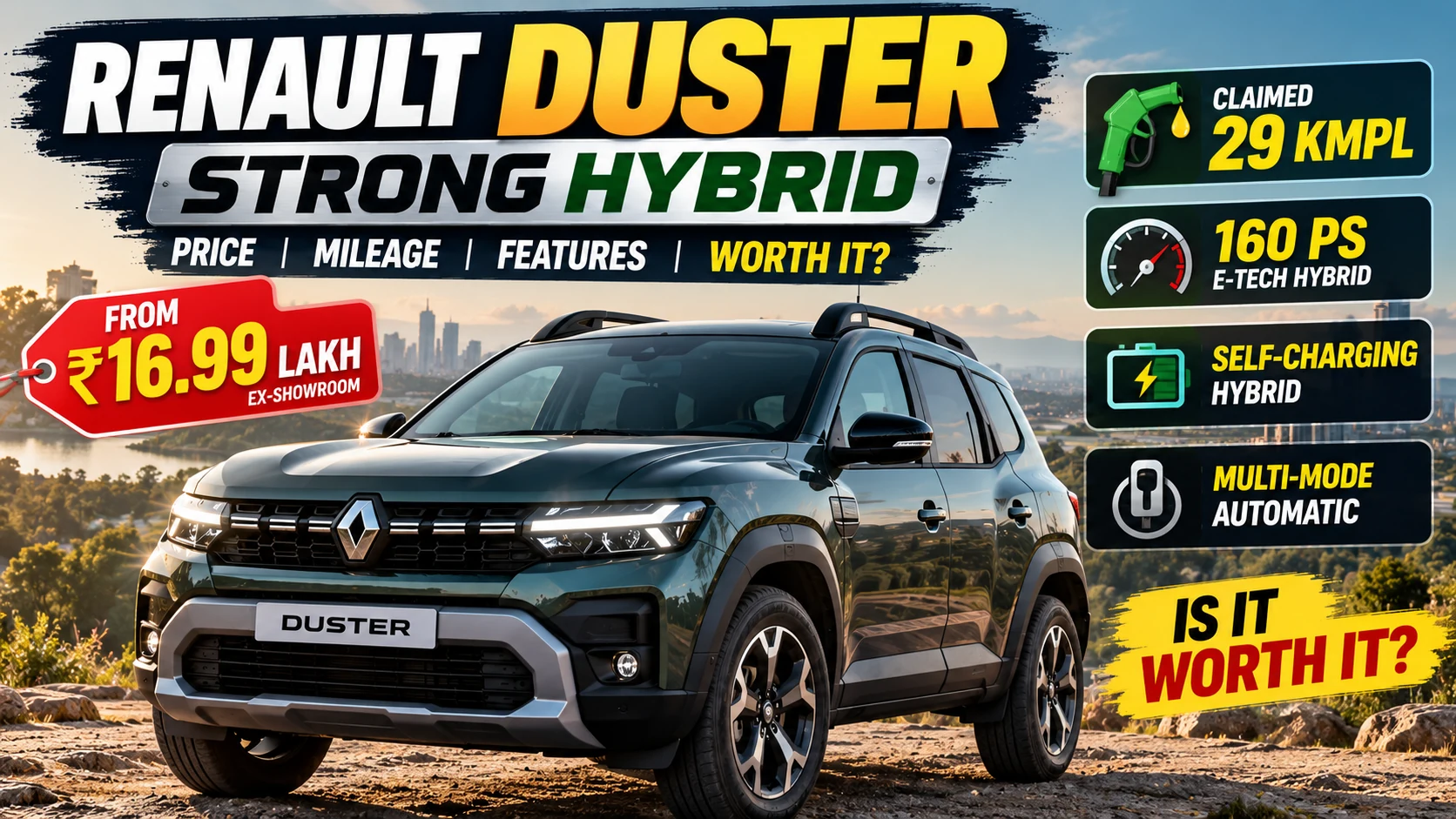
Renault has put a strong hybrid in the Duster, priced it from ₹16.99 lakh ex-showroom and claimed 29 kmpl. That mileage number is what every headline has run with, because it makes this the most efficient petrol SUV in its segment on paper.
What nobody has worked out is the part that actually decides the purchase. The hybrid sits in the same showroom as a turbo-petrol Duster that costs ₹2.50 lakh less, and the fuel saving has to pay that gap back before the hybrid is the cheaper car. Here is the launch detail, and then that calculation done properly.
The Short Answer
The Duster Strong Hybrid costs ₹2.50 lakh more than the equivalent 1.3 turbo-petrol automatic at the same Evolution trim, both ex-showroom. At a claimed 29 kmpl against a turbo-petrol managing around 18 kmpl, the hybrid saves roughly ₹2.15 a kilometre in fuel, so the premium pays itself back at about 1,16,000 km. If you drive 18,000 km a year or more and most of it is city traffic, that happens inside a normal ownership period. If you drive 10,000 km a year, it does not, and you should buy the hybrid for how it drives rather than for what it saves.
Renault Duster Strong Hybrid at a Glance
- Launched: 17 October 2026, with deliveries starting 6 November.
- Price: ₹16.99 lakh to ₹19.49 lakh ex-showroom, introductory, for cars delivered by 31 December 2026.
- Powertrain: 1.8-litre petrol engine, two electric motors and a 1.4 kWh self-charging battery, badged E-Tech 160.
- Combined output: 160 PS, with a claimed 0 to 100 kmph time of 9.6 seconds.
- Claimed mileage: 29 kmpl, certified under the central motor vehicle rules, with a claimed range above 1,400 km on a tankful.
- Booking amount: ₹21,000, with bookings open since 9 October.
- Safety: Six airbags, hill start assist, rear parking assist and a rear view camera on Renault's own specification for the hybrid.
- Warranty: Three years or 1,00,000 km as standard, extendable to seven years or 1,50,000 km through annual servicing, plus eight years or 1,60,000 km on the hybrid battery.
Renault Duster Hybrid Price and Variants
Three variants, all automatic, all front-wheel drive. These are introductory ex-showroom prices, and Renault has tied them to a delivery deadline rather than a booking deadline, which matters if you are joining a queue.
| Variant | Price (ex-showroom) | Equivalent turbo-petrol DCT | The gap |
|---|---|---|---|
| Evolution | ₹16.99 lakh | Evolution 1.3 DCT, ₹14.49 lakh | ₹2.50 lakh |
| Techno | ₹18.99 lakh | Techno 1.3 DCT, ₹15.89 lakh | ₹3.10 lakh |
| Emotion | ₹19.49 lakh | No direct equivalent | Top trim, hybrid only |
That third column is the one worth staring at, and it's the comparison the brochure will never show you. Like for like, at the same trim name and the same automatic gearbox, the hybrid asks ₹2.50 lakh more at Evolution and ₹3.10 lakh more at Techno. Every other number in this article has to be measured against that.
What the E-Tech 160 Hybrid Actually Is
This is a strong hybrid, also called a self-charging hybrid. There is no plug, no charging cable and no wall box. The 1.4 kWh battery fills itself from the engine and from braking, and the car decides on its own when to run on petrol, on electricity, or on both.
Where it differs from its rivals is the gearbox. The Maruti and Toyota strong hybrids use an e-CVT, which is why they're smooth but sound strained when pushed. Renault has used a multi-mode automatic with real fixed ratios, two on the electric side and four on the petrol side, which it says gives fifteen possible combinations. In plain terms it should feel like a conventional automatic rather than a rubber band under hard acceleration, and that's the single thing to judge on a test drive.
One claim needs reading carefully. Renault says the car runs in electric mode for up to 80 percent of city driving, based on its own testing, and adds that this varies with road type, driving style and weather. That isn't 80 percent of every trip and it doesn't make this an electric car. It means that in stop-start traffic, where a petrol engine is at its worst, the engine spends a good deal of its time switched off. That's exactly where the mileage figure comes from, and it's why this car makes sense in a city and much less sense on a highway.
What 29 Kmpl Is Actually Worth in Rupees
A brochure figure isn't money. Converted into running cost at petrol of ₹102.12 a litre, 29 kmpl works out to about ₹3.52 for every kilometre of fuel. Adjust the rate for your own city, and if you want the same arithmetic across every fuel type, we have worked petrol, diesel, CNG and electric out side by side.
Against a turbo-petrol SUV of this size doing a realistic 18 kmpl, which costs about ₹5.67 a kilometre, the hybrid saves roughly ₹2.15 per kilometre. Put that against distance:
- 10,000 km a year: Saves about ₹21,500 a year in fuel.
- 15,000 km a year: Saves about ₹32,000 a year.
- 20,000 km a year: Saves about ₹43,000 a year.
- 25,000 km a year: Saves about ₹54,000 a year.
These are illustrations built on the claimed figure rather than quotes, and your own saving moves with how much of your driving is city traffic. For a high-mileage driver they're still the difference between a fuel bill you notice every month and one you don't.
Hybrid or Turbo-Petrol Duster? The Break-Even, Three Ways
Renault doesn't publish a separate certified figure for each Duster engine, so rather than pick one number for the turbo-petrol and build everything on it, here's the break-even at three different assumptions. The premium is the ₹2.50 lakh from the Evolution row above.
| If the turbo-petrol returns | Hybrid saves | Break-even on ₹2.50 lakh | At 15,000 km a year |
|---|---|---|---|
| 16 kmpl | About ₹2.86 per km | About 87,000 km | About 5.8 years |
| 18 kmpl | About ₹2.15 per km | About 1,16,000 km | About 7.7 years |
| 20 kmpl | About ₹1.59 per km | About 1,58,000 km | Beyond most ownership periods |
Two things fall out of that table. The hybrid's case gets stronger the thirstier the turbo-petrol actually is, which is another way of saying it gets stronger the worse your traffic is. And at the Techno trim, where the gap is ₹3.10 lakh rather than ₹2.50 lakh, every one of those break-even figures stretches by about a quarter. The cheapest hybrid Duster is the one that makes the most financial sense.
There's a fourth scenario worth adding, because certified figures flatter a turbo-petrol more than they flatter a hybrid. Take realistic city numbers of 22 kmpl for the hybrid and 13 kmpl for the turbo, and the saving rises to about ₹3.21 a kilometre with break-even near 78,000 km. At 20,000 km a year that's under four years. Those two mileage figures are estimates rather than tested results, so treat that scenario as the optimistic end of the range rather than a promise.
So the honest answer has a shape rather than a yes or no:
- Heavy city user: At 18,000 km a year or more, mostly urban, the hybrid pays for itself inside a normal ownership period.
- Average driver: At 10,000 to 12,000 km a year the fuel saving alone won't cover the premium before you sell the car.
- Highway-heavy user: The hybrid's advantage is smallest at steady highway speeds, and this is the one case where the turbo-petrol is the better buy.
My take: don't buy this car on break-even alone. Buy it because a strong hybrid is quieter, smoother and almost free of the stop-start shudder that makes city driving tiring, and treat the fuel saving as the thing that softens the premium rather than erases it.
Duster Hybrid vs Grand Vitara, Victoris and Hyryder
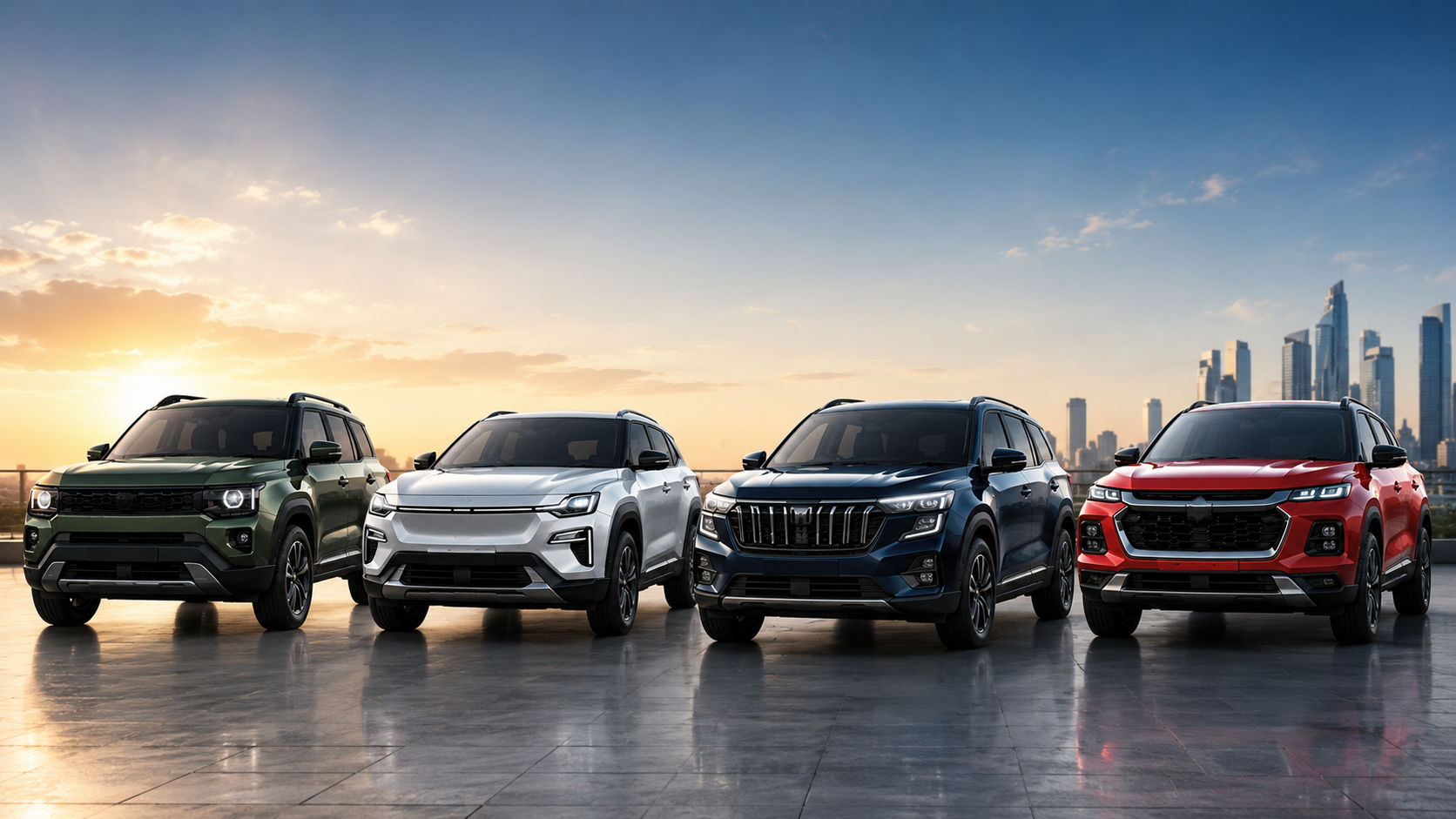
All four are self-charging strong hybrids and all four are front-wheel drive. On price they're close: the Duster starts at ₹16.99 lakh, the Victoris at ₹16.43 lakh and the Grand Vitara at ₹16.68 lakh, with the Hyryder priced near its Grand Vitara sibling since the two share a platform and a powertrain. The engineering is where they separate.
| Model | Engine and power | Claimed mileage | Transmission |
|---|---|---|---|
| Renault Duster | 1.8-litre four-cylinder, 160 PS | 29.00 kmpl | Multi-mode hybrid automatic |
| Maruti Victoris | 1.5-litre three-cylinder, 116 PS | 28.65 kmpl | e-CVT |
| Maruti Grand Vitara | 1.5-litre three-cylinder, 116 PS | 27.97 kmpl | e-CVT |
| Toyota Hyryder | 1.5-litre three-cylinder, 116 PS | 27.97 kmpl | e-CVT |
The headline in that table isn't the mileage, it's the power. The Duster makes 160 PS from four cylinders while the other three make 116 PS from three, and it still posts the best certified figure. That's a real engineering gap and it's why the Duster is the only one of the four that feels quick.
To put any two of them side by side on specification, use our compare tool. What the table doesn't show will decide plenty of these sales. Maruti and Toyota have far larger service networks than Renault, and on a car you plan to keep for a decade that matters more than 44 PS. If the nearest Renault workshop is a long drive from you, let that weigh on the decision.
Features, Safety and Warranty: Read These Properly
The hybrid carries over the new Duster's equipment rather than stripping it back, which isn't always what happens when a brand adds an expensive powertrain. You get a panoramic sunroof, ventilated and electrically adjusted front seats, dual screens, 212 mm of ground clearance, an illuminated grille emblem and a Dune Brown leatherette cabin.
Two lines on the specification sheet need reading more carefully than the rest, because both are written in a way that flatters them.
The crash rating first. The Duster scored five stars at Bharat NCAP, with 30.49 out of 32 for adult occupant protection and 45 out of 49 for child occupant protection. Those stars were awarded on turbo-petrol variants, and the hybrid is not on the rating's applicability list. It shares the same body and structure so there's every reason to expect similar behaviour, but a crash rating belongs to what was actually tested. Renault's own hybrid specification lists six airbags, hill start assist, rear parking assist and a rear view camera, and does not name a driver assistance package, so check the exact equipment on the variant you're buying rather than assuming the range brochure applies.
Now the warranty. The seven-year figure doing the rounds isn't a seven-year warranty in the way most people read it. Standard cover is three years or 1,00,000 km. The extension to seven years or 1,50,000 km is added one year at a time, each year, after you service the car at an authorised Renault workshop. Miss a service and the extension stops where it stopped.
That matters more on a hybrid than on an ordinary petrol car, because the eight-year or 1,60,000 km battery cover is what answers your biggest ownership worry, and cover of this kind carries the same service-record conditions. If you were planning to move the car to a local garage after year three, price that decision properly. You'd be trading the extension and the battery protection for a cheaper service bill.
Is the Protect 360 Package Worth It?
Renault is selling an optional ownership package called Protect 360 alongside the car, reported at launch at ₹89,900. On Renault's own description it bundles three years of comprehensive motor insurance, three years of scheduled maintenance, a 60 percent assured resale value at three years, and financing through its partners. The insurance is underwritten by a third-party insurer and is optional.
The 60 percent figure is the part to interrogate, because it's the only number in the bundle that could be worth a lakh or more on its own. Ask one question before anything else: 60 percent of what? Sixty percent of the ₹16.99 lakh ex-showroom price is about ₹10.19 lakh. Sixty percent of a roughly ₹19.7 lakh on-road price is about ₹11.83 lakh. That's a difference of over ₹1.6 lakh on the same promise, and it should be stated in writing before you pay for the package.
Then ask what voids it. Assured buyback figures normally depend on kilometre limits, a complete service history at authorised workshops and the car's condition at handover, and those conditions are what decide whether the number you were quoted is the number you get three years later. None of this makes it a bad package, and for a buyer who services on schedule and drives average distances it can be the most valuable thing on the invoice. It makes it a package you should see itemised, with its three components priced separately, before you say yes.
Should You Book Now or Wait?
Two dates matter. Deliveries start on 6 November, and the introductory prices apply to cars delivered by 31 December 2026. That second condition is the one people misread: it's a delivery deadline, not a booking deadline. Book in late December, take delivery in January, and there's no guarantee you keep the launch price.
- Get a written delivery estimate before you pay: Ask for the expected date in writing, and ask what happens to your price if the car slips past 31 December.
- Ask which variant is actually in the pipeline: Waiting periods differ by variant and colour, and what's allocated isn't always what you wanted.
- Ask for both on-road quotes on the same day: Get the hybrid and the equivalent turbo-petrol DCT itemised side by side from one dealer, because the ex-showroom gap and the on-road gap are not the same number.
- Keep the package conversation separate: Settle the car price first, then discuss Protect 360 on its own terms.
Conclusion
The Duster Strong Hybrid is the most interesting thing Renault has done in India in years. It makes considerably more power than its rivals, posts the best certified mileage in its class, covers the hybrid battery for eight years and uses a gearbox that should feel better than the e-CVTs it competes against.
Whether it's worth ₹2.50 lakh over the turbo-petrol comes down to two things you already know: how far you drive in a year and how much of that is traffic. Run your own annual kilometres through the per-kilometre saving, remember that the gap grows to ₹3.10 lakh at the Techno trim, and decide on that rather than on the 29 kmpl headline. Drive a lot in a city and the maths works comfortably. Drive 10,000 km a year and you're buying a nicer car, which is a perfectly good reason, just not a financial one.
Weighing it against something else in the segment? Shortlist by budget and body type, then book a test drive and we will connect you with your nearest authorised dealer.
FAQs
1. What is the price of the Renault Duster Strong Hybrid?
It launched on 17 October 2026 at ₹16.99 lakh for the Evolution, ₹18.99 lakh for the Techno and ₹19.49 lakh for the Emotion, all ex-showroom. These are introductory prices and apply to cars delivered by 31 December 2026.
2. How much more does the Duster Hybrid cost than the petrol Duster?
₹2.50 lakh at the Evolution trim and ₹3.10 lakh at the Techno trim, comparing ex-showroom prices against the equivalent 1.3 turbo-petrol DCT. The on-road gap is larger, because taxes and insurance scale with the price.
3. What mileage does the Duster Hybrid give?
The certified figure is 29 kmpl, the highest among strong hybrid SUVs in this segment, with a claimed range above 1,400 km on a tankful. Real-world mileage will be lower and depends heavily on how much of your driving is city traffic, where the hybrid system works best.
4. Does the Duster Hybrid need to be plugged in?
No. It is a self-charging strong hybrid. The 1.4 kWh battery is filled by the petrol engine and by regenerative braking, so there is no charging cable, no wall box and no range anxiety.
5. Is the Duster Hybrid worth the extra money?
On a ₹2.50 lakh premium, the fuel saving pays it back at about 87,000 km if the turbo-petrol returns 16 kmpl, about 1,16,000 km at 18 kmpl and about 1,58,000 km at 20 kmpl. It makes financial sense for heavy city drivers and not for someone covering 10,000 km a year.
6. How does the Duster Hybrid compare with the Grand Vitara and Hyryder?
It starts at a similar price but makes 160 PS from a four-cylinder engine against 116 PS from the three-cylinder Maruti and Toyota hybrids, and still returns a slightly better certified figure. The trade-off is Renault's smaller service network.
7. What is the warranty on the Duster Hybrid?
Three years or 1,00,000 km as standard, extendable to seven years or 1,50,000 km one year at a time through annual servicing at an authorised Renault workshop, plus eight years or 1,60,000 km on the hybrid battery. The longer figures depend on keeping the service record intact.
8. Is the Renault Duster Hybrid safe?
The Duster scored five stars at Bharat NCAP, with 30.49 out of 32 for adult occupant protection and 45 out of 49 for child occupant protection. That rating was awarded on turbo-petrol variants and the hybrid is not on its applicability list. Renault lists six airbags, hill start assist and rear parking assist on the hybrid.