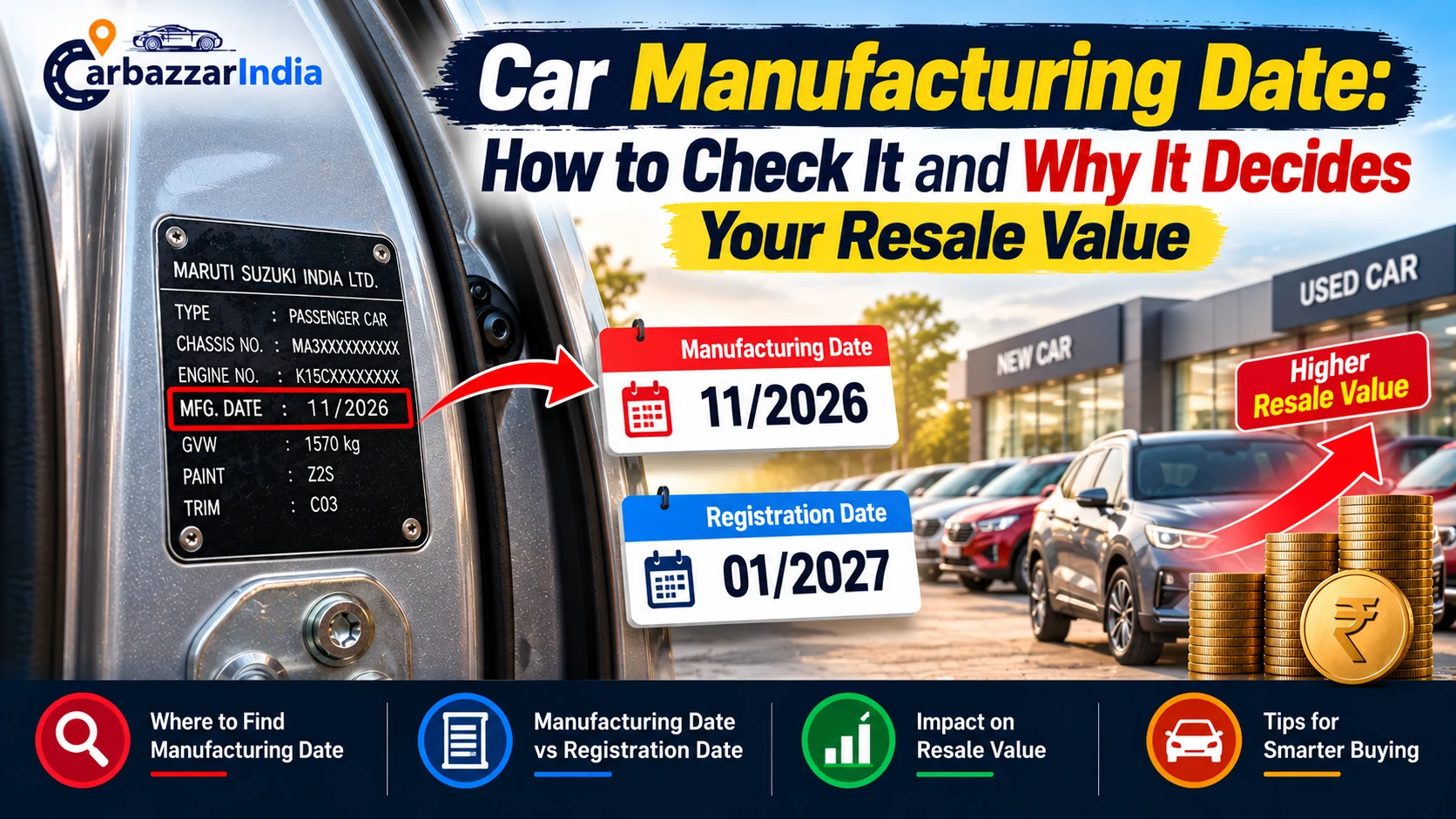
Every December, the same conversation happens in showrooms across India. The salesperson leans across the desk and offers a discount that sounds too good to refuse, and somewhere in your head a voice asks whether you're being handed a bargain or last year's leftover. Both can be true at once, and the thing that decides which is a small metal plate on your car that almost nobody reads.
That plate carries the month and year your car was actually built. It's a different thing from the date on your registration certificate, the two dates do very different jobs, and mixing them up costs Indian buyers real money every single year. This guide shows you where to find the manufacturing date, what each date controls, and how to use the gap between them instead of being caught by it.
Where to Find Your Car's Manufacturing Date
There are two ways. One takes ten seconds and the other needs a bit of decoding, so start with the easy one.
The easy way is the manufacturer's plate. Open the driver's door and look at the B-pillar, the vertical strip of metal the door latches onto. On most cars sold in India you'll find a sticker or riveted plate there carrying the maker's name, the chassis number and a line that reads something like 11/2026. That's November 2026. On some cars the plate sits under the bonnet or on the passenger door frame instead, so check all three before giving up.
The second way is to read the date out of the chassis number, which is worth knowing about when the plate has faded, been painted over or is simply missing on an older car.
Indian chassis numbers do carry the month and year of manufacture, usually as single letters sitting at fixed positions in the string. Most brands run months from A for January through to M for December, skipping the letter I because it reads like a 1, and years the same way with A standing for 2010 and the sequence running on from there, again skipping I, O and Q.
What makes this unreliable as a do-it-yourself exercise is that the positions are not standard. Each manufacturer picks its own, and the layout shifts between model years and between the 17, 19, 21 and 22-character formats used across the industry. Two cars from the same brand, four years apart, can hide the date in different places. So a decoded chassis number is a reasonable sanity check if you already have a date you want to confirm, and close to useless if you are starting from nothing.
If you need the date with certainty, go to the paperwork instead. It is printed on the manufacturer's plate, recorded on Form 22 issued by the manufacturer, and stated on your invoice. Your dealer can also pull the exact month and year against your chassis number from the manufacturer's own system, and that is the version worth trusting. Ask for it in writing if the date matters to your decision.
Manufacturing Date vs Registration Date: Which One Actually Counts?
This is where most of the confusion lives, so here it is in one line each.
- Manufacturing date: The month and year the car came off the production line. It's stamped on the plate and baked into the chassis number, and it never changes.
- Registration date: The day the RTO entered your car into the system and gave it a number plate. It's on your registration certificate, and it's the date almost every rule in the country actually runs on.
A car built in December 2026 and registered in January 2027 has both dates, and they'll follow it for the rest of its life. The gap is normally a few days to a few weeks. It can stretch to months if a car has been sitting at a dealership.
Here's the part that matters: the manufacturing date is what buyers judge you on, and the registration date is what the law and your insurer run on. They pull in different directions, and knowing which one is doing what lets you work the gap in your favour.
What the Registration Date Decides
Almost everything with a legal or financial clock attached starts the day your car is registered, not the day it was built.
- Your registration certificate's 15-year validity: A private car's RC is valid for 15 years from the date of registration. After that you re-register, and from then on it's renewed five years at a time subject to a fitness check.
- City age restrictions, and this one has changed: Delhi NCR has long applied a 10-year limit to diesel vehicles and 15 years to petrol, counted from registration. As things stand after a Supreme Court order of 17 December 2025, protection from age-based action applies to BS-IV and newer vehicles, and enforcement is directed at BS-III and older ones. Every new car sold today is BS-VI, so a car you buy now is not currently exposed to that age rule. This is live litigation that has already shifted more than once, so check the position that applies when you actually need it rather than relying on a figure you read in 2026.
- Your insured value: Insurers work out your car's declared value on a standard age grid, and that grid runs on registration age too.
That grid is worth knowing, because it sets the figure your insurer would pay if the car were stolen or written off completely. It is not what you get for an ordinary dent repair, where a different set of rules decides how much of each part's cost you bear. This is the total-loss number:
| Age of car | Depreciation applied | What that means on a ₹10 lakh car |
|---|---|---|
| Up to 6 months | 5 percent | Insured value about ₹9.50 lakh |
| 6 months to 1 year | 15 percent | About ₹8.50 lakh |
| 1 to 2 years | 20 percent | About ₹8 lakh |
| 2 to 3 years | 30 percent | About ₹7 lakh |
| 3 to 4 years | 40 percent | About ₹6 lakh |
| 4 to 5 years | 50 percent | About ₹5 lakh |
That insured value sits alongside your other running costs, and what each fuel type costs you per kilometre is the other half of that picture. Past five years there's no fixed figure, and the value gets agreed between you and the insurer based on the car's condition and what the model is fetching in the market. What you actually receive on any claim still depends on your policy wording, so read the schedule rather than assuming the grid is the whole story.
Notice the jump from 5 percent to 15 percent at the six-month mark. That's a ₹1 lakh swing on a ₹10 lakh car for the sake of a few weeks, and it's the single sharpest step on the whole grid.
What the Manufacturing Date Decides
For the vehicle-age rules that come up in ordinary ownership, the registration date is the reference the system runs on. That does not leave the manufacturing date powerless. It is the reference point for which emission standard your car was built to, it can come into play on warranty questions and recall notices, and it is what any checking agency uses to place the car in a production batch. What it does not do is start the clocks in the previous section.
Its biggest influence, by a distance, is on what the next person is willing to pay you.
When you sell, the first thing a serious buyer does is open the driver's door and read the plate. If your RC says 2027 but the plate says December 2026, they'll quietly reprice the car in their head, and so will any dealer valuing it for exchange. Nothing about the car is worse. The perception simply is.
How much it costs you depends on how long you've owned it. In the first three or four years the gap is noticeable, because the car is still being compared against others of the same model year. After five or six years it fades, and condition, service history and kilometres on the odometer take over completely. A well-kept car with a full service record and 40,000km will beat a neglected one built six months later every time, and a car returning poor mileage is usually telling you about its upkeep rather than its age.
The December Question: Discount Now or a Newer Car Later?
Now the decision everyone actually faces. December discounts are real, and they're often the biggest of the year, because dealers are clearing stock before the calendar turns and nobody wants to carry last year's cars into January. So is the discount worth the older build date?
Work it with numbers rather than feelings. Here is one illustration, not a promise, because the real figures move with the model, the mileage, the condition and how much demand there is for that car when you sell. Take a car at ₹10 lakh ex-showroom, and if you are still shortlisting, our car comparison tool will show you what else sits at that price.
- Buy in December: The dealer offers ₹60,000 off to clear a December-built car. You pay ₹9.40 lakh, and your money is saved today.
- Wait for January: You pay the full ₹10 lakh, possibly more if prices go up in the new year, which they often do. In exchange you get a car built in the current year.
- The resale gap four years later: That ₹10 lakh car will be worth somewhere around ₹5 lakh. A build date one year older typically shaves a small single-digit percentage off that, so call it ₹20,000 to ₹30,000.
So you're weighing ₹60,000 you keep today against perhaps ₹25,000 you might lose in four years, and that second number is an estimate rather than anything anyone can quote you. Run the same sum with the actual discount you're offered. In most cases it comes out the same way, and the discount wins comfortably.
My take: for anyone keeping a car five years or longer, take the December discount and stop worrying about the plate. The only buyers who should hesitate are people who change cars every two or three years, because they'll meet the resale gap while it's still at its widest.
The Trick Most Buyers Miss
You don't actually have to choose. The discount is attached to the car, and the registration year is attached to the paperwork, and those are two separate things.
Negotiate the December deal on a December-built car, then ask for the registration to be done in the first week of January. Your chassis plate still says December, but your RC says the new year. That gives you:
- The full discount: You bought in the dealer's clearance window and kept that money.
- A newer registration year: Which is what resale listings, exchange valuations and insurance renewals go by.
- A later legal clock: Your 15-year RC validity and any city age limit start counting a year later on paper.
Expect resistance, and understand why. Dealers want the sale booked inside December for their own year-end targets, so the first answer is often no. It's still worth asking, and some will agree if the deal is otherwise closed. The one thing that matters is getting it in writing on the booking form, because a verbal promise about the registration month is worth nothing when delivery day arrives.
Two honest caveats. First, this works best in the last week or two of December. Ask for a January registration in early December and you'll be told to wait a month for the car, which few people want to do. Second, and more importantly, a January RC does not change the plate. Your car was still built in December, and a careful buyer will open the door and see that. What you gain is the newer year on the paperwork that listings, valuations and your insurer go by, not a different car. Treat it as something to ask about rather than something to count on. Whether it works depends on the dealer agreeing and on how your RTO handles the paperwork at a year boundary, and both vary from place to place.
When an Older Manufacturing Date Is Perfectly Fine
Not every old build date is a problem, and treating it as one costs people good deals.
- You're keeping the car long term: Past five or six years, nobody is comparing build months. They're looking at the service book and the paint.
- The discount is large: A ₹1 lakh saving on a mid-size car comfortably outruns any resale gap you'll see.
- The model is about to be replaced anyway: If a new generation is coming, your build month is the least of what affects resale.
If you are still deciding which car to chase a discount on, start by narrowing the list by budget and body type. And one situation where you should walk away: if the car has been sitting on the dealer's lot for several months, check the tyres and the battery before you sign anything. Rubber hardens and batteries weaken when a car stands still, and a car built eight months ago that has never moved deserves a harder look than its odometer suggests.
Buying Used? The Plate Matters More Here
Everything above assumes you're buying new. On a used car the manufacturing date stops being a bargaining detail and becomes the first thing you check, because this is where buyers get misled most often.
The listing will say the car's year, and that year almost always means the registration year. A car advertised as a 2022 model could easily have been built in late 2021, which makes it several months older than you assumed and worth correspondingly less. On a five-year-old car that's rarely a dealbreaker. On a two-year-old car it's a real negotiating point, and most sellers won't raise it unless you do.
Check three dates on any used car and see whether they tell a consistent story:
- The plate: Month and year of manufacture, on the B-pillar.
- The registration certificate: The date the car entered the system.
- The tyres: Each sidewall carries a four-digit code where the first two digits are the week and the last two the year. On a low-kilometre car, original tyres with a build date close to the car's own is a good sign that the odometer is telling the truth.
A gap of a few weeks between manufacture and registration is completely normal. A gap of six months or more means the car sat unsold somewhere, and that's worth knowing before you agree a price, not after.
What to Check Before You Accept Delivery
Do this at the dealership, before you sign the delivery acceptance, because afterwards you have almost no leverage.
- Read the plate yourself: Open the driver's door and check the manufacturing month and year with your own eyes. Don't ask, look.
- Match it to the invoice: The manufacturing date on the invoice should agree with the plate. If they don't match, stop and get it explained before you pay the balance.
- Check the odometer: A brand-new car should show single-digit or low double-digit kilometres. A few hundred means it has been driven somewhere, and you deserve to know where.
- Inspect the tyres: Tyres carry their own four-digit manufacturing week and year on the sidewall. On a new car they should be close to the car's build date.
- Test the battery: Ask them to start the car cold, after it has been standing. A sluggish crank on a new car usually means it has been parked a long time.
- Confirm the registration month in writing: If you've negotiated a January registration, make sure the booking form says so.
A small habit that saves arguments later: photograph the plate, the odometer and the invoice on delivery day. If anything comes up at resale or during a warranty claim, you'll have the dates on record.
Ready to go and look at one? Book a test drive and we will put you in touch with your nearest authorised dealer.
Conclusion
The manufacturing date isn't something to be afraid of. It's just information, and once you know it's there and what it controls, it stops being a trap the dealer sets and becomes something you can work with. The registration date runs the law and your insurance. The manufacturing date runs the next buyer's opinion. They're different levers.
So before you sign anything this December, open the driver's door and read the plate. Then work out your own numbers: what you're saving today against what you might lose years from now. For most people that sum comes out clearly in favour of the discount, and the ones it doesn't favour are exactly the people who should know that before they buy, not after.
FAQs
1. How do I check my car's manufacturing date?
Open the driver's door and look for the manufacturer's plate on the B-pillar. It shows the month and year in a format like 11/2026. If the plate is missing or unclear, the date is also encoded in the chassis number at fixed positions that vary by brand.
2. Is the manufacturing date the same as the registration date?
No. The manufacturing date is when the car was built and never changes. The registration date is when the RTO registered it, and that's the date almost every legal and insurance rule actually runs on.
3. Does a December-manufactured car lose more resale value?
Slightly, and mostly in the first three or four years while buyers are still comparing model years. After five or six years, condition, kilometres and service history matter far more than the build month.
4. Should I buy a car in December or wait for January?
If you're keeping the car five years or more, the December discount usually wins. The money is certain and you keep it today, while the resale gap is an estimate that lands years away and depends on the model, the condition and the market at the time. Run the sum on the actual discount you're offered rather than assuming a ratio.
5. Can I buy in December and register in January?
Often yes, if you ask. The discount attaches to the car and the registration year to the paperwork. Dealers resist because of their own year-end targets, so negotiate it and get it written on the booking form.
6. Does the 15-year rule count from manufacturing or registration?
From registration. A private car's RC is valid for 15 years from the date of registration, after which you re-register and then renew every five years subject to a fitness check.
7. How much does my car's insured value drop in the first year?
Insurers apply 5 percent depreciation up to six months and 15 percent from six months to a year. On a ₹10 lakh car that's a drop of roughly ₹1 lakh in insured value across that six-month boundary.
8. What if the plate and the chassis number give different dates?
Stop and ask the dealer to show you the manufacturing date recorded on the invoice, which is the official record. Decoding positions vary by brand and change on older cars, so a mismatch is usually a decoding error rather than anything suspicious.