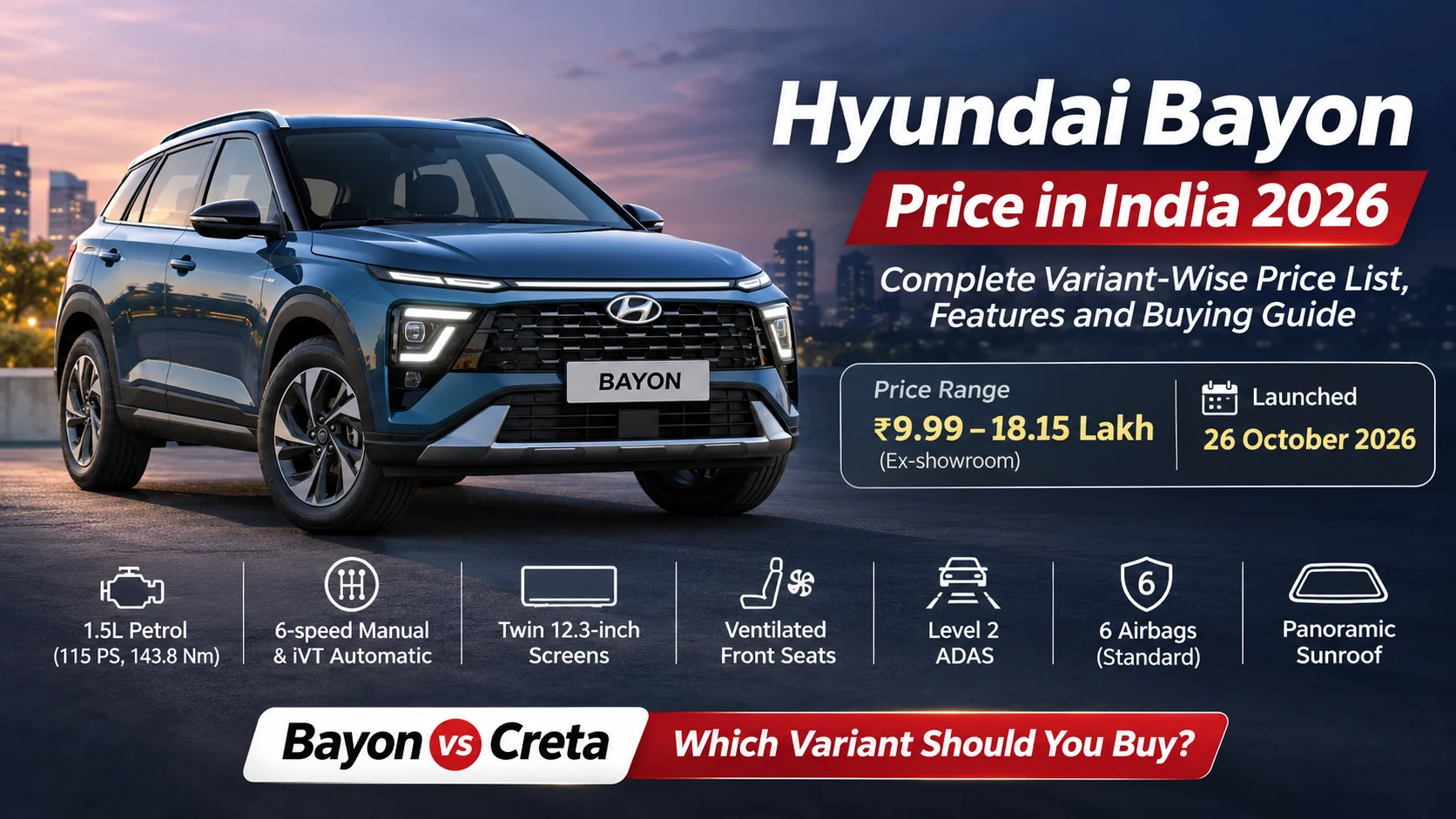
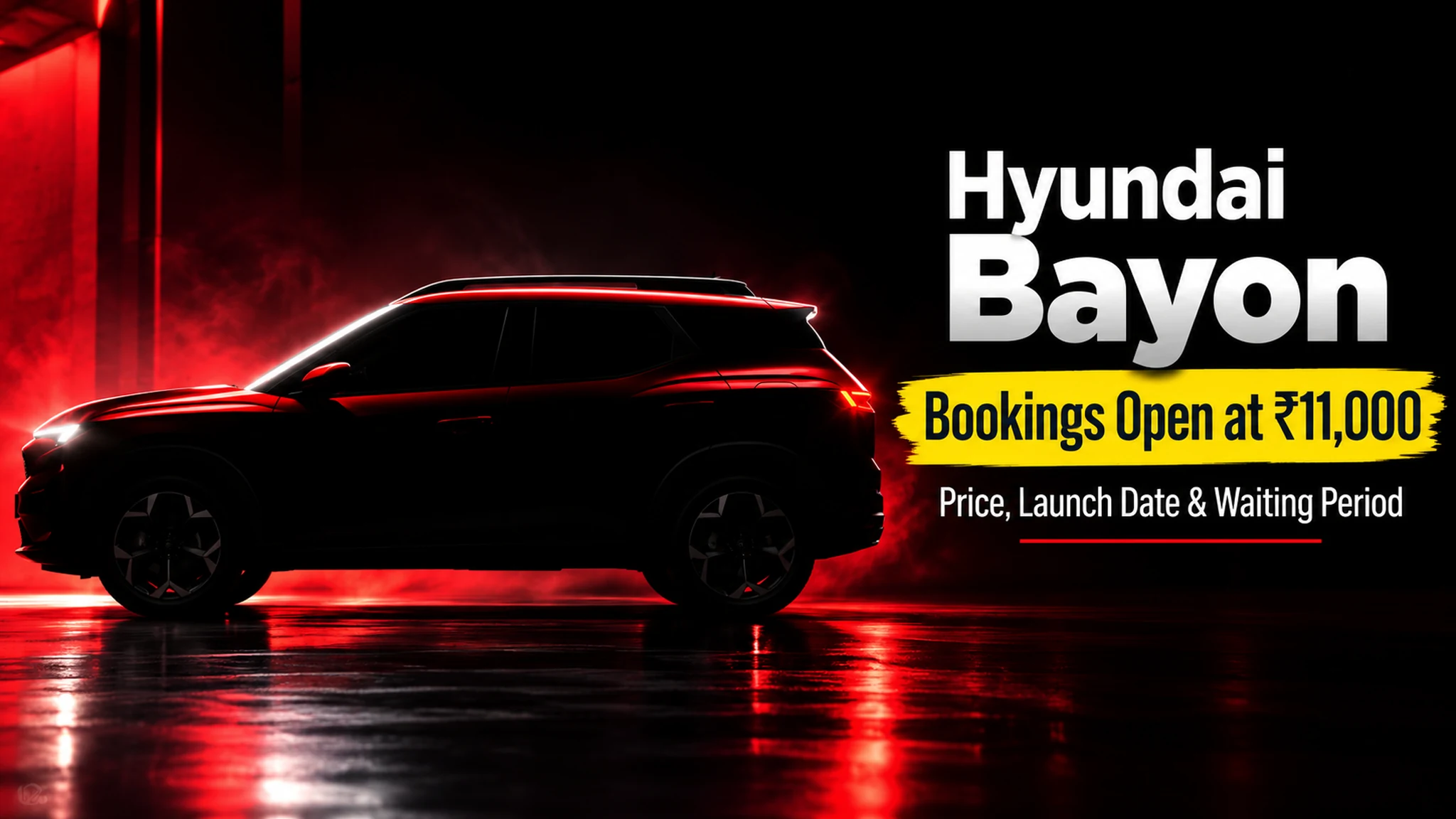
The Bayon is no longer a car you book on faith. Hyundai launched it on 26 October 2026 at an introductory ₹9,99,900 ex-showroom, which means anyone who paid the ₹11,000 booking amount back in September now knows exactly what they were queuing for, and anyone still deciding can see the full price list before committing.
This guide covers the booking process as it stands today: what the ₹11,000 gets you, how to book online or at a dealership, what the launch changed, and the questions worth settling before you turn a booking into a purchase.
The Short Answer
Bookings opened in late September 2026 at ₹11,000, payable on Hyundai's website or at any authorised dealership, and they are still open. The car launched on 26 October at an introductory ₹9,99,900 ex-showroom for the base HX2, with the range running to ₹18,14,900 across eleven variants. Deliveries are running through the festive period. The booking amount buys you a place in the queue and nothing more, so get the refund terms, the variant allocation and the on-road breakup in writing before you pay anything beyond it.
Hyundai Bayon Booking and Launch at a Glance
- Bookings opened: Late September 2026, and still open.
- Booking amount: ₹11,000, online at Hyundai's official website or at any authorised dealership.
- Launched: 26 October 2026.
- Introductory price: ₹9,99,900 ex-showroom for the HX2, with the range reaching ₹18,14,900.
- Variants: Eleven, from HX2 to HX10 DT, with a dual-tone option costing ₹15,000 where offered.
- Engine: 1.5-litre naturally aspirated petrol, 115 PS and 143.8 Nm, with a six-speed manual on every variant and an iVT automatic from HX5 upwards.
- Deliveries: Through the festive season, with dealers confirming allocation individually.
- Now confirmed at launch: The engine, the eleven-variant list and the variant each feature belongs to, all of which were unknown while bookings were open. A sunroof arrives at HX3+, ventilated seats and the surround-view camera at HX8, and Level 2 driver assistance only on the top HX10.
- Still unconfirmed: A CNG version has been reported for early 2027 but Hyundai has not announced it, and no independent crash rating has been published yet.
What the Launch Changed for People Who Had Already Booked
If you booked in September or October, the launch answered the one question you could not answer at the time: what the car actually costs.
The headline ₹9,99,900 is the introductory price of the base HX2 manual. The range climbs to ₹18,14,900 for the top HX10 DT with the automatic, which is a spread of more than ₹8 lakh across eleven variants. The full variant-wise price list is here, along with what each trim adds and where the range overlaps the Creta. That matters because most bookings in this segment are taken without a variant attached, so the car you end up being offered may not be the one you had in mind when you paid.
The other thing the launch settled is the top of the range. Before 26 October the expected price was widely put at somewhere between ₹9 lakh and ₹14 lakh. The bottom of that estimate was close, the top was not: the range actually reaches ₹18,14,900. If you booked expecting a ceiling of around ₹14 lakh, the variant you had in mind may sit higher up the list than you assumed.
There is a second reason the variant matters more than most buyers expect. The features the Bayon is being advertised on are not spread across the range. Level 2 driver assistance and the twin 12.3-inch screens sit on the HX10 alone, which starts at ₹16.65 lakh, while ventilated seats and the surround-view camera begin at HX8. If you booked with one of those in mind, the variant your booking is attached to decides whether you actually get it.
The practical step now is simple. Ask your dealer which variant your booking has been allocated against, ask for the on-road price of that exact variant in writing, and compare it against the variant you actually want. If there is a gap, now is the moment to correct it, not at delivery.
How to Book a Hyundai Bayon
Two routes, and they lead to the same place. Booking online is faster and gives you a timestamped record; booking at a dealership gets you a named person to chase.
- Book online through Hyundai's official website: Choose the Bayon, enter your details and your city, pick your preferred dealership and pay the ₹11,000. You get a booking confirmation with a reference number, which is the document to keep.
- Or book at an authorised dealership: Pay the same ₹11,000 at the showroom. Insist on a printed receipt that names the model, the amount and the date rather than a verbal confirmation or a message.
- Record who you are dealing with: Take the sales consultant's name and number and call it once before you leave. A booking with a contact you've actually spoken to moves faster than one sitting in a system.
- Get the refund position in writing: Ask what happens to your ₹11,000 if you cancel, and get the answer on paper rather than as an assurance. This is the single most common gap between what buyers assume and what they can prove later.
- Follow up in writing, not by phone: When you ask about allocation or delivery, send a message or an email. A written trail is what you need if a date slips and you want it taken seriously.
One note on timing. Booking online and then walking into the dealership with the reference number tends to produce a better conversation than arriving cold, because the branch can already see you in the system.
What the ₹11,000 Booking Amount Actually Buys
Two things first, because they are the questions people actually ask. The ₹11,000 is adjusted against the final price of the car, so it is not a fee on top, it is the first part of the payment. And it is usually refundable if you cancel before billing, though a small deduction can apply depending on the dealership, which is why the terms printed on your receipt matter.
Beyond that, what it buys is queue position. That's worth something during a festive-season launch, and it's worth being clear that it isn't worth more than that.
Here is what the booking amount does not do, and each of these catches someone out every launch:
- It doesn't lock your price: Introductory pricing usually runs for a limited period or a limited number of bookings. If your delivery slips past that window, the price can change.
- It doesn't guarantee your variant: Most launch bookings are taken without a variant committed, and allocation depends on what the factory sends your dealership.
- It doesn't guarantee your colour: Colour availability varies more than variant availability in the first few months, and it is a common reason deliveries slip.
- It doesn't fix your delivery date: Unless you have a date in writing, a festive-season delivery is a general intention rather than a commitment to you specifically.
None of this means you shouldn't book. It means the booking is the start of a conversation rather than the end of one, and the things worth pinning down are pinned down in writing, not in a showroom conversation you won't be able to reproduce later.
Hyundai Bayon Waiting Period: What Is Known So Far
Being straight about this: there isn't a reliable waiting-period figure for the Bayon yet. The car launched on 26 October, deliveries have only just begun, and any number circulating this early is either a single dealership's estimate or a guess.
What can be said is what usually drives the waiting period in the first few months after a launch, so you know what to ask about:
- Variant and gearbox: Automatics and higher trims typically carry longer waits than base manual variants, because the initial production mix leans towards what sells fastest.
- Colour: A popular or newly introduced shade can add weeks on its own, independently of the variant.
- City and dealership: Allocation is distributed across dealerships, so two showrooms in the same city can quote different timelines for the same car on the same day.
- Festive demand: Launches timed to the festive season see the heaviest early demand, which usually eases once that period ends.
My advice: ask your own dealership for a written estimate for your exact variant and colour, and ask a second dealership in the same city for the same thing. The gap between those two answers tells you more than any published figure would.
Before You Turn a Booking Into a Purchase
The booking is refundable in principle and reversible in practice. The invoice is neither of those things. These are the things worth settling in the gap between the two.
- Get the full on-road breakup for your exact variant: Ex-showroom, registration, insurance and anything else, each on its own line. A single lump sum is where the margin hides.
- Keep the accessories conversation separate from the car price: Settle what the car costs first, then discuss any package on its own terms, itemised.
- Check the variant-wise feature list, not the brochure: On a range spanning more than ₹8 lakh, the difference between two trims is the whole decision, and brochure features are range features.
- Arrange your own insurance quote before accepting the dealer's: You're free to insure the car with whoever you like, and if it is being financed, check whether the policy has been folded into the loan.
- Confirm the manufacturing month before you accept delivery: A car built in the previous calendar year is worth less the day you sell it, and this is the easiest thing to check and the hardest to fix afterwards.
Booking the Bayon Against Booking a Rival
The Bayon isn't the only car taking festive bookings, and the way the booking works differs more than people expect between brands.
Three things are worth comparing before you commit money to any of them. The token amount itself varies from a few thousand rupees to well over twenty thousand. The refund position varies more, from fully refundable before billing to a flat deduction. And the allocation practice varies most of all: some brands let you book a specific variant and colour from the start, others take a general booking and allocate later, which is what leaves buyers accepting a car they didn't quite choose.
On Hyundai's side the picture is straightforward enough. The amount is modest at ₹11,000, it comes off the final price, and it's generally refundable before billing. Its weakness is the allocation question, which is common to most launches and is exactly why the variant conversation needs to happen early rather than at delivery.
If you're cross-shopping the Bayon against something like the Victoris, the Kushaq, the Taigun or the Elevate, ask each dealership the same three questions: what the token is, what happens to it if you cancel, and whether the booking is tied to a specific variant and colour. The answers tell you a lot about how the next two months will go.
Should You Book Now, or Just Walk In?
The calculation has changed since the launch. Before 26 October, booking was a bet on an unknown price. Now the prices are public, so booking is simply a question of queue position.
If you know which variant you want and you want it soon, booking still makes sense, because allocation goes in order and festive-season demand is real. If you are undecided between variants, or between the Bayon and something else, there's less reason to rush. The ₹11,000 holds a place in a queue, and a queue you aren't sure you want to be in isn't worth much.
One thing worth doing either way before you commit: drive the variant you intend to buy, not the one the showroom has ready. A top-spec demonstration car tells you very little about how the variant you can afford actually feels.
Ready to drive one? Book a test drive and we will connect you with your nearest authorised dealer.
What Happens Between Booking and Delivery
The gap between paying the token and taking the keys is where most of the friction in a new car purchase lives. Knowing the sequence makes it easier to spot when something has stalled.
- Allocation: Your dealership is assigned a car matching your variant and colour from the factory's dispatch. This is the step that takes the longest and the one you have least control over, which is why getting your variant confirmed early matters.
- Intimation and billing: The dealership tells you the car has arrived and raises the invoice. This is the point at which the price is fixed, so any question about introductory pricing needs to be settled before this, not after.
- Insurance and registration: Done in parallel with billing. If you are arranging your own insurance, tell the dealership early rather than at this stage, because late changes here are what push a delivery date by a week.
- Pre-delivery inspection: The dealership prepares the car. This is your window to ask for the manufacturing month and to raise anything you want checked before it is handed over.
- Delivery: Inspect the car in daylight, confirm the variant and the accessories against the invoice, and count what is in the boot before you sign anything.
If any of those steps goes quiet for more than a week without an explanation, a written follow-up to the sales consultant with your booking reference usually restarts it faster than a phone call does.
Conclusion
Bookings are open at ₹11,000, the car has launched at ₹9,99,900 introductory for the base variant, and the range runs to ₹18,14,900. The booking process itself is straightforward. What decides whether it goes smoothly is how much of it you get in writing.
If you've already booked, the one call worth making this week is to confirm which variant your booking is allocated against and what it costs on the road. If you haven't, look at the full price list first and work out which variant your budget actually reaches, because on this range that choice matters more than the booking does.
FAQs
1. What is the booking amount for the Hyundai Bayon?
₹11,000, payable online through Hyundai's official website or at any authorised dealership. Bookings opened in late September 2026 and remain open after the launch.
2. When was the Hyundai Bayon launched and at what price?
It launched on 26 October 2026 at an introductory ₹9,99,900 ex-showroom for the base HX2 manual. The range extends to ₹18,14,900 for the top HX10 DT with the iVT automatic, across eleven variants.
3. How do I book a Hyundai Bayon online?
Through Hyundai's official India website: select the Bayon, enter your details and city, choose your preferred dealership and pay the ₹11,000. Keep the booking confirmation and reference number, and follow up with the dealership in writing.
4. Is the Bayon booking amount refundable?
Hyundai has not published a public refund policy, and practice varies by dealership. Ask for the refund terms in writing before you pay rather than relying on a verbal assurance.
5. Does booking guarantee my variant, colour or price?
No. The booking secures queue position only. Most launch bookings are taken without a committed variant, colour availability varies in the early months, and introductory pricing usually applies for a limited window rather than being locked to your booking.
6. What is the waiting period for the Hyundai Bayon?
There is no reliable figure yet, as the car launched on 26 October and deliveries have only just started. Waiting times will vary by variant, gearbox, colour, city and dealership, so ask two dealerships in your city for written estimates for your exact variant.
7. Which Bayon variants get the automatic gearbox?
The iVT automatic is offered from HX5 upwards and is not available on HX2, HX3 or HX3+. It adds between ₹1.35 lakh and ₹1.44 lakh over the manual depending on the variant, so the cheapest automatic Bayon is ₹13,84,800.
8. Will the Hyundai Bayon get a CNG version?
A CNG variant has been reported for early 2027, but Hyundai has not announced it. Treat it as unconfirmed and ask your dealer rather than delaying a purchase on the strength of it.