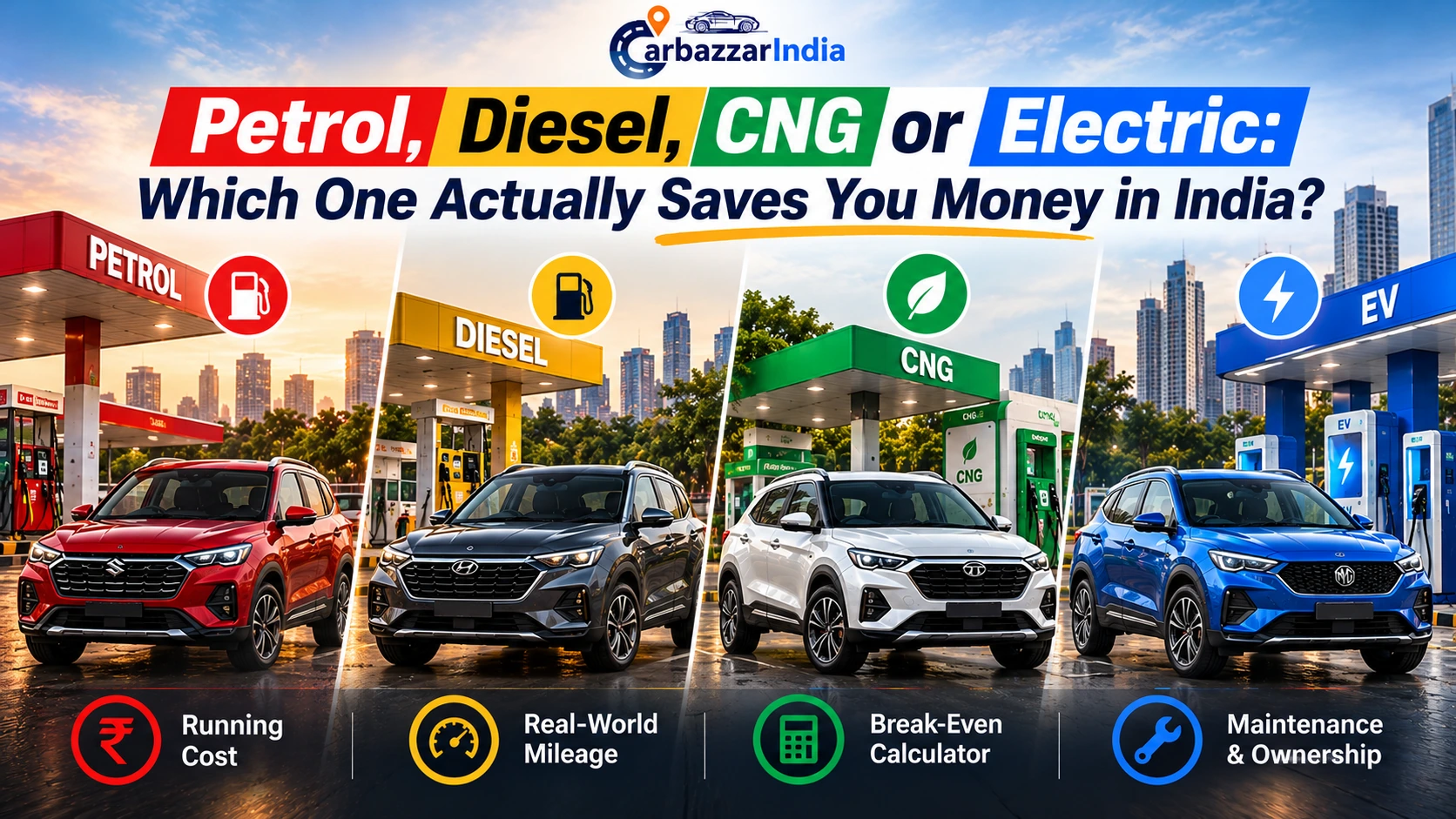
Every showroom conversation in India ends up at the same place. You like a car, and then the salesperson leans in and says the CNG version will save you a fortune, or that diesel is the only sensible choice for your running, or that an EV costs almost nothing to run. All three statements can be true. All three can also be completely wrong for you, and the difference comes down to one number nobody at the dealership will work out with you.
That number is how many kilometres you've got to drive before the extra money you paid upfront comes back to you in fuel savings. It is simple arithmetic, it takes four minutes, and it will tell you more than any brochure. This guide gives you the current running cost of all four fuel types, the formula, three worked examples with real car prices, and the hidden costs that quietly change the answer.
The One Number That Decides Everything
A CNG, diesel or electric version of the same car almost always costs more than the petrol one, and how much more swings a lot between models and variants. That extra money isn't a fee, it's an investment, and like any investment it has a payback period.
Think of it this way. If the CNG version costs ₹90,000 more and saves you ₹2 every kilometre, you get your ₹90,000 back after 45,000km. Drive less than that before you sell the car and you've lost money, no matter what the mileage sticker says. Drive much more and the car has paid you back and keeps paying.
Everything else in this guide is just filling in those two blanks: what the premium actually is, and what you really save per kilometre.
What Each Fuel Costs You Per Kilometre Right Now
These are Delhi rates as of 16 October 2026, and the efficiency figures are what cars really return in mixed Indian driving, not what the brochure claims. Everything below is worked out on those assumptions, so treat the table as an illustration rather than a quote. Fuel prices move every few weeks and differ by city, electricity tariffs differ by state and by how much your household already uses, so put your own numbers in before you decide anything.
| Fuel | Rate | Real-world efficiency | Cost per km |
|---|---|---|---|
| Petrol (hatchback) | ₹102.12 per litre | About 18kmpl | About ₹5.67 |
| Petrol (compact SUV) | ₹102.12 per litre | About 15kmpl | About ₹6.81 |
| Diesel (compact SUV) | ₹95.20 per litre | About 19kmpl | About ₹5.01 |
| CNG (hatchback) | ₹86.98 per kg | About 26km per kg | About ₹3.35 |
| Electric (home charging) | ₹8 per unit | About 6.5km per unit | About ₹1.23 |
| Electric (public fast charger) | About ₹22 per unit | About 6.5km per unit | About ₹3.38 |
Two things in that table deserve a second look.
- Petrol and diesel are nearly the same price now: The gap in Delhi is under ₹7 a litre. Ten years ago it was more than ₹20. This single change has quietly destroyed most of the case for buying a diesel car, and almost nobody has updated their thinking.
- An EV on a public charger costs the same as CNG: Home charging is where the savings live. Charge mainly at public fast chargers and your running cost roughly triples, which wrecks the entire calculation.
The Formula, and How to Use Your Own Numbers
Here's the whole thing. You need three numbers and a calculator.
- Find the real premium: Ask for the on-road price of the exact same trim in both fuels and subtract. Do not use ex-showroom, because insurance and road tax on the costlier version add to the gap, and that is money leaving your account too.
- Work out your saving per kilometre: Divide the fuel rate by your realistic efficiency for each option, then subtract one from the other.
- Divide: Premium divided by saving per kilometre gives you the break-even distance. Divide that by your monthly running to get the payback in months.
If you are weighing two specific cars, our car comparison tool puts their prices and specs side by side. Then ask yourself one honest question: will you still own this car by then? Most Indian buyers change cars in five to seven years. If the break-even lands beyond that, the cheaper version was the better buy.
Most People Guess Their Monthly Running Wrong
The formula is only as good as the kilometre figure you feed it, and this is where almost everyone goes wrong. Ask any car owner how much they drive and you will hear a round number that sounds about right. Check the odometer and the truth is usually different, often by 30 percent or more in either direction.
People who mostly commute underestimate, because a 14km office run twice a day quietly becomes 600km a month before you have gone anywhere interesting. People who take two long trips a year overestimate, because those trips feel big but add up to less than one busy month of city driving.
Three ways to get the real number, in order of accuracy:
- Read your own odometer: Note the reading today, note it again in 30 days. This is the only method with no guesswork in it, and it is worth the wait if you are about to spend lakhs.
- Use your service records: Your workshop stamps the odometer reading at every service. Take the difference between your last two services, divide by the number of months between them, and you have a solid average across a full year.
- Count backwards from fuel bills: Add up a month of fuel spends, divide by the rate per litre to get litres, and multiply by your real mileage. Rougher than the others, but you can do it in five minutes with your payment history.
Whichever you use, add the trips you take once or twice a year and spread them across twelve months. A single 1,200km holiday drive adds 100km to every month of your average, and on a borderline decision that's enough to flip the answer.
Worked Example 1: Is a CNG Car Worth ₹90,000 More?
Take a popular hatchback where the CNG version costs about ₹89,500 more than the same petrol trim.
- Petrol running cost: About ₹5.67 a kilometre at a realistic 18kmpl.
- CNG running cost: About ₹3.35 a kilometre at a realistic 26km per kg.
- Saving: About ₹2.32 every kilometre.
- Break-even: ₹89,500 divided by ₹2.32, which is roughly 38,500km.
Now put your own running against that:
| Your monthly running | Time to break even | Verdict |
|---|---|---|
| 500km | Over 6 years | Skip the CNG |
| 1,000km | About 3 years 2 months | Worth it if you keep the car |
| 1,500km | About 2 years 2 months | Clearly worth it |
| 2,500km and above | Under 16 months | Buy it without thinking twice |
CNG has the friendliest maths of the three alternatives, because the premium is the smallest and the saving per kilometre is large. That is why it has quietly become the default choice for city drivers and anyone running a car commercially.
Worked Example 2: Does Diesel Still Make Sense?
This is where most buyers are still working off outdated instincts. Take a popular compact SUV where the diesel costs about ₹1.65 lakh more on-road than the petrol in the same trim.
- Petrol running cost: About ₹6.81 a kilometre at a realistic 15kmpl.
- Diesel running cost: About ₹5.01 a kilometre at a realistic 19kmpl.
- Saving: About ₹1.80 every kilometre.
- Break-even: ₹1.65 lakh divided by ₹1.80, which is roughly 92,000km.
Ninety-two thousand kilometres. Read that again, because it changes the decision completely.
| Your monthly running | Time to break even | Verdict |
|---|---|---|
| 1,000km | Over 7 years | Take the petrol |
| 1,500km | About 5 years | Borderline at best |
| 2,000km | About 3 years 10 months | Diesel starts making sense |
| 3,000km and above | Under 2 years 7 months | Diesel is the right call |
My take: diesel used to be the obvious pick for anyone doing even moderate running. It isn't any more, and the reason is simple: the price gap between the two fuels has shrunk to under ₹7 a litre while the premium on the car has stayed roughly the same. You now need serious highway running, not just a long office commute, before diesel earns its money back.
And if you live in Delhi NCR, factor in that diesel vehicles there have a shorter registered life than petrol ones. That shortens your ownership window, which makes the break-even even harder to reach.
Worked Example 3: When Does an Electric Car Pay for Itself?
EVs are the most misunderstood of the lot, because the running cost headline really is spectacular and the upfront gap really is large. Take an electric compact SUV that costs about ₹5 lakh more than its petrol equivalent.
- Real premium: About ₹5 lakh for the car, plus roughly ₹35,000 to put a charging point in your parking. Call it ₹5.35 lakh, because you cannot run the car properly without the second bit.
- Petrol running cost: About ₹6.81 a kilometre.
- EV running cost at home: About ₹1.23 a kilometre at ₹8 a unit.
- Saving: About ₹5.58 every kilometre, which is the biggest per-kilometre saving of any option here.
- Break-even: ₹5.35 lakh divided by ₹5.58, which is roughly 96,000km. At 1,600km a month that lands at five years, which is about as long as most people keep a car.
So an EV and a diesel land at almost the same break-even distance, but for opposite reasons. The diesel saves little and costs a little more. The EV saves a lot and costs a lot more.
Here's the part that decides it, and it's got nothing to do with the car. If you can charge at home overnight, the maths above holds. If you have to rely on public fast chargers at around ₹22 a unit, your running cost jumps to roughly ₹3.38 a kilometre, your saving drops to about ₹3.43, and the break-even stretches past 1,55,000km. At that point you are unlikely to ever get your money back.
If the maths works for you, our electric car listings are a good place to start. So the real EV question is not which car to buy. It is whether you have a parking spot where you can fit a charging point. Answer that first, then look at cars.
Why Brochure Mileage Breaks All of This
Every calculation above used real-world efficiency, not the certified figure printed in the brochure. That was deliberate, and it matters more than people realise. If your car is returning far less than you expected, these are the usual reasons.
Certified mileage is measured in a laboratory on rollers, at gentle speeds, with no air conditioning, no traffic, no passengers and no luggage. Your car won't see those conditions on any single day of its life. In ordinary Indian driving, most cars return somewhere between 70 and 85 percent of the certified number, and city-heavy use can push it lower still.
If you build your break-even calculation on brochure figures, you will overstate your savings by roughly a quarter and talk yourself into a premium that takes years longer to recover than you think. A useful habit: take the brochure number, knock off 25 percent, and use that. If the maths still works, the decision is safe.
One more thing worth knowing. The gap between certified and real mileage is usually widest on CNG and smallest on diesel, because diesel engines hold their efficiency better in stop-start traffic. That narrows the CNG advantage slightly, though not enough to change the verdict.
The Costs That Do Not Show Up in Your Fuel Bill
Fuel is the big number, but it isn't the only one, and these quietly shift the break-even by thousands of kilometres.
- Diesel servicing costs more: Bills run higher than the petrol version of the same car because of the extra filters, the larger oil quantity and the emission hardware. How much more varies by model and workshop, so ask your dealer for the five-year service plan price of both versions and compare the actual figures rather than a rule of thumb.
- CNG tanks need periodic testing: A factory CNG tank has to be inspected and certified at set intervals. It is not expensive, but it is a workshop visit you would not otherwise make, and an expired certificate is a problem at insurance renewal and resale.
- EVs are the cheapest to service: No oil changes, no filters, no clutch, far less brake wear thanks to regenerative braking. That works in the EV's favour over five years, and almost nobody counts it.
- A home charging point is not free: Budget roughly ₹20,000 to ₹50,000 for a proper wall box and the wiring, depending on how far your parking is from the meter. This is already built into the EV example above, and it is the cost people most often forget.
- Insurance rises with price: The costlier version of the same car carries a higher insured value, so you pay more every year. On a ₹5 lakh premium that difference is real money.
- Resale cuts both ways: CNG cars sell easily in the used market and hold value well. Diesel resale is softening, especially in cities with age restrictions. EV resale is still the big unknown, because nobody has a long track record with battery health yet.
What Nobody Tells You About Each Fuel
The numbers assume everything goes smoothly. Here's what daily ownership actually feels like.
- CNG: You lose most of your boot to the cylinder unless the car has an underbody tank. The car feels noticeably slower on gas, especially with a full load on a climb. And in many cities, filling up means queueing, sometimes for 20 minutes or more. If your time has a value, put a number on it.
- Diesel: Still the best highway companion of the four, with torque that makes overtaking effortless and a relaxed cruising feel no small petrol matches. The trade-offs are a noisier cold start, costlier repairs outside warranty and tightening rules in big cities.
- Petrol: The boring answer that is right more often than people expect. Cheapest to buy, cheapest to repair, accepted everywhere, no restrictions, no range anxiety, no queue. If your running is modest, this is almost always the correct choice.
- Electric: Effortless in the city, dirt cheap to run at home, and the nicest of the four to drive in traffic. But it reshapes your life around charging, and a long trip needs planning rather than just turning up at a pump.
So Which One Should You Buy?
Forget the badge on the boot for a moment and find yourself in this list. Once you know your fuel, you can shortlist cars by budget and body type.
- Under 1,000km a month: Buy petrol. Nothing else will pay back inside a sensible ownership period, and you will have spent less on day one.
- 1,000km to 1,500km a month, mostly city: Buy CNG if your city has decent filling coverage and you can live with the smaller boot. This is the sweet spot where CNG beats everything.
- Over 2,000km a month with regular highway runs: Diesel finally earns its premium, and the driving experience is a genuine bonus rather than just a saving.
- Over 1,600km a month with home charging: An electric car works, and it gets stronger every month you keep it. Below that, the ₹5 lakh-plus premium takes longer to come back than most people keep a car, so buy the EV because you want one rather than to save money.
That 1,600km figure is not a law, it is what falls out of one example: a ₹5.35 lakh premium and a saving of ₹5.58 a kilometre. Pick a cheaper EV, get better efficiency than 6.5km a unit, pay a lower electricity tariff, and your threshold drops. A pricier model, heavier insurance on the higher value, or a weaker resale at the end and it climbs. Run the formula on the two cars actually in front of you and use that number, not this one.
- No home charging: Do not buy an electric car for the running cost. Buy it because you want one, and go in knowing the savings will be modest.
One option this guide leaves out on purpose is the strong hybrid, because it works on a different logic. A hybrid doesn't ask you to change where you refuel or how you drive, it just uses less petrol doing the same thing, and its premium sits between CNG and electric. If that sounds like your kind of compromise, it deserves its own comparison rather than a paragraph here.
The pattern underneath all of this is simple. The more you drive, the more the costlier fuel makes sense. The less you drive, the more the market rewards you for buying the plain petrol version and keeping the money.
Conclusion
The honest answer to which fuel saves you money is that it depends on a number only you have, which is how far you actually drive. Work it out properly before you walk into a showroom and you will be the best prepared person in the room, because the salesperson is working off averages and you will be working off your own odometer.
Take four minutes this week. Check your last three fuel bills, work out your real monthly running, then run the formula on the car you are considering. If the payback lands inside the time you plan to keep the car, pay the premium with confidence. If it does not, buy the petrol version and enjoy the money you kept.
Narrowed it down? Book a test drive and we will connect you with your nearest authorised dealer.
FAQs
1. Which fuel is cheapest to run in India right now?
Electric, by a wide margin, if you charge at home. At around ₹8 a unit it works out to roughly ₹1.23 a kilometre, against about ₹3.35 for CNG, ₹5.01 for diesel and ₹5.67 for petrol.
2. How many kilometres before a CNG car pays for itself?
Usually around 38,000km to 45,000km, based on a premium of about ₹90,000 and a saving of roughly ₹2.30 a kilometre. At 1,500km a month that is a little over two years.
3. Is diesel still worth buying in India?
Only if you drive more than about 2,000km a month, mostly on highways. The petrol and diesel price gap has narrowed to under ₹7 a litre, which pushes the break-even out to roughly 92,000km on a typical compact SUV.
4. Does an electric car really save money?
Only if you charge at home. Home charging gives the biggest per-kilometre saving of any fuel. Relying on public fast chargers roughly triples your running cost and pushes the break-even beyond 1,55,000km.
5. Why is my real mileage lower than the brochure figure?
Certified mileage is measured in laboratory conditions with no traffic, no air conditioning and no load. Most cars return 70 to 85 percent of that figure in normal Indian driving, so plan on about 25 percent less.
6. Do CNG cars need extra maintenance?
The servicing itself is similar to petrol, but the gas tank has to be inspected and certified at set intervals. Keep that certificate current, because it matters at insurance renewal and at resale.
7. Which fuel holds its resale value best?
CNG cars sell quickly and hold value well in the used market. Diesel resale is softening in cities with vehicle age restrictions. Electric resale is still unproven because battery health over long periods is a new question.
8. I drive less than 800km a month. What should I buy?
Petrol. At that running, no alternative fuel will return its premium inside a normal ownership period, and you will have paid less upfront, less for insurance and less for repairs.