Your Search for the Best Car to Buy in India Starts Here
Buying a car in India used to mean one decision. Petrol or diesel. That was it.
But now you have a third option, a hybrid. And the Toyota Camry, which was once the only hybrid on the market and was priced at an outrageous Rs 44 lakh, is not the only option. Now, the hybrid car at the lower end of the market is priced at Rs. 10.50 lakh, a direct competitor to established players like the Creta and the Seltos.
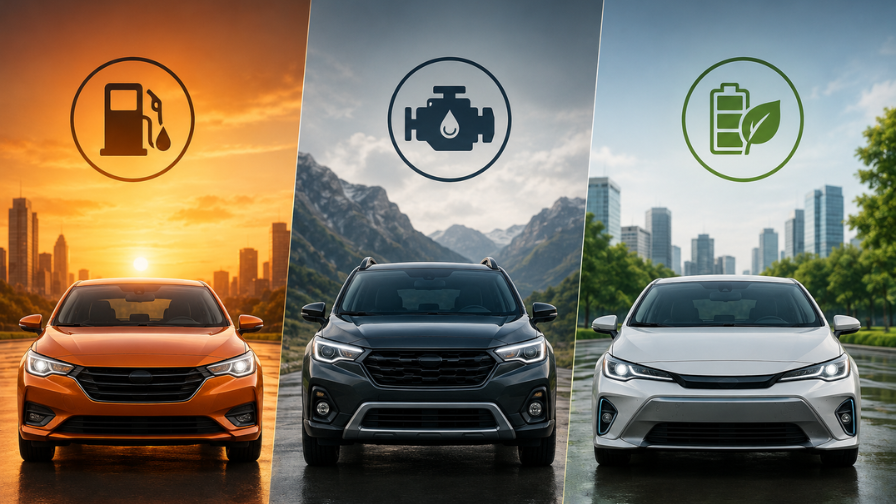
So, what is the right car to choose? The answer is no longer petrol or diesel. Now the right choice is one of petrol, diesel, or hybrid. The Best option depends on your driving habits, monthly running, budget, and overall usage needs.
If you want to simplify everything, choose a number. That number is, however, the number of kilometres you drive in a month.
Why Your Monthly Kilometres Matter More Than Anything Else
When people try to sell you a car, they'll tell you about torque, estimated mileage, resale potential, and so on. Those things matter, but none of them matters more than your own driving pattern.
Think about it practically. Consider this for a second. The person who drives 800 kilometres a month in the city is going to have a very different fuel cost from the person who drives 2,500 kilometres a month between cities on a highway. Choosing the same fuel type for both drivers wouldn't be the smartest decision.
So, to be more accurate, before you go on, do this. Check your last fuel receipts, or check your car's odometer. Now take a rough monthly average. It does not have to be exact. Once you have a number, the rest of this guide will make a lot more sense.
If you drive less than 1,200 kilometres a month, it is almost certain that petrol is the best answer.
Between 1,200 and 2,000 kilometres, mostly city — a strong hybrid, especially by 2026, is a better economic choice.
More than 2,000 kilometres a month with significant highway driving, diesel still has a case, though a weaker one than it used to.
Those three lines summarise what this entire guide will explain in detail.
Petrol in 2026 — The Honest Case
Petrol is still what most Indian buyers choose, and for a lot of them, it is the right decision. Not the most fuel-efficient one, not the cheapest to run per kilometre, but the right one for how they actually live.
Here is what petrol does well that often gets overlooked. A petrol engine is simpler. Any mechanic in any town across India can service it. There are no diesel particulate filters to worry about, no battery degradation concerns, and no need to think about charging infrastructure. You fill up and drive. That simplicity has real value, especially for buyers who are not deeply invested in monitoring their car's systems.
The purchase price is also lower. A petrol variant of almost any car in India costs less upfront than the diesel version, sometimes by Rs 1 to 1.5 lakh. For a buyer doing moderate kilometres, that difference takes years to recover at the pump, which means petrol actually works out cheaper in total cost of ownership.
The 2026 Skoda Kushaq facelift is a strong example of what modern petrol looks like in India right now. Launched in March 2026, it starts at Rs 10.69 lakh and goes up to Rs 18.99 lakh. Two engines are on offer: a 1.0-litre TSI producing 115 bhp and a 1.5-litre TSI producing 150 bhp. The Skoda Kushaq mileage as claimed by ARAI sits between 18.72 and 19.66 kmpl, depending on the variant. In real city driving, owners report closer to 13 to 16 kmpl, which is honest territory for a turbocharged petrol SUV in Indian traffic.
What the Kushaq also demonstrates is how much turbo petrol has matured. The 1.5 TSI paired with the 7-speed DSG is a genuinely engaging combination, responsive, quick, and enjoyable on both city roads and highways. The new 8-speed torque converter automatic paired with the 1.0 TSI in this facelift is a notable improvement over the previous DSG setup at city speeds. Smoother in slow traffic, more relaxed to live with daily.
Where petrol runs short is purely at the fuel pump if your monthly distances are high. If you are covering 2,000 kilometres a month with petrol at Rs 102.12 per litre in a car returning 14 kmpl in the real world, you are spending roughly Rs 14,589 on fuel every month. That figure is where diesel and hybrid start looking attractive.
But for a buyer under 1,500 kilometres a month? The extra efficiency from other fuel types rarely recovers its price premium within a reasonable ownership period. Petrol remains the most uncomplicated, accessible, and honest choice for moderate-use Indian buyers.
Browse petrol cars on CarBazzar India
Diesel in 2026 — Still Relevant, But for Fewer Buyers
In 2026, that logic still exists. It has just become harder to justify for a larger proportion of buyers.
This was an easy decision to make once before, concerning the diesel or petrol car. Diesel actually got 4 to 6 kms per litre, the pump price difference was substantial, and for a high mileage customer, the break-even period was reached in two years. The argument was logical and true.
That logic has not changed in 2026. However, justifying the costs has become harder for most customers.
Three factors have made the difference. First, there has been a significant drop in the price difference between petrol and diesel at the pump. If the price of a litre of diesel was Rs 20 to 25 less than petrol, the difference in mileage was a huge monthly saving. The smaller the gap, the longer it takes the savings to build up.
Second, BS6 Phase 2 emission standards have made diesel engines more expensive to produce and maintain. Costs have increased due to diesel particulate filters, more intricate fuel injection systems and stronger emissions hardware – both in terms of the price tag and the service bill. The BS6 Phase 2 diesel service will normally be more expensive than the same service performed on a petrol vehicle.
The third, and most crucial change, is the availability of good hybrid petrol cars in India from less than Rs 11 lakh, which return 22-26 kmpl in real city driving conditions. Two years ago, there was no such alternative available at an affordable cost. It has taken a large portion of the high-mileage city buyer segment away from diesel.
Diesel's remaining stronghold is the long-distance highway driver. Someone doing 2,500 kilometres a month, with a meaningful share of that on national highways, benefits from diesel's highway mileage of 18 to 23 kmpl and the strong torque that makes overtaking and carrying heavy loads feel effortless. Large SUVs and MPVs on long gradients still suit diesel well. The Innova Crysta remains a relevant diesel product for this profile precisely because the use case fits.
A point to highlight that many purchasers aren't aware of is the diesel particulate filter problem with BS6 Phase 2 engines. These filters need to be regenerated periodically, which involves a high-speed run in order to remove accumulated soot. The filter does not regenerate by itself if the driver's driving habits involve a lot of short trips and driving the car in the city only. This eventually leads to costly issues. Bigger and bigger numbers of these cases are being seen by dealerships, as buyers opt for the diesel choice without realising how they use it.
In 2026, diesel is not the best kind of fuel if your monthly distance is less than 1,500 kilometres or you drive mainly within cities. It's a sensible option for the true long-distance, highway-driving purchaser.
Explore diesel cars on CarBazzar India
Hybrid in 2026 — The Option That Has Changed the Game
Walk into any Maruti or Toyota showroom today and ask about the strong hybrid variant. Nine out of ten times, there is a waiting period. That was not the case two years ago.
Strong hybrid cars in India now start at Rs 10.50 lakh. The Maruti Suzuki Victoris at that price claims 28.65 kmpl. The Toyota Urban Cruiser Hyryder at Rs 10.99 lakh claims 27.97 kmpl. The Maruti Grand Vitara hybrid at Rs 12.37 lakh returns the same 27.97 kmpl figure. None of these is a niche premium product. They are everyday compact SUVs fighting for the same buyer as the Hyundai Creta — except the fuel bill at the end of every month looks very different.
Grand Vitara hybrid owners posting pump-to-pump figures in owner communities are reporting 22 to 26 kmpl in real city conditions. Not ARAI lab numbers. Actual owners, actual traffic, actual fuel receipts.
In monetary terms, what does that imply? Take 1,500 km a month, petrol at Rs 102.12 per litre, and compare a regular petrol SUV at 13 kmpl real world against a strong hybrid at 23 kmpl:
Monthly cost of petrol: Rs 11,783 per month
The monthly cost of a hybrid is around Rs 6,600.
Monthly savings: approximately Rs 5,123 per month
Annual saving: approximately Rs 61,477 per year
Over five years: approximately Rs 3.07 lakh in total fuel savings
The upfront cost is 1.5 to 2 lakh more than the equivalent petrol variant, but that price differential is offset in three years, and the hybrid saves real money in the next two years. This is no trivial bonus. This is why a large number of Indian buyers in the Rs 12-20 lakh range are opting for hybrid cars instead of diesel-powered ones.
The Renault Duster hybrid is one of the most-awaited products of the segment. The third-generation Duster made a comeback in India in 2026, and the turbo petrol variants are priced from Rs 10.49 lakh. The strong hybrid model is anticipated to hit the Indian market around Diwali 2026 at around Rs 20 lakh ex-showroom. The powertrain is made up of a 109 hp petrol engine that is paired with a 49 hp electric motor and a 20 hp hybrid starter generator that provides a total system output of 160 hp. But before the single hybrid unit was delivered, Renault had announced a production ramp-up due to the high demand for their allocation. The Duster hybrid price discussion will be a big one once the Duster is officially available.
Before going further, one important distinction that buyers often miss. Not all hybrids are the same, and the differences are large enough to affect whether the fuel efficiency case actually applies to you.
A strong hybrid, such as the Maruti Grand Vitara, Toyota Hyryder, Toyota Innova Hycross and the Honda City eHEV, can operate on electric power alone at low speeds, recharge its own battery through braking and deceleration, and does not need any external charging. City mileage jumps up substantially. This is the hybrid that achieves the above-mentioned fuel savings.
A mild hybrid, like the one in the Maruti Ertiga, uses a small electric motor to assist the petrol engine, but it cannot run on electricity alone. The mileage improvement is real but modest, typically 1 to 2 kmpl above the standard petrol version. A mild hybrid is not as strong a hybrid, and the financial argument isn't as solid.
Plug-in hybrid / PHEV (on the Audi, Mercedes, Volvo and some others in India) are hybrid cars that need external charging but can run considerable distances in electric mode. Lack of availability in the Indian mainstream market, and it is only practical for buyers who can charge at home or at work.
When comparing mileage advantage for any hybrid car, make sure you ask what type of hybrid it is before making the calculation.
See all hybrid cars on CarBazzar India
The Diesel Hybrid vs Petrol Hybrid Question
This comparison comes up in searches and deserves a direct answer.
There are currently no diesel hybrid cars in the Indian mainstream market. Every hybrid vehicle on sale here — the Victoris, Grand Vitara, Hyryder, Innova Hycross, City eHEV — uses a petrol-electric system. Diesel engines in India are already fuel-efficient enough on their own that the cost of adding hybrid technology does not produce a price-to-benefit ratio that Indian buyers would accept.
When comparing a diesel hybrid vs petrol hybrid in the Indian context, you are really comparing a diesel-only car against a petrol-plus-hybrid. For city-heavy driving above 1,200 kilometres a month, the strong petrol hybrid wins on running costs. For sustained highway use above 2,000 kilometres a month, a diesel without a hybrid still competes on total cost grounds.
The Best Hybrid Cars in India Right Now
For buyers who have concluded that a hybrid suits their usage pattern, here is where the market actually stands in 2026.
Maruti Suzuki Victoris — starting from Rs 10.50 lakh, ARAI claimed 28.65 kmpl. The most affordable entry point into the strong hybrid territory in India. Maruti's service network means you are never far from a service centre, regardless of where you live. The lower variants could be better equipped, but the hybrid system itself is mature and reliable.
Toyota Urban Cruiser Hyryder — from Rs 10.99 lakh, ARAI claimed 27.97 kmpl. Mechanically identical to the Grand Vitara, with Toyota's reliability record and resale value on top. Real-world city mileage from owners typically sits at 22 to 24 kmpl.
Maruti Suzuki Grand Vitara — from Rs 12.37 lakh, ARAI claimed 27.97 kmpl. Better equipped in higher variants than the Victoris, strong resale value, and a hybrid system with enough real-world history to have a clear ownership track record.
Honda City Hybrid eHEV — the sedan option for buyers who do not want an SUV. Honda's e: HEV system is well-calibrated for Indian city driving. Refined, comfortable, and returns strong city mileage for a car of its class.
Toyota Innova Hycross — from Rs 21 lakh. For family buyers who need genuine space and want hybrid efficiency, this is currently the best combination available in the Indian market. Nothing else at this price point delivers what the Hycross does in this specific category.
Renault Duster Hybrid — expected around Diwali 2026, approximately Rs 20 lakh. Already sold out for the year before delivery. If you are not in a rush and want a strong hybrid compact SUV at a competitive price point, this is worth tracking.
Compare these models on CarBazzar India
Real-World Mileage Reference — What Owners Actually Report
Figures from ARAI are tested under controlled conditions and serve as a comparison point and not as a basis for calculating your fuel budget. Instead, use this table.
|
Fuel Type |
Real City Mileage |
Real Highway Mileage |
Best Suited For |
|
Petrol naturally aspirated |
10 to 13 kmpl |
14 to 17 kmpl |
Under 1,200 km monthly |
|
Petrol turbocharged |
12 to 16 kmpl |
16 to 19 kmpl |
Moderate use, and a great way to enjoy driving. |
|
Diesel |
14 to 17 kmpl |
18 to 23 kmpl |
2,000 plus km, highway heavy |
|
Strong hybrid petrol |
20 to 27 kmpl |
16 to 20 kmpl |
City heavy, 1,200 plus km monthly |
The hybrid city number being higher than the highway number is not a problem — it is how the technology works. Hybrid systems recover energy through braking and coasting. On a clear highway at sustained speed, there is very little of that. A diesel doing 21 kmpl on a highway run genuinely competes with a hybrid doing 17 to 18 on the same route. This is exactly why diesel retains a real use case for long-distance driving even in 2026.
Answering the Questions Indian Buyers Actually Ask
Q1. Petrol car or diesel car — which is better in 2026?
Less than 1,500 kilometres per month, primarily in cities: petrol is the easier and more cost-effective option, all things considered. Above 2,000 kilometres monthly, if there is a lot of highway driving involved, then it still makes financial sense to use diesel. Looking at the above two profiles, with heavy usage in the city, a strong hybrid is the most cost-effective solution that is available in India at the moment.
Q2. What is the Renault Duster hybrid price?
The official price is yet to be announced. On the basis of the information available, it is expected that it will cost around Rs 20 lakh ex-showroom and will be revealed prior to Diwali 2026. The turbo petrol Duster variants are on sale now from Rs 10.49 lakh. The hybrid deliveries are likely to start after Diwali, as the current order for 2026 has already been filled, and if someone wants to get a hybrid, they will have to be on the waiting list for early 2027 deliveries.
Q3. What is the actual Skoda Kushaq mileage?
The 2026 Kushaq facelift claims 18.72 to 19.66 kmpl on ARAI testing. Owners say they get 13 to 16 kmpl in real city driving, irrespective of their driving habits and their use of air conditioning. On highways with steady speeds, 17 to 19 kmpl is achievable. The real-world efficiency numbers in normal driving conditions will be returned when using the 1.0 TSI in manual mode. The 1.0 TSI manual returns the most efficient real-world numbers in everyday conditions.
Q4. Are hybrid cars actually worth it in India?
For strong hybrid models, yes — for buyers doing 1,200 or more kilometres a month with city-heavy usage, the five-year savings comfortably exceed the price premium over the equivalent petrol variant. For mild hybrid models, the case is more modest. The mileage improvement is real, but the savings are smaller and the break-even period is longer.
Q5. Which hybrid car gives the best mileage in India?
The Maruti Suzuki Victoris leads with a claimed 28.65 kmpl on ARAI testing. Real-world city mileage from owners sits between 22 and 25 kmpl. The Toyota Hyryder and Maruti Grand Vitara hybrid use essentially the same system and return almost identical real-world figures.
Q6. Should I wait for the Duster hybrid or buy something now?
If a compact SUV is what you want and your timeline is flexible, waiting is a reasonable choice — the Duster hybrid is shaping up to be a genuinely competitive product at its price point. If you need a car within the next two to three months, the Maruti Grand Vitara hybrid is the most balanced and proven strong hybrid compact SUV currently available in India.
Find cars by fuel type and budget on CarBazzar India
The Decision, Simplified
This entire guide comes down to one honest framework.
If you drive mostly within a city, cover moderate monthly distances, and want the most straightforward ownership experience, buy petrol. Lower upfront cost, simpler maintenance, and wide service availability across India.
If you are a genuine high-mileage driver, consistently above 2,000 kilometres a month with meaningful highway use, diesel remains a financially rational choice, provided you understand the BS6 Phase 2 maintenance requirements and plan accordingly.
If you live in a city, drive 1,200 or more kilometres every month, and plan to keep the car for four or five years, a strong hybrid is now the most financially intelligent choice available in India. The numbers support it clearly, the products are mainstream and accessible, and the ownership experience has been proven over several years of real use.
Calculate your monthly kilometres. Match them to the right fuel type. Then explore what is available within your budget.
Start your search on CarBazzar India