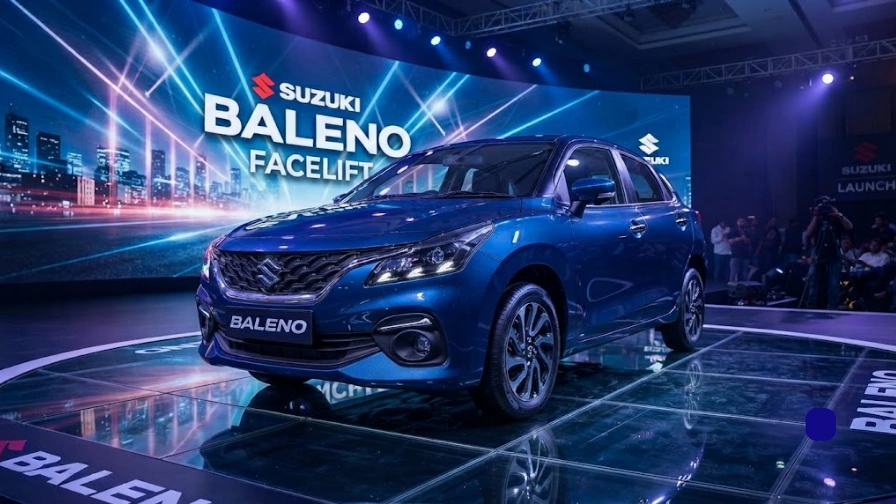
Maruti Suzuki has officially confirmed that the Baleno facelift will launch in India on September 5, 2026, marking the first major update to the second-generation Baleno since it arrived back in February 2022. If you've been eyeing a new premium hatchback and the Baleno is on your shortlist, the timing couldn't be more awkward — the update is barely a couple of weeks away as things stand.
So what exactly is changing, how different will the facelift really be from the car currently sitting in NEXA showrooms, and is it worth holding off your purchase? Here's a detailed, fact-based breakdown, built on official confirmation from Maruti Suzuki along with the most consistent details from spy shots and dealer-level reports.
A quick caveat before we dive in: Maruti hasn't released official specifications, features, or pricing for the facelift yet — that will happen at the September 5 unveiling. Everything about the new car below is based on test-mule sightings and industry reporting, and is clearly marked as "expected." Everything about the current Baleno is confirmed, official, on-sale information as of August 2026.
Maruti Baleno Facelift vs Current Baleno: Key Differences at a Glance
|
Aspect |
Current Baleno |
Baleno Facelift (Expected) |
|
Launch/on-sale date |
On sale since Feb 2022 |
September 5, 2026 |
|
Engine |
1.2L K-Series, 4-cylinder, DualJet petrol |
Rumoured switch to the Swift's 1.2L Z-Series 3-cylinder petrol |
|
CNG option |
Manual only |
Manual, possibly with AMT for the first time |
|
Transmission |
5-speed MT / 5-speed AMT |
Likely to continue, AMT tuning may be revised |
|
Sunroof |
Not offered |
Expected to be introduced (single-pane) |
|
Airbags |
6 airbags standard across the range |
6 airbags expected to continue |
|
ADAS |
Not offered |
Possible, on the top Alpha trim only |
|
Front grille/bumper |
Current design, fog lamps present |
Redesigned grille with chrome bar, revised bumper, fog lamps likely dropped |
|
Alloy wheels |
Existing 16-inch design |
New alloy wheel design expected |
|
Price (ex-showroom) |
₹5.99 lakh – ₹9.47 lakh |
Expected to start around ₹6.70–6.80 lakh, a modest premium over current pricing |
Maruti Baleno Facelift vs Current Baleno: What Has Changed?
The core silhouette of the Baleno isn't going anywhere — Maruti is treating this as a mid-cycle refresh, not a generation change, so the overall proportions, doors, and roofline are expected to carry over.
Exterior: The most visible update is up front. Spy shots of test mules have consistently shown a redesigned grille with a thicker horizontal chrome bar connecting the headlamps, along with a reworked front bumper that appears to lose the fog lamps seen on the current car. The boomerang-shaped LED daytime running lights and overall headlamp shape are expected to be retained, so this isn't a ground-up redesign of the face — more a refresh of it. At the rear, changes look minimal: the existing tail-lamp cluster, roof-mounted spoiler, and rear wiper are all expected to continue, though a new set of alloy wheels should freshen up the side profile.
Interior: The dashboard layout looks set to stay familiar too. Test mules have shown the same layered dashboard design, the freestanding 9-inch touchscreen sitting atop the dash, trapezoidal AC vents, and the flat-bottom steering wheel from the current car. The changes here are expected to be more about finish than function — new upholstery, extra ambient lighting, and possibly some new trim inserts to lift the cabin's perceived quality. A sunroof is one of the more meaningful additions being talked about, since the current Baleno doesn't offer one at all — a genuine gap against rivals like the Hyundai i20.
Under the hood is where the more interesting rumours are coming from — details on that below.
Engine and Performance
This is the section where reports diverge the most, so it's worth being upfront about what's confirmed versus what's speculation.
The current Baleno is powered by a 1.2-litre K-Series DualJet, DualVVT, 4-cylinder petrol engine, good for around 88.5 bhp, paired with a 5-speed manual or 5-speed AMT. There's also a factory-fitted CNG version of the same engine, offered only with the manual gearbox, which is ARAI-rated at roughly 30.61 km/kg. The petrol variants return an ARAI-claimed mileage of around 22.35–22.94 kmpl.
For the facelift, multiple reports point toward a fairly significant powertrain change: Maruti is expected to drop the 4-cylinder K-Series unit in favour of the newer 1.2-litre Z-Series 3-cylinder petrol engine that currently powers the Swift. This engine is generally regarded as more efficient and refined in its existing application, though exact power and torque figures for a Baleno-tuned version haven't been confirmed. If this swap goes through, it would also mark the first time Maruti offers a CNG-AMT combination in the country — something currently unique to Tata Motors in the mass market. A small number of reports have also floated the possibility of Maruti's low-cost hybrid technology eventually making it to the Baleno, though this is described even by those sources as more likely for a future generation (late 2026 or 2027) rather than this particular facelift.
Bottom line: if you care primarily about a proven, well-understood engine, the current Baleno's K-Series unit has years of real-world reliability data behind it. The facelift's engine, if the Z-Series switch is confirmed, will be a newer proposition that buyers won't have long-term data on right away.
Safety Features
Safety is one area where the current Baleno is already in a strong position, and it's likely to stay that way with the update.
The current Baleno comes with 6 airbags as standard across the entire range — a fitment Maruti extended to the whole lineup, not just the top trims. It also gets ESP (Electronic Stability Program), hill-hold assist, ABS with EBD, a rear parking camera, and rear parking sensors on higher trims.
For the facelift, most reports expect the 6-airbag setup to continue as standard, alongside the existing ESP and hill-hold assist. The more notable talking point is the possible addition of ADAS (Advanced Driver Assistance Systems) on the range-topping Alpha variant — features like forward collision warning or lane-departure alerts. If Maruti does bring this in, the Baleno facelift would become the first car in the premium hatchback segment in India to offer ADAS, a genuine first for the segment rather than just an incremental update. Front parking sensors, which the current car doesn't get, are also being talked about as a possible addition. None of this is officially confirmed yet, so treat the ADAS angle in particular as the more speculative one on this list.
Maruti Baleno Facelift vs Current Baleno: Price Difference
The current Maruti Baleno is priced from ₹5.99 lakh to ₹9.47 lakh (ex-showroom) as of August 2026, spanning the Sigma, Delta, Zeta, and Alpha trims, with CNG variants priced between roughly ₹7.85 lakh and ₹8.82 lakh, and automatic (AMT) variants between ₹7.42 lakh and ₹9.47 lakh.
Maruti hasn't announced official pricing for the facelift, and won't until the September 5 launch event. That said, the consistent expectation across multiple industry reports is a modest premium over the current range — most estimates suggest the base variant could start somewhere around ₹6.70–6.80 lakh, with a typical increase of roughly ₹10,000–₹30,000 over equivalent current-model variants, depending on the trim and added features (sunroof, ADAS, revised engine). This isn't unusual for a mid-cycle update; it's broadly in line with how Maruti has priced recent facelifts like the Brezza's.
If your budget is tight and you're comparing on price alone, the current Baleno's known, stable pricing is easier to plan around than the facelift's estimated numbers.
Which Baleno Has Better Features?
On paper, the facelift is shaping up to be the better-equipped car — but the gap may be narrower than it first appears, since a lot of the current Baleno's feature set is already fairly generous for the segment.
The current Baleno already offers a 9-inch touchscreen infotainment system with wireless Android Auto and Apple CarPlay, automatic climate control, a head-up display on higher trims, rear AC vents, cruise control, and 60:40 split rear seats. What it conspicuously lacks — and where rivals like the Hyundai i20 have had an edge — is a sunroof and any form of driver-assistance tech.
The facelift is expected to close both of those gaps: a sunroof is widely tipped to be introduced, and ADAS (if confirmed) would put the Baleno ahead of every other car in its segment on that front. Beyond that, expect updated upholstery, refreshed ambient lighting, and possibly a tweaked instrument cluster or minor UI updates to the touchscreen — evolutionary rather than revolutionary changes.
So: if features like a sunroof or driver-assistance tech matter to you, the facelift is the clear pick, assuming these rumoured additions make it to production as expected.
Should You Buy the Current Baleno or Wait for the Facelift?
This really comes down to how urgently you need a car and how much value you place on the specific updates.
Reasons to buy the current Baleno now:
· You need a car immediately and can't wait even a couple of weeks.
· You want to lock in known pricing with dealer discounts, which often increase on outgoing models right before a facelift launch as showrooms clear stock.
· You're not particularly bothered about a sunroof or ADAS, and simply want a reliable, well-reviewed hatchback with the proven K-Series engine.
· You may be able to negotiate a better deal on the current model in the weeks immediately after the facelift launches, as dealers look to move remaining stock.
Reasons to wait for the facelift:
· The launch is literally days away (September 5, 2026) — waiting a couple of weeks costs you very little at this point.
· You want the segment-first ADAS features, if they're confirmed at launch.
· A sunroof is a must-have for you.
· You'd rather have the latest engine and software/feature updates, even if it means paying a modest premium.
Given how close the launch date is, there's a strong practical case for simply waiting the extra couple of weeks and making a fully informed decision once official specs and prices are out on September 5, rather than committing to the outgoing model right before an update.
Is the Maruti Baleno Facelift Worth the Wait?
Based on what's known so far, yes — for most buyers, waiting makes sense, but with a caveat. The changes expected on the facelift are meaningful in areas that matter (a sunroof, potential ADAS, a possibly more efficient engine) rather than being purely cosmetic tweaks. At the same time, none of these changes look transformative enough to make the current Baleno a bad car to own — it remains one of the best-selling and most practical hatchbacks in its class, and will likely continue to be sold at a discount once the facelift arrives, which could make it the better value option for budget-conscious buyers.
If your decision hinges on ADAS or the sunroof specifically, waiting is close to a no-brainer given the launch is only around two weeks away. If neither of those matters to you, there's no strong reason to delay your purchase.
Opinion: Maruti Baleno Facelift vs Current Baleno: Which One Should You Buy?
If you're reading this close to the September 5, 2026 launch date, the answer is fairly straightforward: wait. The cost of waiting a couple of weeks is negligible compared to the potential upside — a sunroof, possibly segment-first ADAS, and a refreshed design — and you'll also get official, confirmed pricing instead of estimates. Buying the outgoing car just days before a facelift launch rarely works in a buyer's favour, since resale value and perceived desirability typically dip the moment a newer version is announced.
That said, if you find a current-generation Baleno at a genuinely steep discount — which is common right before and after a facelift as dealers clear inventory — and you don't care about a sunroof or driver-assistance features, it remains a solid, well-rounded hatchback with a strong safety package and a proven engine. It won't suddenly become a worse car the day the facelift launches.
For most other buyers, though, letting the last two weeks play out and comparing the actual, confirmed facelift specs and prices against the current model's now-discounted pricing is the smarter move.
FAQs
Q1. When will the Maruti Baleno facelift launch in India?
Maruti Suzuki has confirmed the Baleno facelift will launch on September 5, 2026.
Q2. What is the price of the current Maruti Baleno?
The current Baleno is priced from ₹5.99 lakh to ₹9.47 lakh (ex-showroom, as of August 2026).
Q3. How much will the Baleno facelift cost?
Official pricing hasn't been announced. Multiple industry reports suggest a starting price of around ₹6.70–6.80 lakh, a modest premium over the current model.
Q4. Will the Baleno facelift get a new engine?
It's rumoured, though not officially confirmed, that Maruti will replace the current 4-cylinder K-Series engine with the Swift's 1.2L Z-Series 3-cylinder petrol unit.
Q5. Does the current Baleno have a sunroof?
No, the current Baleno does not offer a sunroof. This is expected to be introduced with the facelift.
Q6. Will the Baleno facelift get ADAS?
It's expected, but not officially confirmed, that ADAS could be offered on the top Alpha variant. If confirmed, it would be a first for the premium hatchback segment in India.
Q7. How many airbags does the current Baleno have?
The current Baleno comes with 6 airbags as standard across all variants.
Q8. Should I buy the current Baleno or wait for the facelift?
Given the facelift is launching within weeks, most buyers are better off waiting for official details and pricing before deciding, unless they need a car immediately or find a significant discount on the outgoing model.
Q9. What are the rivals of the Maruti Baleno?
The Baleno primarily competes with the Hyundai i20, Tata Altroz, and Toyota Glanza.