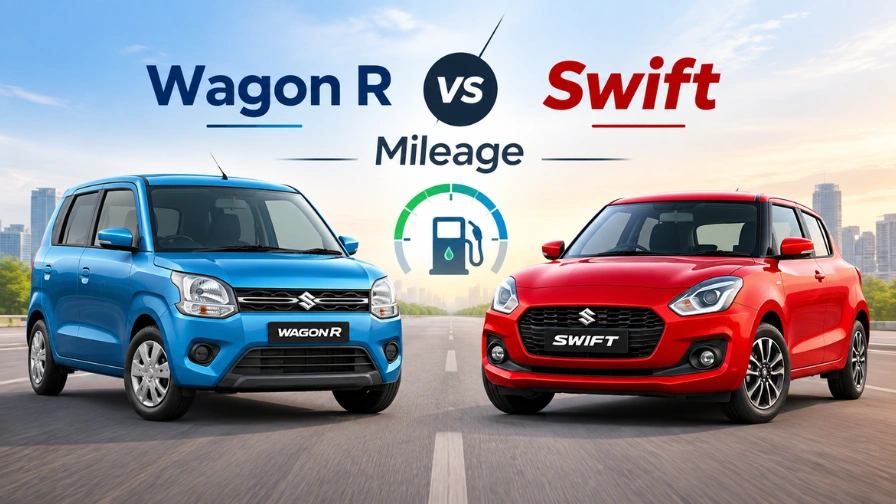
The Maruti Wagon R and Maruti Swift are both known for delivering strong fuel economy, but their mileage stories are not as straightforward as the figures printed in their brochures. On paper, the Maruti Swift looks slightly more fuel-efficient in petrol form, with a claimed mileage of up to 25.75 kmpl. The Wagon R, meanwhile, offers up to 25.19 kmpl with its 1.0-litre petrol AMT.
But there is an interesting twist when you move away from laboratory figures. Real-world traffic, air-conditioning, passengers, driving style, road conditions and frequent acceleration can bring the mileage of both cars significantly lower. In some independent tests, the Wagon R has actually returned better city mileage than the Swift AMT.
Then there is CNG.
The Wagon R claims 34.05 km/kg, compared with 32.85 km/kg for the Swift, giving the Wagon R a clear advantage on paper for buyers who cover high monthly distances on CNG. So, which one actually saves more money on fuel? The answer depends less on the badge and more on which fuel you use, where you drive and how many kilometres you cover every month.
Official ARAI Mileage Numbers: On Paper Comparison
Let's start with the numbers manufacturers quote because they provide a standardised way to compare the two cars.
Wagon R Mileage
The current-generation Wagon R is available with 1.0-litre and 1.2-litre petrol engines, along with a factory-fitted S-CNG option.
|
Wagon R Powertrain |
ARAI Mileage |
|
1.0L Petrol Manual |
24.35 kmpl |
|
1.0L Petrol AMT |
25.19 kmpl |
|
1.2L Petrol Manual |
23.56 kmpl |
|
1.2L Petrol AMT |
24.43 kmpl |
|
S-CNG |
34.05 km/kg |
The most fuel-efficient petrol Wagon R on paper is therefore the 1.0-litre AMT at 25.19 kmpl. The CNG version goes considerably further on every kilogram of fuel, with a claimed 34.05 km/kg.
Swift Mileage
The current Swift uses Maruti Suzuki's 1.2-litre, 3-cylinder Z-Series petrol engine.
|
Swift Powertrain |
ARAI Mileage |
|
Petrol Manual |
24.8 kmpl |
|
Petrol AMT |
25.75 kmpl |
|
S-CNG Manual |
32.85 km/kg |
The Swift therefore has a small advantage over the Wagon R in petrol mileage. Its 25.75 kmpl AMT figure is 0.56 kmpl higher than the Wagon R 1.0 AMT's 25.19 kmpl figure. That sounds impressive when you see it on a specification sheet, but in practical terms the difference is extremely small. At 1,000 km, the difference between 25.19 kmpl and 25.75 kmpl amounts to only a small amount of petrol. The picture changes completely with CNG.
Here, the Wagon R's claimed 34.05 km/kg is higher than the Swift's 32.85 km/kg.
ARAI Mileage Winner Depends on the Fuel
So, if we judge only the official figures:
Petrol: Swift has the edge.
CNG: Wagon R has the edge.
And that is why simply saying "Swift has better mileage" or "Wagon R has better mileage" doesn't tell the complete story.
Real-World Mileage: What Owners Actually Get (The Experience Factor)
This is where the comparison gets much more interesting. ARAI mileage figures are generated under controlled testing conditions. Your daily commute, however, probably looks nothing like a controlled test cycle. You may spend 20 minutes moving through bumper-to-bumper traffic, stop at traffic lights, use the air conditioner continuously, carry multiple passengers and accelerate hard to find gaps in traffic. All of these factors affect fuel consumption.
Independent testing shows just how large the difference between claimed and tested mileage can become.
For example, CarWale's test data for the Wagon R AMT records 19.31 kmpl in the city and 22.34 kmpl on the highway, compared with its claimed 25.19 kmpl figure. The Swift's real-world results also show a substantial gap from its brochure number. Autocar India's testing recorded 15.9 kmpl for the Swift AMT, with its detailed testing showing 12.7 kmpl in the city cycle and 19.1 kmpl on the highway.
That tells us something important: A higher ARAI number does not automatically mean a lower monthly fuel bill. Your actual mileage depends heavily on how and where you drive.
City Driving Conditions (Heavy Traffic)
For people who primarily drive in cities, this is probably the most important part of the comparison. Stop-and-go traffic is particularly demanding on a petrol engine. The car repeatedly accelerates from low speeds, brakes, idles at traffic lights and moves forward again.
Here, the Wagon R has one natural advantage: its relatively light body. The 1.0-litre Wagon R is around the 850 kg mark, depending on configuration. That means the engine has less mass to move every time you pull away from a standstill. The smaller 1.0-litre engine can also make sense for buyers whose driving is almost entirely urban and who don't need the additional performance of the 1.2-litre Wagon R.
The Swift, however, has been engineered with efficiency in mind as well. Its Z-Series 3-cylinder engine uses an idle start-stop system and is designed to reduce fuel consumption during everyday driving. Autocar India's testing also found the new Swift considerably more efficient than the previous-generation Swift in its city cycle.
But the numbers show that the Swift's impressive ARAI figure doesn't necessarily translate into an equally large advantage in heavy traffic.
So Which Is Better in the City?
Based on the available independent test figures, the Wagon R can have an advantage in stop-start urban driving. But there is an important qualification: the two figures should not be treated as a laboratory-style head-to-head comparison unless the cars were tested under identical conditions. Traffic density, route, weather, air-conditioner usage, tyre pressure and driving style can all change the result.
For a buyer, the practical conclusion is simpler:
If your daily driving consists mainly of crowded city roads, don't buy the Swift purely because its ARAI number is slightly higher. The real-world difference may be much smaller than the brochure suggests.
Highway and Long-Distance Cruising
Highway driving changes the equation. Once the car reaches a steady cruising speed, there are fewer repeated acceleration and braking cycles. The engine can operate more consistently, and fuel efficiency generally improves. The Wagon R's tested figure of 22.34 kmpl on the highway shows this clearly.
The Swift is also efficient at cruising speeds. Autocar India's testing recorded around 19 kmpl for the manual and 19.1 kmpl for the AMT in its highway cycle. However, these tests used different conditions and should not be interpreted as a perfectly controlled Wagon R-versus-Swift highway shootout.
There is another factor that can easily overwhelm a small difference between the cars: speed.
Driving at 100–110 km/h, carrying a full load and using the AC continuously can reduce fuel economy considerably compared with relaxed cruising. So if you regularly travel long distances, your driving style may have a bigger impact on your fuel bill than the 0.5 kmpl difference between the two cars' claimed petrol mileage figures.
Engine Specs & Technical Breakdown Impacting Fuel Efficiency
Mileage isn't just about the number printed next to "kmpl". The engine, weight, transmission and overall vehicle design all influence how much fuel the car needs.
|
Specification |
Wagon R |
Swift |
|
Engine options |
998cc 3-cylinder / 1197cc 4-cylinder |
1197cc 3-cylinder Z-Series |
|
Transmission |
5-speed MT / AMT |
5-speed MT / AMT |
|
Petrol tank |
32 litres |
37 litres |
|
Approx. kerb weight |
Around 850 kg for 1.0L |
Around 925 kg |
|
Maximum power |
Up to around 89 bhp |
Around 81.6 bhp |
|
Maximum torque |
Up to around 113 Nm |
Around 111.7 Nm |
The Wagon R gives buyers more engine choice.
Its 1.0-litre K10C is the smaller and lighter option, while the 1.2-litre Wagon R uses a four-cylinder engine aimed at buyers who want more performance.
Swift takes a different approach. Its current 1.2-litre Z-Series engine uses three cylinders, rather than the four-cylinder configuration used by the older Swift's engine. The engine is designed around efficiency and uses an idle start-stop system. This helps explain why the Swift can achieve such a high ARAI mileage figure despite being larger than the 1.0-litre Wagon R engine.
Why Doesn't the Smaller Wagon R Automatically Win?
Because engine displacement isn't the only factor determining fuel economy. Aerodynamics, gearing, engine calibration, rolling resistance, vehicle weight and transmission behaviour all influence the final result. Likewise, a larger engine doesn't automatically mean poor mileage.
The Swift's 1.2-litre Z-Series engine demonstrates this perfectly: its claimed petrol mileage is higher than the 1.0-litre Wagon R's manual figure. This is also why comparing cars purely on engine size can be misleading.
Monthly Running Cost Calculator: Wagon R vs Swift
Let's convert mileage into something that actually matters to a buyer: money spent every month.
Assume:
● Monthly driving: 1,000 km
● Delhi petrol price: ₹102.12/litre
● Delhi CNG price: ₹86.98/kg
These calculations use the claimed and real-world mileage figures supplied for this comparison.
Petrol Running Cost
|
Scenario |
Wagon R |
Swift |
|
ARAI mileage |
24.35 kmpl |
24.8 kmpl |
|
Fuel required for 1,000 km |
41.1 litres |
40.3 litres |
|
Approx. monthly cost |
₹4,194 |
₹4,118 |
|
Real-world mileage assumption |
19 kmpl |
18 kmpl |
|
Approx. monthly cost |
₹5,372 |
₹5,674 |
On the official mileage figures, the Swift saves only around ₹76 per month at a 1,000 km monthly running. That's barely enough to make fuel economy the deciding factor. Using the real-world mileage assumptions above, the Wagon R comes out around ₹300 per month cheaper.
Over 12 months, that's roughly ₹3,600. Again, the difference isn't huge.
CNG Running Cost
CNG creates a slightly different picture.
|
Scenario |
Wagon R CNG |
Swift CNG |
|
ARAI mileage |
34.05 km/kg |
32.85 km/kg |
|
Fuel required for 1,000 km |
29.4 kg |
30.4 kg |
|
Approx. monthly cost |
₹2,554 |
₹2,648 |
|
Real-world mileage assumption |
24 km/kg |
26 km/kg |
|
Approx. monthly cost |
₹3,624 |
₹3,345 |
On claimed mileage, the Wagon R saves around ₹94 per month compared with the Swift.
But when the assumed real-world mileage is used, the Swift comes out ahead by roughly ₹279 per month. And this is exactly why real-world mileage matters. A car that looks more economical on paper isn't necessarily the car that puts the least strain on your wallet every month.
What Happens Over 5 Years?
Assuming 1,000 km per month, you're driving approximately 60,000 km in five years. At that distance, even a ₹200–₹300 monthly difference becomes meaningful. But remember that these calculations are based on specific mileage assumptions.
Your actual five-year fuel bill can be substantially different because of:
● Petrol and CNG price changes
● Traffic conditions
● AC usage
● Tyre pressure
● Driving style
● Vehicle load
● Highway/city usage
● Maintenance condition
Therefore, it's better to treat the calculator as a comparison tool, not a promise of what your actual fuel bill will be.
The Bigger Question: Is a 0.5 kmpl Difference Really Important?
This is probably the most useful takeaway from the entire comparison. The Swift's petrol AMT claims 25.75 kmpl, while the Wagon R 1.0 AMT claims 25.19 kmpl.
The difference is just 0.56 kmpl.
At 1,000 km per month, that doesn't translate into a dramatic saving. Even if one car saves ₹75–₹100 per month in a particular scenario, fuel economy alone isn't going to transform the total cost of owning the car. The calculation becomes much more significant for someone driving 2,000–3,000 km every month, particularly if the car is used commercially or for a long daily commute.
For a person driving only 500–800 km a month, the difference is even less meaningful.
This is why your annual kilometres should be considered before you make a mileage-based purchase decision.
So, Which Maruti Saves More Money on Fuel?
There isn't one universal winner because the answer changes with the fuel and driving environment.
If You Choose Petrol
The Swift has the higher claimed ARAI mileage, especially in AMT form. However, independent testing shows that real-world mileage can be substantially lower than the brochure figures, and the difference between the two cars can become much smaller in everyday driving. For city-heavy driving, the Wagon R's lower weight and compact 1.0-litre configuration can make it a very economical option.
If You Choose CNG
The Wagon R has the higher claimed CNG efficiency, at 34.05 km/kg versus 32.85 km/kg for the Swift. For someone covering very high monthly kilometres, that difference can matter. However, actual CNG mileage can vary considerably, so buyers should not assume the claimed figure will be their everyday number.
If You Drive Mostly in the City
The Wagon R makes a strong case because of its light weight, compact dimensions and efficient 1.0-litre engine option. It's particularly suited to someone whose priority is keeping everyday running costs low.
If You Drive Mostly on Highways
Both cars are capable of delivering strong fuel economy at steady cruising speeds. At this point, driving speed becomes extremely important. A relaxed highway driver can potentially achieve considerably better economy than someone who drives aggressively at high speeds.
Beyond Mileage: Which One Should You Buy?
If you are choosing between the Wagon R and Swift purely on mileage, the answer isn't as simple as looking at the highest ARAI number. The Swift wins on claimed petrol mileage, with up to 25.75 kmpl for the AMT compared with 25.19 kmpl for the Wagon R 1.0 AMT.
The Wagon R wins on claimed CNG mileage, with 34.05 km/kg against 32.85 km/kg for the Swift. But real-world testing changes the picture. Independent tests show that both cars can deliver considerably less than their official figures once they are driven in genuine traffic and everyday conditions.
More importantly, the monthly difference in petrol running cost at 1,000 km is relatively small. So, if you are buying a car primarily for low-cost city commuting, the Wagon R's lighter body, efficient 1.0-litre engine and strong CNG mileage make it an attractive proposition.
If you want a hatchback of Maruti Suzuki with slightly better claimed petrol efficiency, the Swift has the numbers on its side, but the real-world advantage isn't necessarily large enough to justify choosing it on mileage alone. For a high-mileage CNG user, the Wagon R's claimed efficiency advantage becomes more relevant.
Ultimately, don't let a difference of half a kilometre per litre decide a purchase involving several lakh rupees. Look at the purchase price, maintenance cost, insurance, fuel type, expected annual kilometres and your actual driving conditions. Because when it comes to Wagon R vs Swift mileage, the car that saves you the most money isn't necessarily the one with the biggest number on the brochure. It's the one that matches how you actually drive.
Frequently Asked Questions
Which has better mileage, Wagon R or Swift?
The Swift has a slightly higher claimed petrol mileage, with up to 25.75 kmpl for its AMT version. The Wagon R 1.0-litre AMT claims 25.19 kmpl. However, the Wagon R has the higher claimed CNG mileage at 34.05 km/kg compared with 32.85 km/kg for the Swift.
Is Wagon R more fuel-efficient than Swift in real-world driving?
It can be, particularly in city driving. Independent testing has recorded 19.31 kmpl for the Wagon R AMT in the city, while Autocar India's Swift AMT testing returned 15.9 kmpl overall in its real-world test. However, these tests were conducted under different conditions, so they should not be treated as a perfectly like-for-like comparison.
Which gives better mileage in city traffic: Wagon R or Swift?
The Wagon R can have an advantage in heavy stop-and-go traffic because of its lighter body and efficient 1.0-litre engine option. However, actual mileage depends heavily on traffic, AC usage, driving style and vehicle load.
Which is better for highway mileage, Wagon R or Swift?
Both can be economical on highways when driven at steady speeds. Independent tests have recorded 22.34 kmpl for the Wagon R in a highway test, while Autocar India's Swift testing recorded around 19 kmpl for the manual and 19.1 kmpl for the AMT. Since these tests use different conditions, the figures aren't directly comparable.
Is Wagon R CNG mileage better than Swift CNG?
Yes, based on the claimed figures used in this comparison. The Wagon R CNG is rated at 34.05 km/kg, while the Swift CNG is rated at 32.85 km/kg. This gives the Wagon R an on-paper advantage for CNG-focused buyers.
Which is cheaper to run for 1,000 km per month?
The answer depends on the fuel and the mileage you actually achieve. At the claimed petrol mileage used in this comparison, the Swift costs slightly less to cover 1,000 km. At the assumed real-world petrol figures, the Wagon R comes out cheaper. On CNG, the Wagon R is cheaper using claimed mileage, while the Swift comes out ahead using the stated real-world assumptions.
Why is real-world mileage lower than ARAI mileage?
ARAI mileage is measured under controlled testing conditions. Real driving involves traffic, acceleration, braking, AC usage, passengers, road gradients and different driving habits. As a result, everyday mileage is normally lower than the certified figure.
Which is better for a high-mileage city user, Wagon R or Swift?
For a buyer covering high kilometres primarily in the city, the Wagon R's efficient 1.0-litre option and higher claimed CNG mileage make it worth considering. However, the final choice should be based on the fuel type, actual daily route and expected monthly running rather than mileage figures alone.