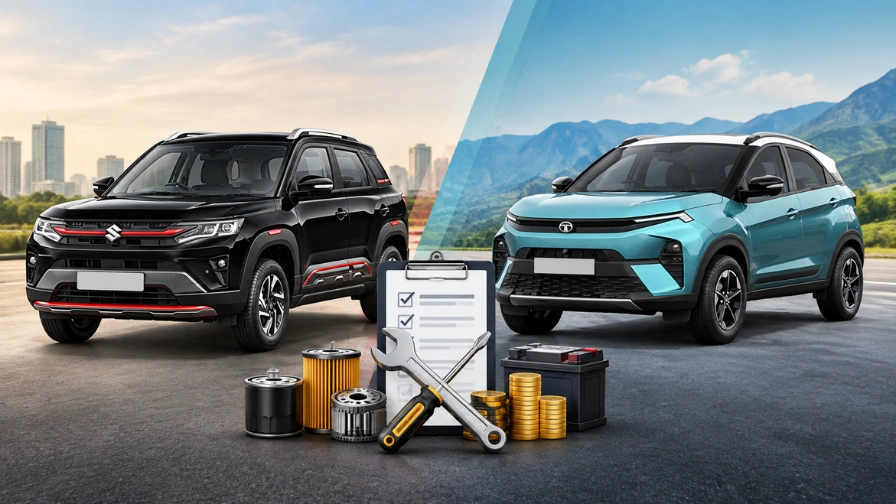
If you're choosing between the Maruti Brezza and the Tata Nexon, the purchase price is only the beginning. Both start at roughly the same price, with the Brezza ranging from about ₹7.4 lakh to ₹13.71 lakh ex-showroom as of September 2026, while the Nexon ranges from about ₹7.4 lakh to ₹14.52 lakh. The bigger question is what each SUV is likely to cost you over the next five years.
Based on the available estimates, the Brezza comes out cheaper in like-for-like maintenance comparisons. The difference in scheduled servicing is roughly ₹5,000 to ₹16,000 over five years, while fuel adds another significant difference of about ₹40,000 in favour of the Brezza. However, maintenance costs vary depending on the service schedule, workshop, consumables and the way the car is used. This guide breaks down those numbers so you can see where the difference actually comes from.
Brezza vs Nexon: 5-Year Maintenance Cost at a Glance
The comparison below assumes a petrol manual, about 10,000 km of driving per year, or 50,000 km over five years, with servicing carried out at an authorised workshop.
|
|
Brezza (1.5L petrol) |
Nexon (1.2L turbo petrol) |
|
Scheduled servicing, 5 years |
₹17,092 to ₹25,809 |
₹31,358 to ₹33,099 |
|
Average per year |
₹3,400–5,200 |
₹6,300–6,600 |
|
One set of 4 tyres |
₹24,000–28,000 |
₹26,000–32,000 |
|
Battery (one replacement) |
about ₹4,500 |
₹6,500–8,000 |
|
Fuel, 50,000 km at ₹95/L |
₹3.39 lakh (14 kmpl) |
₹3.80 lakh (12.5 kmpl) |
|
Standard warranty |
3 years / 1,00,000 km |
3 years / 1,00,000 km |
|
Service interval |
10,000 km or 12 months |
minor check every 7,500 km/6 months, major every 15,000 km/12 months |
The fuel figures above use real-world mileage rather than the official test-cycle figure. Real-world mileage is about 13–15 kmpl for the Brezza petrol manual and 11–14 kmpl for the Nexon petrol manual.
What Does "Maintenance Cost" Actually Include?
Maintenance can mean different things to different owners, so it is important to define what is being counted in this comparison. Here, scheduled servicing includes engine oil, filters, brake fluid, coolant, spark plugs and labour according to the service schedule. Wear-and-tear items include tyres, battery, brake pads, wipers and clutch.
Unscheduled repairs cover anything that needs fixing outside warranty, while add-ons refer to dealer extras that are not part of the manufacturer's regular service requirements. Fuel, insurance, depreciation and accident repairs are not included in the maintenance figure. Fuel and other running costs are considered separately later in the total-cost section.
There is also a reason why published maintenance figures can differ. Some estimates are based on the manufacturer's price schedule, while others are based on actual workshop bills. Some figures may also relate to older generations of the same vehicle. For that reason, the numbers below should be treated as planning estimates. A written quotation from your local dealer remains the final figure.
Brezza 5-Year Maintenance Cost: Year-by-Year Breakdown
To estimate the Brezza's five-year maintenance cost, we have used the available service-cost figures for its 1.5-litre petrol engine. These figures provide a practical estimate of what owners can expect to spend on routine servicing over the first five years.
|
Year |
Service due |
Estimated cost |
|
1 |
1,000 km and 10,000 km services (labour free, parts only) |
₹3,248 |
|
2 |
20,000 km (labour free) |
₹1,624 |
|
3 |
30,000 km |
₹3,499 |
|
4 |
40,000 km (the costliest visit) |
₹5,222 |
|
5 |
50,000 km |
₹3,499 |
|
Total |
|
₹17,092 |
Labour is free for the first three services. From the 30,000 km service onward, it is about ₹2,365 per visit, with parts and consumables of roughly ₹1,134 to ₹3,052 on top. The fourth year is the most expensive because it is the major service and includes brake fluid, air filter and coolant replacement at 40,000 km. Depending on which estimate is used, the Brezza's five-year servicing bill therefore lands between about ₹15,500 and ₹29,500.
Nexon 5-Year Maintenance Cost: Year-by-Year Breakdown
The Nexon's five-year maintenance estimate is based on its scheduled service requirements and the typical costs associated with the recommended maintenance work. The figures below give you a practical idea of how the maintenance bill can build up year by year.
|
Year |
Key work |
Estimated cost |
|
1 |
Engine oil, oil filter |
₹3,500 |
|
2 |
Brake fluid, AC filter, alignment |
₹5,500 |
|
3 |
Coolant top-up, air and fuel filters |
₹6,000 |
|
4 |
Major service |
₹9,500 |
|
5 |
Suspension check, brake pads |
₹7,000 |
|
Total |
|
₹31,500 |
The actual cost can vary depending on the work required at each service. This estimate assumes a 10,000 km service interval, and the timing-belt requirement can vary depending on the engine. So, if you're planning your maintenance budget, check the service schedule for your specific Nexon engine before assuming any major replacement cost.
The Nexon's actual service schedule calls for services at 1,500 km, 7,500 km and 15,000 km with free labour, followed by services every 12 months or 15,000 km. Brake and clutch fluids are replaced at 30,000 km or 2 years. Petrol spark plugs are due every 30,000 km or 2 years, while the air filter and coolant are due around 45,000 km or 3 years.
For reference, genuine parts run roughly ₹2,400 for petrol engine oil, ₹200–220 for an oil filter, ₹700 for an air filter, ₹550 for a cabin filter and ₹1,300 for spark plugs.
Brezza vs Nexon: Scheduled Service Cost Comparison
Looking specifically at scheduled servicing gives us the following picture:
|
Factor |
Brezza |
Nexon |
|
Labour-free services |
First three (1,000, 10,000, 20,000 km) |
First three (1,500, 7,500, 15,000 km) |
|
Regular interval |
Every 10,000 km or 12 months |
Every 15,000 km or 12 months |
|
Schedule-based 5-yr total |
₹15,550–17,092 |
₹31,358–33,099 |
|
Workshop-bill-based guidance |
₹6,500–9,500 per year at authorised centres |
₹7,000–8,500 per year |
This is where the comparison becomes less straightforward. Price-schedule data suggests that the Nexon costs roughly ₹3,000 more per year. Workshop-bill estimates, however, put both cars in a similar range of about ₹6,500 to ₹9,500 a year. In other words, the difference between the two can become much smaller depending on the workshop, the actual work carried out and the additional items included on the invoice.
Which Has More Expensive Wear-and-Tear Items?
Regular servicing is only one part of ownership. Tyres, batteries, brake components and other wear items also contribute to the cost of keeping an SUV on the road.
|
Item |
Brezza |
Nexon |
|
Tyres (set of 4) |
₹24,000–28,000; typically last 40,000–50,000 km |
₹26,000–32,000; about 45,000 km |
|
Battery |
₹4,500 at 3–4 years |
₹6,500–8,000 at 3–4 years |
|
Brake pads |
an older estimate put replacement around ₹2,500, with roughly four years of life |
Covered by Tata's paid P2P plan if you buy it |
|
Suspension |
Front-end noise reported after about 45,000 km |
Rear suspension knock after 50,000 km on bad roads; bush replacement ₹2,500–4,500 |
|
Clutch (manual) |
Wear reported around 55,000–70,000 km |
Driving-style dependent |
|
AC |
Cooling can drop after 2–3 years, needing a gas top-up |
Not flagged in sources |
Based on these figures, the Nexon costs a little more for tyres and the battery, adding about ₹4,000 to ₹7,500 over five years by the calculation above. Neither SUV shows a major wear-item cost problem within 50,000 km. The Brezza clutch figure also mostly falls beyond the five-year ownership period for someone driving 10,000 km a year.
Tata also offers prepaid maintenance coverage. Its Gold AMC is priced at roughly ₹18,000 for two years and is described as covering scheduled service, labour and wear items such as brake pads. Maruti's warranty also has exclusions, with consumables such as the clutch, brake discs and brake pads not covered.
Petrol vs CNG: Does Fuel Choice Change Maintenance Cost?
Fuel type can change the ownership equation significantly, particularly for drivers covering higher annual kilometres.
Brezza
The New Brezza offers a 1.5L petrol, a new 1.0L turbo petrol and a factory S-CNG with an underbody tank and no spare tyre. The CNG version costs roughly ₹600–900 more per service for CNG checks, along with a cylinder hydro-test every three years at about ₹2,500–3,500. Based on these figures, the five-year CNG maintenance penalty works out to roughly ₹5,500–8,000.
That additional maintenance cost is relatively small compared with the fuel savings. The same estimates suggest that CNG owners save about ₹30,000–40,000 a year on fuel at 12,000 km a year. The CNG premium is about ₹1.05 lakh, with the LXi priced at ₹8.30 lakh and the LXi CNG at ₹9.35 lakh. At typical usage, that puts the payback period at around three years.
Nexon
The Nexon is available with petrol, diesel, twin-cylinder iCNG and an EV. Annual maintenance is estimated at about ₹7,000–8,500 for petrol, ₹9,500–11,000 for diesel and ₹7,500–9,000 for iCNG. iCNG owners also face a three-yearly cylinder hydro-test costing roughly ₹3,000–4,500.
For the diesel Nexon, the timing belt is one of the major maintenance items. The belt kit costs about ₹7,000 in parts, while one estimate puts the belt-inclusive service at ₹16,500–26,000. There are conflicting replacement intervals, with estimates ranging from every 3 years/45–60,000 km to year 6/90,000 km. The exact interval should therefore be confirmed before buying the vehicle or a used example.
Nexon EV
The Nexon EV cannot be directly compared with the Brezza because the Brezza has no EV version. Published estimates put annual EV servicing at ₹1,500–2,500, but the available figures vary widely. As a result, the EV falls outside the scope of this petrol-focused comparison.
Brezza vs Nexon Maintenance Cost at 50,000 km
At 50,000 km, the Brezza has gone through six visits: the initial 1,000 km service followed by services every 10,000 km. The cumulative servicing cost is ₹17,092 based on the schedule-based estimate. For the Nexon, major services fall at 15,000, 30,000 and 45,000 km, with minor check-ups between them. Its cumulative servicing cost comes to around ₹31,000–34,000.
The picture changes only in terms of timing if you drive much more. For example, if you cover 50,000 km in three years instead of five, the service cost to reach 50,000 km remains roughly the same because servicing is largely linked to kilometres. You simply reach those services sooner.
What does change is when wear items become due. Tyres, which are expected to last about 40–50,000 km on both cars according to the figures above, and the battery may need replacement earlier for a high-mileage driver. Warranty duration also becomes important. Both cars have standard warranties of 3 years or 1 lakh km, meaning a heavy driver could reach the kilometre limit before reaching the time limit.
What Could Increase the 5-Year Maintenance Bill?
The figures above assume relatively predictable ownership. Several factors can push the final bill higher.
● Dealer add-ons: Interior enrichment, engine dressing and similar extras can add ₹3,000–5,000 to a Nexon bill without any mechanical benefit, and the same applies to the Brezza.
● Wrong or cheap oil: Turbo petrol engines are sensitive to oil quality. Use the grade specified in the owner's manual. Sources differ on the exact Nexon grade.
● Missed services: Skipping scheduled maintenance can affect warranty claims and potentially lead to larger repairs later.
● Poor roads: Suspension bushes and tyres can take additional punishment on poor roads.
● Out-of-warranty repairs: Standard cover ends at 3 years/1 lakh km for both cars, while Maruti offers extended packages up to 6 years/1.6 lakh km.
● Turbo Brezza unknowns: The 1.0L Boosterjet is new to this model, and no published service schedule exists yet. Costs may fall in a similar range, but that remains an assumption.
● Nexon gearboxes: Some individual owner reviews mention AMT problems on the diesel. These are anecdotal and do not establish a verified defect rate, but they are a reason to test-drive a used automatic and check its service history carefully.
Brezza vs Nexon: Service Network and Ownership Convenience
Maintenance cost is not just about the amount on the invoice. The distance to the workshop and how easily you can get the car serviced can also affect ownership convenience.
Maruti Suzuki had 5,926 service touchpoints across about 3,000 cities and towns in April 2026, with a target of around 8,000 by FY2030–31. Its network includes workshops, sales-and-service points and service-on-wheels.
Tata Motors Passenger Vehicles has rapidly scaled its standalone presence to bridge the gap with market leaders Maruti Suzuki and Hyundai. As of mid-2026, Tata Passenger Vehicles manages over 1,600+ sales touchpoints and 1,150+ dedicated service touchpoints across 1,200+ Indian cities.
Owner feedback also suggests that turnaround can be slower at authorised workshops in smaller towns. Tata's passenger-car arm recently rebranded as TATA.CARS, but its existing sales and service setup is unchanged. At the same time, the Nexon has fewer scheduled visits per year. That can make a difference for owners who have to travel a significant distance to reach an authorised workshop.
For either SUV, checking the distance to your nearest workshop before buying can be worthwhile because convenience becomes a real ownership cost when the car needs regular servicing.
5-Year Maintenance Cost vs Total Cost of Ownership
Maintenance is only one part of the money you spend on a car. To understand the broader running-cost difference, we can combine fuel, servicing, one set of tyres and one battery. The assumptions remain the same: 50,000 km, petrol manual and ₹95/L fuel.
|
|
Brezza |
Nexon |
|
Fuel |
₹3.39 lakh |
₹3.80 lakh |
|
Servicing |
₹17,000–25,800 |
₹31,400–34,000 |
|
Tyres (one set) |
₹24,000–28,000 |
₹26,000–32,000 |
|
Battery (one) |
₹4,500 |
₹6,500–8,000 |
|
Total running cost |
₹3.85–3.98 lakh |
₹4.44–4.54 lakh |
|
Per km |
₹7.7–8.0 |
₹8.9–9.1 |
The resulting difference is about ₹56,000 to ₹59,000 over five years, with about ₹41,000 of that difference coming from fuel.
Fuel prices can change the final calculation. Every ₹1/L change shifts five-year fuel expenditure by about ₹3,571 for the Brezza and ₹4,000 for the Nexon. Two major ownership costs have deliberately been left out because reliable, directly comparable five-year figures were not available.
Insurance: Nexon renewals are estimated at ₹16,000–22,000 a year, while some estimates put the Brezza at ₹10,000–12,000 a year in years 2 to 5. Actual premiums depend on the insured value, add-ons and your no-claim bonus.
Resale: There is no reliable five-year resale data for the 2026 models, so resale value has been left out rather than making an assumption.
Brezza vs Nexon: Who Should Choose Which?
The Brezza makes more sense for a buyer who wants a lower and more predictable running cost, access to a service centre even in a smaller town, or the fuel savings offered by CNG for a high-mileage commute. It also suits buyers who prefer the simpler and more established 1.5L petrol engine.
The Nexon, meanwhile, can appeal to buyers who place greater importance on its feature set and turbo torque rather than focusing solely on the lowest running cost. It also gives buyers the choice of diesel or EV powertrains and offers a longer 15,000 km service interval, which means fewer scheduled workshop visits.
For buyers choosing the Nexon, a prepaid maintenance plan can also provide greater cost certainty. However, current plan pricing should be checked with the dealer because prices can change.
Final 5-Year Cost Verdict
If you drive around 50,000 km over five years, the Brezza comes out with the lower overall running cost. Its advantage is not limited to servicing alone: it saves roughly ₹5,000–16,000 on scheduled servicing, about ₹4,000–7,500 on wear-and-tear items, and around ₹41,000 on fuel.
Taken together, these differences put the Brezza about ₹56,000–59,000 ahead in the estimated five-year running cost.
For a buyer focused mainly on keeping monthly and long-term ownership expenses under control, this difference is significant. The Brezza also benefits from lower fuel expenditure and a wider service network, which can make routine ownership easier, especially for high-mileage users or those living in smaller cities.
The Nexon, however, should not be considered an expensive car to maintain. Its servicing works out to roughly ₹6,300–6,600 a year, and it offers features, turbo-petrol performance, diesel and EV options, along with a longer 15,000 km service interval.
So, the practical takeaway is simple: if your priority is lower five-year running costs, the Brezza has the numbers in its favour. If you are willing to spend somewhat more on ownership for the Nexon's features, performance or powertrain choices, the maintenance difference should be considered alongside those benefits rather than viewed in isolation.
FAQs
Which is cheaper to maintain, the Brezza or the Nexon?
The Brezza, on every like-for-like comparison. Schedule-based estimates put its five-year servicing at about ₹17,000–26,000 against ₹31,000–34,000 for the Nexon. Workshop-bill estimates show a narrower gap.
How much does a Brezza service cost?
On the published schedule, the early services are about ₹1,624 each, the 30,000 km service ₹3,499 and the 40,000 km major service ₹5,222. Workshop estimates quote higher figures, around ₹2,800–3,800 for the first paid service and ₹4,500–6,500 at 20,000 km.
How much does a Nexon service cost?
A regular petrol service at an authorised centre is typically ₹3,000–4,500, while a heavier 30,000 km service can cost ₹5,000–7,500. Annual estimates in other guides run higher, at ₹7,000–8,500.
Does the Nexon's turbo engine cost more to maintain?
It doesn't necessarily have to, but oil quality becomes more important. Use the grade specified in the owner's manual and do not stretch service intervals.
Will the new turbo Brezza cost more to maintain than the 1.5L?
No published service schedule exists yet, so there is no reliable way to say for sure. Ask the dealer for the specific service schedule before booking the turbo.
Does CNG raise maintenance cost?
Yes, slightly. On the Brezza, it adds about ₹600–900 per service plus a three-yearly cylinder test. The fuel savings generally outweigh the additional maintenance cost.
Should I buy an extended warranty or maintenance plan?
If you plan to keep the car beyond three years or drive heavily, compare the cost of the extended warranty or maintenance plan with the expected maintenance expenses. Get the current plan cost from the dealer and compare it with the estimates above before making a decision.