
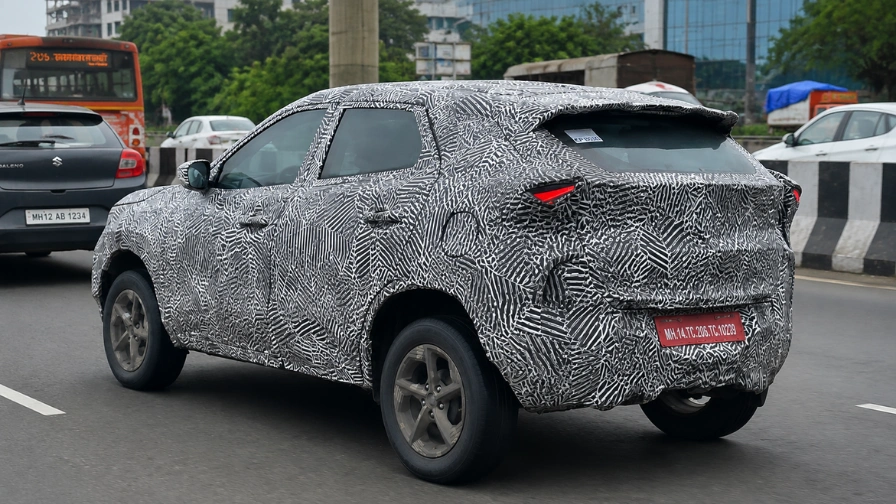
Tata's best-selling SUV is about to get its biggest shake-up since it first went on sale in 2017. After two facelifts (2020 and 2023), the Nexon is now heading into a full generational change, with a new platform, a redesigned body, a reworked cabin, and updated powertrain options all said to be in the works. Test mules have already been spotted on Indian roads under heavy camouflage, and early leaks are starting to reveal how different this next-gen model will really look and feel compared to the current car. Here's everything that's known so far about the next-gen Tata Nexon, based on the latest spy shots, leaks and official signals.
Next-Gen Tata Nexon 2027 – Latest Updates
Tata Motors has commenced road testing of the next-generation Nexon, internally codenamed Garud, with the SUV recently spotted under heavy camouflage revealing significant changes to its body structure and profile. This marks the first real confirmation that development has moved past the drawing board.
Since the Nexon originally launched in 2017 and only received facelifts in 2020 and 2023, a 2027 launch for the second-generation model would give the current Nexon a lifecycle of almost a decade. That's unusually long for a segment as competitive as India's compact SUV space, which tells you Tata has been taking its time to get this one right rather than rushing out an update.
Interestingly, there have already been two recorded test mule sightings, and the second one, from spy photographer Punit Patil, even gave a peek inside the cabin, though the interior shown still looked broadly similar to the current Nexon's, suggesting the car is either retaining some current-gen elements or is simply still very early in its development cycle.
Next-Gen Tata Nexon Launch Date in India
Most reports converge on a 2027 launch window, though the exact timing varies slightly by source. Some outlets peg it for a commercial debut by mid-2027 under the "Project Garud" codename, while others describe it more broadly as arriving sometime in 2027, roughly a decade after the original Nexon's 2017 debut.
There's also some ambiguity around whether the petrol/CNG version and the EV version will launch together. Reports suggest Tata may not launch the electric and internal-combustion versions simultaneously, leaving open the possibility of separate launch timelines. So don't be surprised if the ICE Nexon arrives first, with the EV following a few months later, similar to how Tata staggered the current Nexon and Nexon EV.
Next-Gen Tata Nexon Gets a New Design
This is where the next-gen Nexon breaks most clearly from its predecessor. Spy shots reveal it isn't a mild refresh, it's a redesigned profile with a revised rear section that goes well beyond a conventional facelift.
Key styling changes spotted so far:
● A more upright C-pillar, one of the most noticeable revisions is around the C-pillar, which appears more upright and substantial, giving the SUV a boxier stance.
● A completely reworked rear door and overall side profile compared to the outgoing model.
● A straighter, more conventional SUV roofline. The revised roof and C-pillar arrangement could result in a roomier rear section, particularly in terms of headroom, and gives the prototype a more conventional SUV profile compared with the current Nexon.
● A sharper A-pillar transition. The A-pillar appears to have been revised as well, with a sharper transition towards the roof.
● A boxier, more "SUV-ish" side silhouette overall — the new generation comes with a straighter roofline that should carve out more headroom for rear occupants.
On the front and design language, expect Tata to lean on its newer design cues. Reports note the new Nexon is expected to take design inspiration from Tata's latest models, likely borrowing elements from the Curvv, Sierra and the recently revealed Harrier/Safari facelifts — think slimmer LED light bars, a cleaner grille-less front fascia (especially on the EV), and flush door handles.
Next-Gen Tata Nexon Interior and Features
Tata is expected to give the cabin a ground-up overhaul rather than a cosmetic tweak. The interior should receive a complete redesign with newer displays, connected technology and additional safety features. Autocar India echoes this, noting the car is expected to get an all-new exterior and interior design taking inspiration from newer Tata models, with a more modern cabin and styling aligned to Tata's latest SUVs.
From the early interior spy shots, a few details stand out:
● Most of the dashboard trim has been stripped down in the test mule, leaving just the infotainment screen and parts of the centre console like climate controls visible — typical for an early prototype.
● An electronic parking brake has been spotted, which would be a new addition for the ICE Nexon, distinct from what's currently offered.
● Expect updated digital displays, a newer infotainment system, expanded connected-car functionality, and additional safety technology.
Given Tata's recent product trend (Curvv, Sierra, Punch EV), expect the next-gen Nexon to carry a larger touchscreen (likely 12.3 inches, matching what the current Nexon Camo Edition already offers), a bigger digital driver's display, a level-2 ADAS suite, ventilated seats, a panoramic sunroof, and possibly a 360-degree camera as standard on higher trims.
Next-Gen Tata Nexon Engine and Powertrain Options
Here's where reports diverge slightly, and it's worth understanding both possibilities.
The likely scenario — petrol and CNG carried forward, diesel under a cloud:
Most recent reports agree the next-gen Nexon will continue with petrol, flex-fuel and CNG powertrains, while the future of its 1.5-litre diesel engine remains uncertain since upgrading it to comply with upcoming emission regulations could raise costs significantly — making a diesel discontinuation likely. The 1.2-litre turbo-petrol engine is expected to continue with manual and automatic gearbox options.
The other scenario — diesel sticks around, at least for now:
Other reports suggest Tata could carry over its petrol, turbo-petrol and diesel engines from the current version, since the diesel Nexon still has a loyal following, especially among highway and fleet buyers.
Platform talk:
There's also debate on the underlying architecture. Some reports say it could be built on the ATLAS platform, a modified version of the X1 platform also used by the Curvv, while others report a more radical shift — a brand-new ARGOS platform that would replace the ageing X1 architecture, which traces its roots back to the 1998 Tata Indica — a genuinely significant development if true. A third view holds that the car will retain a significantly modified version of Tata's existing X1 architecture rather than moving to an entirely new platform.
The honest takeaway: Tata hasn't confirmed the platform or final engine lineup yet, and different insider sources are reading the test mules differently. What's consistent across virtually every report is that CNG stays, petrol stays, and diesel is the one genuinely at risk.
Next-Gen Tata Nexon CNG – What to Expect
CNG has become a core part of the Nexon's identity, and nothing suggests that's changing. If anything, it looks set to become more prominent. Reports state the next-gen Nexon is expected to be offered with petrol and CNG powertrains, and this appears across multiple independent sources.
A likely upgrade area: CNG with an automatic transmission. Today's Nexon CNG is manual-only, the current CNG variant isn't offered with an automatic transmission, something that could be addressed with the facelift/next generation, especially since the Punch already offers this combination. Given Tata has already solved this on the Punch, it's a reasonable bet the next-gen Nexon CNG finally gets an AMT or DCT option, something CNG buyers have been asking for.
Expect the CNG variant to also inherit the twin-cylinder tank layout Tata has been rolling out across its range (which frees up boot space compared to the older single-cylinder setup), along with the same safety and infotainment upgrades as the petrol version.
Next-Gen Tata Nexon EV – Expected Battery, Range and Features
The EV side is arguably the most interesting part of this story, because Tata's electric architecture has moved fast in the last two years.
Platform: The next-gen Nexon EV is expected to be built on Tata's updated Acti.EV platform, with improved battery options likely carrying forward the existing 30kWh and 45kWh packs, and potentially a larger option offering better real-world range beyond the current 489 km.
Current baseline (for context): Today's Nexon EV is offered with 30 kWh and 45 kWh battery packs, with a claimed range of 275–489 km (MIDC/ARAI), and the 45kWh pack delivers 142bhp, while the smaller 30kWh version develops 127bhp, with a 215Nm torque figure common to the range and a 205mm ground clearance. The next-gen version is expected to build meaningfully on this.
What might change: Given that Tata's newer Acti.ev-based products like the Sierra EV are being pitched with much longer legs (that SUV is expected to deliver a driving range between 450 km and 600 km depending on the battery pack), it's reasonable to expect the next-gen Nexon EV to push closer to, or past, the 500 km ARAI mark on its top variant, likely helped by improved cell chemistry and better aerodynamics from the redesigned body.
Expect the EV to also share the new interior and safety tech with the ICE version, plus EV-specific touches like a closed-off front grille, unique alloy designs, and possibly a frunk depending on the final platform layout.
Next-Gen Tata Nexon 2027 vs Current Tata Nexon
|
Aspect |
Current Nexon (2026) |
Next-Gen Nexon (2027, expected) |
|
Platform |
X1 platform (updated) |
Modified X1/ATLAS, or all-new ARGOS platform (unconfirmed) |
|
Design |
Coupe-style profile, 2023 facelift look |
Boxier stance, upright C-pillar, straighter roofline, all-new panels |
|
Interior |
Current-gen dashboard, 10.25-inch touchscreen on top trims |
Fully redesigned cabin, larger displays, new switchgear, electronic parking brake |
|
Engines |
1.2L turbo-petrol, 1.5L diesel, petrol-CNG |
Petrol and CNG confirmed; diesel's future uncertain |
|
CNG gearbox |
Manual only |
Automatic/AMT expected to be added |
|
EV battery |
30kWh / 45kWh, up to 489 km range |
Same packs likely carried over, plus a possible larger option for more range |
|
Safety |
5-star Global NCAP & Bharat NCAP, 6 airbags standard, Level 2 ADAS |
Expected to retain and expand on this, with more standard ADAS features |
|
Price |
₹7.40 lakh – ₹15.60 lakh (ex-showroom) |
Expected ₹8.00 lakh – ₹17.24 lakh (ex-showroom) |
Next-Gen Tata Nexon Expected Variants
Tata is likely to retain its familiar variant strategy while updating trim names or feature packs to reflect the new generation. Currently, the Nexon lineup is structured around four core personas, Smart, Pure, Creative, and Fearless — spanning around 60 variants that range from an essentials-focused base model with 6 airbags, electronic stability control and LED headlamps, up to fully loaded trims with wireless Apple CarPlay/Android Auto and connected car features.
Expect the next-gen model to broadly retain this Smart–Pure–Creative–Fearless (or similarly named) structure, spread across:
● Base/entry trims focused on core safety kit
● Mid trims adding touchscreen, connected tech, rear AC vents
● Top trims with sunroof, ventilated seats, ADAS, 360-degree camera
● A dedicated CNG range (likely across most trims, mirroring today's approach)
● A separate EV variant line-up (likely Medium Range and Long Range, similar to today's naming)
Next-Gen Tata Nexon Expected Price in India
Pricing estimates vary slightly depending on the source, but they cluster in a similar band:
● Autocar India pegs the next Nexon at an expected price of ₹8.00 – 17.00 lakh, slightly above the current range.
● Motor Octane estimates it could be priced between ₹8.70 lakh and ₹17.24 lakh (on-road, Mumbai), given the modified platform and additional features.
For context, the current Nexon is priced from ₹7.40 lakh to ₹14.40 lakh (ex-showroom) for petrol and diesel, with CNG variants running from ₹8.99 lakh to ₹14.59 lakh. So the next-gen model is expected to command a premium of roughly ₹60,000–₹1 lakh at both ends of the range — a fair trade-off given the scale of the redesign, new tech, and (likely) new platform underneath.
Next-Gen Tata Nexon Rivals
The next-gen Nexon will continue to fight in India's fiercest SUV segment — sub-4-metre compact SUVs. Reports consistently list the same set of rivals:
● Maruti Suzuki Brezza (also due for its own facelift)
● Hyundai Venue
● Kia Sonet
● Mahindra XUV 3XO
● Skoda Kylaq
There's also a new wave of competition on the horizon — reports mention upcoming rivals like the Mahindra Vision S and the Renault Bridger, both of which could arrive around the same 2027 window and intensify the fight further.
Should You Wait for the Next-Gen Tata Nexon?
This depends heavily on your timeline and priorities.
Reasons to wait:
● A genuinely new design, not just a cosmetic update, this is a once-in-a-decade change for the Nexon.
● Likely a fresh or heavily reworked platform, which usually brings better refinement, safety, and packaging.
● A completely redesigned interior with newer tech, more space, and additional safety features.
● Possibly longer EV range and a CNG-automatic option, both genuine gaps in the current lineup.
Reasons to buy now:
● The current Nexon is still a fresh, well-specced product, it recently added a panoramic sunroof at under ₹10 lakh, the cheapest such offering in India, and Autocar's road tests praise its composed suspension and best-in-class 208mm ground clearance.
● It's currently one of India's best-selling models, it was the second highest-selling car in India in June 2026, so resale value, parts availability, and dealer network support are all strong.
● 2027 is still over a year away, and early-generation vehicles sometimes come with initial teething issues that get ironed out over the first year.
● Waiting means paying a likely price premium for the new model.
If you need a car in the next 6–12 months and like what the current Nexon offers, there's little reason to hold off, it remains one of the most complete packages in its class. But if your purchase timeline is flexible and you specifically want the newest tech, design, or a longer-range EV, waiting for 2027 makes sense.
Next-Gen Tata Nexon 2027 – Expected Specifications
Based on everything reported so far, here's a realistic specification outlook (all figures are projections, not confirmed):
● Platform: Modified X1/ATLAS architecture, or possibly an all-new ARGOS platform
● Engines: 1.2L turbo-petrol (likely carried over/updated), petrol-CNG; diesel status uncertain
● Transmissions: Manual, automatic (AT/DCT), and possibly CNG-automatic for the first time
● EV battery options: 30kWh and 45kWh likely carried over, with a possible larger pack for extended range
● EV range: Expected to move closer to, or beyond, the current 489 km ARAI figure
● Design: Boxier profile, upright C-pillar, straighter roofline, all-new sheet metal
● Interior: Redesigned dashboard, larger touchscreen and driver display, electronic parking brake, upgraded connected-car tech
● Safety: 6 airbags standard, Level 2 ADAS expected across more variants, 5-star safety rating targeted
● Ground clearance: Likely to remain segment-leading, in line with the current 208mm
● Price range: Approximately ₹8.00 lakh – ₹17.24 lakh (ex-showroom, projected)
Final Verdict
The next-gen Tata Nexon isn't shaping up to be a routine mid-cycle update, it's a genuine second-generation model, arriving almost exactly ten years after the original changed the game for Indian compact SUVs. Between the boxier new design, a reworked interior, continued petrol and CNG support (with a long-overdue CNG-automatic option likely on the way), and a more capable EV, Tata appears to be aiming this car squarely at extending its segment leadership rather than just keeping pace.
That said, several key details, the final platform, the diesel engine's fate, and exact battery specifications for the EV are still unconfirmed and will likely firm up only as more test mules surface over the next several months. For now, treat this as a car worth watching closely through 2027, but not a reason to postpone a purchase you need to make today.
FAQs About Next-Gen Tata Nexon
Q1. When will the next-gen Tata Nexon launch in India?
Most reports point to a 2027 launch, with some suggesting a mid-2027 window under the internal codename "Garud."
Q2. Will the next-gen Nexon get a diesel engine?
It's uncertain. Several reports suggest the diesel engine may be discontinued due to the cost of meeting upcoming emission norms, while others say it could be carried over, Tata hasn't confirmed either way.
Q3. Will the next-gen Nexon CNG get an automatic transmission?
It hasn't been confirmed, but given that Tata already offers this on the Punch, it's a strong possibility and would address a long-standing gap in the current Nexon CNG lineup.
Q4. What platform will the next-gen Nexon use?
Reports are split, some say a modified X1/ATLAS platform, others point to an entirely new ARGOS platform that would replace the current X1 architecture.
Q5. Will the Nexon EV launch alongside the petrol/CNG version?
Not necessarily. Reports suggest Tata may stagger the launches, releasing the ICE version and the EV version at different times.
Q6. How much will the next-gen Nexon cost?
Current estimates put it in the ₹8.00 lakh to ₹17.24 lakh (ex-showroom) range, roughly ₹60,000 to ₹1 lakh more than the current model at both ends.
Q7. What will the next-gen Nexon EV's range be?
Not officially confirmed, but it's expected to carry over the existing 30kWh/45kWh batteries with a possible larger option, likely pushing real-world range beyond the current 489 km ARAI figure.
Q8. Who will the next-gen Nexon compete with?
The Maruti Brezza, Hyundai Venue, Kia Sonet, Mahindra XUV 3XO, and Skoda Kylaq, along with newer entrants like the Mahindra Vision S and Renault Bridger expected around the same time.