For nearly a decade, the Toyota Fortuner has sat almost unchallenged at the top of India's body-on-frame, full-size SUV pyramid. Buyers who wanted road presence, reliability, and genuine off-road ability simply didn't have many real alternatives — the Ford Endeavour exited, the MG Gloster never scaled up, and the Skoda Kodiaq/VW Tayron play in a different, more car-like space.
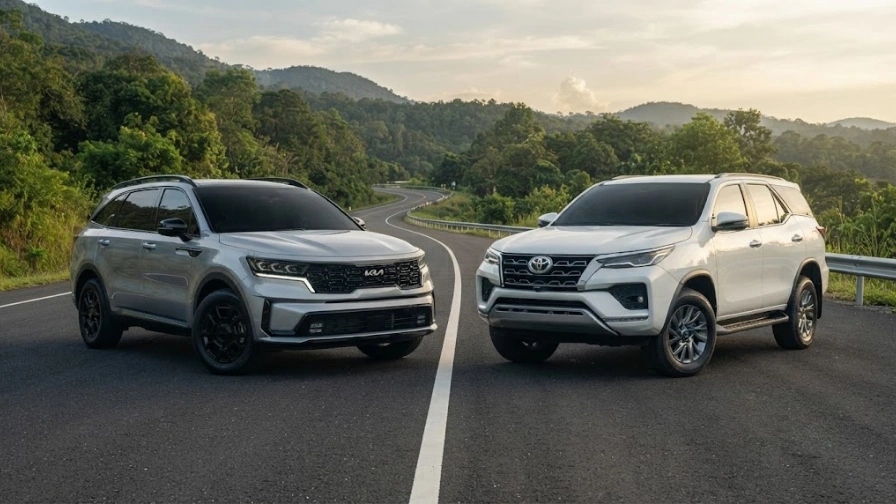
That's about to change. Kia motors has been caught testing a heavily camouflaged Sorento on Indian roads, and every signal — from the 19-inch wheels to the rotary gear selector spotted through the windows — points to a genuine attempt to go after the Fortuner's customer base. This isn't a rebadged Carens with a third row bolted on; it's Kia's global three-row flagship, localised for India.
This blog breaks down everything we know so far — design, dimensions, engines, features, safety, off-road ability, and expected pricing — and stacks it up honestly against the Fortuner, including where the incoming Kia is likely to fall short. No fluff, no marketing spin — just the practical stuff you need before you decide whether to wait or buy now.
Upcoming Kia Sorento 7-Seater SUV at a Glance
The Sorento will be an all-new nameplate for India, slotting above the Seltos and Carens as Kia's flagship model in the country. A few key facts, based on spy shots, dealer chatter, and Kia's global product line:
· Body type: Monocoque (unibody) three-row SUV — not a ladder-frame truck-based SUV like the Fortuner
· Seating: Genuine 7-seat layout (globally offered in 5, 6, and 7-seat configurations, though India is expected to get the 7-seat version primarily)
· Powertrain: Strong hybrid (petrol-electric) is the frontrunner for India, built around a 1.6-litre turbo-petrol paired with an electric motor
· Expected launch window: Anywhere from mid-2026 to around October 2026, depending on the source — Kia itself hasn't officially confirmed a date yet
· Expected price band: Roughly ₹30–45 lakh (ex-showroom), with most estimates clustering around ₹32–40 lakh
· Key rivals it's aimed at: Toyota Fortuner, Skoda Kodiaq, MG Gloster, and eventually the Mahindra XUV 7XO
The most important thing to understand upfront: this is a car-based (monocoque) SUV competing against a truck-based (body-on-frame) SUV. That single architectural difference explains almost every trade-off you'll read about below — ride comfort versus off-road toughness, city manners versus load-lugging ability, fuel efficiency versus outright durability.
Toyota Fortuner - India's Favourite Premium SUV
Toyota Fortuner needs no introduction, but it's worth resetting expectations on where it actually stands today, because Toyota has quietly kept it current with regular updates rather than a full redesign.
· Body type: Body-on-frame (ladder-frame), shared with the Hilux pickup platform
· Engines: 2.7-litre petrol (166 PS/245 Nm) and 2.8-litre diesel (204 PS/500 Nm), the diesel now available with a 48V mild-hybrid system for better efficiency and smoother low-speed response
· Transmission: 6-speed manual or 6-speed automatic; diesel available with 4×2 or 4×4
· Current price range: Roughly ₹34.76 lakh to ₹50.46 lakh (ex-showroom) as of mid-2026, after a January 2026 price hike of up to ₹74,000-87,000 on top variants
· On-road price: Can realistically cross ₹55–60 lakh depending on your city and variant
· Variants: Base, mid trims, the sportier Legender, and the flagship GR-S 4×4
The Fortuner's real strength has never really been about being the most modern or tech-loaded SUV in its class. It wins on three things Indian buyers weight heavily: unmatched resale value, a bulletproof reliability reputation built over 15+ years, and genuine 4×4 hardware that isn't just for badge value. It's also become something of a status symbol — many buyers explicitly cite the "VIP" image it projects.
Upcoming Kia Sorento 7-Seater SUV vs Toyota Fortuner – Design Comparison
Kia Sorento (expected): The India-spec test mule shows a bold, boxy stance with squared-off wheel arches, a tall bonnet, and a flat tailgate — clearly designed to look more rugged and substantial than a typical crossover, likely a deliberate move to not look "soft" next to the Fortuner. Expect:
· Vertically stacked LED headlamps with T-shaped or Y-shaped LED daytime running lights that double as turn indicators
· A blacked-out "Tiger Nose" grille with horizontal and vertical slats
· Connected, C-shaped tail-lamps running across the width of the tailgate
· Large 19-inch alloy wheels as standard, wrapped in 235/55 R19 tyres
· Chrome window surrounds, black roof rails, and a subtle roof-mounted spoiler with an integrated stop lamp
The overall effect leans upmarket and tech-forward rather than "tough truck" — think premium family SUV with a rugged edge, not an off-roader with a premium finish.
Toyota Fortuner: The Fortuner's design language has aged well precisely because Toyota hasn't chased trends. It's upright, wide, and intentionally imposing — a look that says "this is a serious off-roader" rather than "this is a tech showcase." The Legender trim softens this slightly with a more road-focused face and details, while the GR-S doubles down on aggression with unique styling cues.
Verdict: The Sorento will likely look more modern and tech-savvy on first glance, with cleaner lighting signatures and a more contemporary face. But the Fortuner's road presence comes from something design alone can't replicate — the perceived toughness of a ladder-frame SUV. For buyers who want to be seen in a commanding vehicle, the Fortuner's reputation still carries weight the Sorento hasn't earned yet in India.
Upcoming Kia Sorento 7-Seater SUV vs Toyota Fortuner Dimensions Comparison
|
Parameter |
Kia Sorento (Global-spec, expected for India) |
Toyota Fortuner |
|
Length |
4,815 mm |
4,795 mm |
|
Width |
1,900 mm |
1,855 mm |
|
Height |
1,700 mm |
1,835 mm |
|
Wheelbase |
2,815 mm |
2,745 mm |
|
Boot space (all seats up) |
Expected to be generous, third-row-down capacity likely class-competitive |
296 litres |
|
Ground clearance |
Lower (monocoque platform) |
Higher (ladder-frame, off-road oriented) |
Two things stand out here. First, the Sorento is actually longer, wider, and has a longer wheelbase than the Fortuner — on paper, that should translate into more third-row and cabin space. Second, the Fortuner is noticeably taller, which is a direct result of its ladder-frame construction and higher ground clearance — a trade-off that costs it a lower centre of gravity and city-friendly manners, but buys genuine off-road capability.
Practical takeaway: If interior room and a longer wheelbase for third-row comfort matter more to you than ground clearance, the Sorento's dimensions look promising on paper. If you regularly deal with flooded roads, broken terrain, or unpaved stretches, the Fortuner's extra height and ground clearance aren't just numbers — they're real-world usability.
Upcoming Kia Sorento 7-Seater SUV Interior vs Toyota Fortuner Interior
Kia Sorento (expected): Spy shots have already revealed a rotary-style gear selector — a strong signal of Kia's premium hybrid powertrain and upmarket positioning. Expect a cabin built around:
· A curved panoramic display housing dual 12.3-inch (or similar) screens for instrument cluster and infotainment
· Kia's latest ccNC (connected car Navigation Cockpit) infotainment software
· A four-spoke steering wheel with mounted controls
· Multi-zone climate control, USB ports across all three rows
· Ventilated and possibly heated seats on higher trims
· A panoramic sunroof
This is a genuinely modern, tech-dense cabin that should feel a generation ahead of the Fortuner's interior in terms of screen quality, UI, and connected features.
Toyota Fortuner: The Fortuner's cabin is functional rather than flashy — an 8-inch touchscreen with Android Auto/Apple CarPlay, dual-zone automatic climate control, ventilated front seats on select variants, and an 11-speaker JBL sound system. It's comfortable and well-built, but by 2026 standards, the screen size and UI feel noticeably behind rivals with newer platforms.
Verdict: This is likely to be one of the Sorento's clearest wins. Toyota has been conservative about interior tech on the Fortuner for years, prioritising durability and simplicity over screen real estate. If you spend a lot of time inside your SUV and care about cabin tech, connected features, and third-row comfort, the Sorento's expected interior should feel like a meaningful step up — assuming Kia doesn't strip features out for the India-spec version to hit a price target.
Upcoming Kia Sorento 7-Seater SUV Features vs Toyota Fortuner
Expected Sorento features:
· Panoramic sunroof
· Dual 12-inch-class digital displays
· Wireless charging, connected-car tech (Kia Connect)
· Ventilated front seats
· Multi-zone climate control with rear vents across all rows
· Ambient lighting
· Possibly a premium sound system (Bose or Harman Kardon, based on global trims)
Fortuner features:
· 8-inch touchscreen with wired/wireless Android Auto and Apple CarPlay
· Dual-zone climate control
· Ventilated front seats (select variants)
· 11-speaker JBL audio system
· 360-degree camera
· Cruise control (adaptive on some trims)
Verdict: On paper, the Sorento is shaping up to be more loaded, particularly around infotainment, connectivity, and cabin ambience. The Fortuner's feature list has grown over the years but still feels like it's playing catch-up in the tech department — Toyota's philosophy has consistently been "give people what they need," not "give people everything possible." Buyers who value being fully loaded should lean Kia; buyers who see extra tech as things that can eventually break should stick with Toyota's simpler, more proven set.
Upcoming Kia Sorento 7-Seater SUV Engine Comparison with Toyota Fortuner
|
Parameter |
Kia Sorento (expected) |
Toyota Fortuner |
|
Primary powertrain |
1.6-litre turbo-petrol + electric motor (strong hybrid) |
2.7L petrol or 2.8L diesel (mild-hybrid on top diesel trims) |
|
Power output |
227 hp combined system output |
166 hp (petrol) / 204 hp (diesel) |
|
Torque |
350+ Nm (combined) |
245 Nm (petrol) / up to 500 Nm (diesel) |
|
Transmission |
6-speed automatic |
6-speed manual or automatic |
|
Drivetrain |
FWD standard, AWD likely on top trims |
RWD (petrol), RWD/4WD (diesel) |
|
Fuel type |
Petrol-hybrid only expected for India |
Petrol and diesel |
This is one of the most important practical differences. The Sorento's hybrid setup should deliver stronger outright power and noticeably better fuel efficiency in city driving, since the electric motor handles low-speed torque duties efficiently. But it's expected to launch without a diesel option in India — a significant gap, since diesel remains the preferred fuel for large SUV buyers who cover big highway distances, tow trailers, or want the low-end grunt for towing and rough terrain that a hybrid petrol setup doesn't naturally replicate.
The Fortuner's 2.8-litre diesel, with up to 500 Nm of torque, is simply in a different league for towing, sustained highway cruising with a full load, and high-altitude or hilly driving where diesel torque delivery still has real advantages.
Verdict: If your driving is mostly urban and semi-urban with occasional highway runs, the Sorento's hybrid setup should be more efficient and refined. If you tow, drive long highway stretches loaded with people and luggage, or need consistent low-end torque, the Fortuner's diesel is hard to beat — and that's before even considering Toyota's diesel reliability reputation, built over two decades in India.
Upcoming Kia Sorento 7-Seater SUV Safety Features vs Toyota Fortuner
Expected Sorento safety kit:
· Level 2 ADAS (based on multiple sensor cut-outs spotted on test mules) — likely including adaptive cruise control, lane-keeping assist, autonomous emergency braking, blind-spot monitoring, and rear cross-traffic alert
· Multiple airbags (likely 6-7, in line with Kia's other India models)
· Electronic stability control, hill-start assist
· 360-degree camera
Fortuner safety kit:
· 7 airbags
· ABS with EBD and brake assist
· Vehicle stability control
· Hill assist control
· 360-degree camera
· Front and rear parking sensors
· Traction control system
Verdict: The Fortuner's safety kit is solid but fairly conventional — no ADAS as standard, which is a real gap by 2026 standards. If Kia does bring genuine Level 2 ADAS to the Sorento (as the spy shots strongly suggest), it would put the Kia meaningfully ahead on active safety tech — a real practical advantage for highway driving where lane-keeping and adaptive cruise reduce driver fatigue significantly. This is worth waiting for if active safety tech is a priority for you.
Upcoming Kia Sorento 7-Seater SUV Off-Road Capability vs Toyota Fortuner
This is the category where the architectural difference between the two SUVs matters most — and where the Fortuner has a structural advantage the Sorento simply cannot replicate.
· Toyota Fortuner: Built on a genuine ladder-frame chassis shared with the Hilux, offering true low-range gearing on 4×4 diesel variants, an electronic differential lock on higher trims, generous ground clearance, and approach/departure angles designed for real off-roading — not just rough patches of tarmac.
· Kia Sorento: A monocoque (unibody) SUV. Even with AWD on top trims, it will not have low-range gearing or the same articulation and ground clearance as a ladder-frame vehicle. Its AWD system is designed for slippery roads, light snow, gravel, and mild off-tarmac use — not rock-crawling, deep water fording, or sustained rough terrain.
Verdict: If genuine off-road capability — flooded roads, unpaved terrain, hill stations with poor road quality, occasional rock-crawling — is a real requirement for you, the Fortuner remains in a different class entirely. The Sorento is being positioned as a premium family SUV with some AWD security, not as an off-road machine. Don't let the boxy, rugged-looking design fool you into expecting Fortuner-like trail capability.
Ride Experience Comparison
Kia Sorento (expected): Monocoque construction typically delivers a more car-like ride — better body control in corners, less vertical bounce over broken roads, quieter cabin at speed, and generally more comfortable behaviour in stop-go city traffic. Hybrid powertrains also tend to feel smoother at low speeds since the electric motor fills in torque gaps that a traditional petrol engine would need higher revs to deliver.
Toyota Fortuner: Ladder-frame SUVs have an inherent trade-off — a slightly firmer, occasionally bouncier ride on rough roads (particularly unladen), some noticeable body roll in corners, but genuinely superior high-speed stability on highways and much better composure over broken or unpaved surfaces at low-to-moderate speeds. The Fortuner's commanding driving position is also part of its appeal — sitting higher gives a sense of control many buyers explicitly look for.
Verdict: For daily city and highway use with occasional bad roads, the Sorento should feel noticeably more comfortable and refined — closer to a large crossover than a truck. For buyers who regularly drive through genuinely poor road conditions, unpaved stretches, or want that elevated, commanding driving position, the Fortuner's ride character — despite the firmness — remains better suited to those conditions.
Expected Price of Upcoming Kia Sorento
Price estimates vary across sources, but they converge on a fairly consistent range:
· Lower estimate: ₹30 lakh (ex-showroom base variant)
· Common estimate range: ₹32–40 lakh
· Higher estimate: Up to ₹45 lakh for a fully loaded top variant
For context, unofficial bookings have reportedly already opened at some dealerships for a token amount of ₹25,000 — a strong signal of genuine market interest even before an official launch date is confirmed.
Compared to the Fortuner's current ₹34.76–50.46 lakh (ex-showroom) range, the Sorento is expected to undercut the Fortuner at the lower end while overlapping meaningfully in the mid-variants — meaning a well-specced Sorento could directly compete with a mid-range Fortuner diesel automatic on price, while potentially offering more features for the money.
Upcoming Kia Sorento 7-Seater SUV Maintenance Cost vs Toyota Fortuner
This is genuinely hard to predict with certainty since the Sorento hasn't launched in India yet, but a few practical, historically grounded points are worth flagging:
· Toyota Fortuner: Toyota's after-sales network in India is extensive, parts availability is excellent even in smaller towns, and the Fortuner's mechanicals (especially the diesel engine and drivetrain) have a well-earned reputation for going well past 2–3 lakh km with routine maintenance. Resale value remains among the strongest in the segment, which is itself a form of "maintenance cost" recovery.
· Kia Sorento (expected): Kia's service network in India has expanded significantly since the Seltos launch and is generally well-regarded for service quality, but it doesn't yet match Toyota's depth, especially in tier-2/3 towns. Hybrid powertrains also introduce additional components (battery packs, electric motors, power electronics) that, while generally reliable in modern hybrids, typically cost more to service or replace outside warranty than a conventional engine — something buyers should factor in for long-term ownership, especially once out of Kia's standard warranty period.
Practical takeaway: Until the Sorento has a few years of real-world ownership data in India, the Fortuner's maintenance cost and resale value predictability remain a known, lower-risk quantity. The Sorento is the more unknown variable here — likely fine, but unproven in the Indian context.
Expected Pros and Cons of Upcoming Kia Sorento 7-Seater SUV
Pros:
· More modern, tech-loaded cabin with larger screens and better connectivity
· Likely Level 2 ADAS — a genuine safety upgrade over the Fortuner
· Hybrid powertrain should deliver better city fuel efficiency and refinement
· Larger footprint (length, width, wheelbase) than the Fortuner on paper
· Expected to undercut the Fortuner at the entry price point
Cons:
· No confirmed diesel option for India — a dealbreaker for many large-SUV buyers
· Monocoque construction means no genuine off-road/low-range capability
· Unproven reliability and resale value in the Indian market
· Kia's service network, while growing, doesn't yet match Toyota's depth
· Launch timeline and final specs are still unofficial and could shift
Pros and Cons of Toyota Fortuner
Pros:
· Unmatched reliability reputation built over 15+ years in India
· Genuine 4×4 capability with low-range gearing on diesel variants
· Best-in-class resale value in the full-size SUV segment
· Extensive service network, even in smaller towns
· Strong diesel engine with class-leading torque for towing and highway use
Cons:
· Interior tech and screen size feel dated compared to newer rivals
· No ADAS as standard across the range
· Firmer ride, more body roll compared to monocoque rivals
· Rising prices — regular hikes have pushed it closer to ₹50 lakh at the top end
· Ladder-frame construction means a slightly less refined city ride
Should You Wait for the Upcoming Kia Sorento 7-Seater SUV or Buy Toyota Fortuner?
Here's the honest, practical answer depending on your priorities:
Buy the Fortuner now if:
· You need genuine 4×4/off-road capability
· You want a diesel engine for towing or long highway distances
· Reliability, resale value, and service network predictability matter more to you than having the latest tech
· You need the vehicle immediately and can't wait 6-12+ months for an uncertain launch
Wait for the Sorento if:
· You primarily drive in cities and on highways, with minimal genuine off-roading
· Cabin tech, ADAS, and a more refined ride matter more to you than outright ruggedness
· You're open to a hybrid petrol powertrain over diesel
· You're comfortable being an early adopter of a new nameplate in the Indian market
Neither is objectively "better" — they're built for genuinely different priorities, and that's worth internalising before you let showroom presence or spec-sheet numbers make the decision for you.
Conclusion
The upcoming Kia Sorento is shaping up to be a genuinely serious, well-equipped challenger — not just another crossover chasing the Fortuner's shadow. On paper, it should out-tech, out-feature, and possibly even out-price the Fortuner at the entry level. But "better" depends entirely on what you're buying an SUV for.
If your idea of a premium SUV is one that can handle a flooded highway, a broken hill road, or years of hard use without drama, the Fortuner's ladder-frame toughness and Toyota's reliability halo remain hard to match — and no amount of screen real estate changes that equation. If your idea of a premium SUV is a comfortable, tech-forward family hauler that rarely leaves paved roads, the Sorento could well end up being the smarter buy — once it actually launches with confirmed India-spec pricing and features.
The smartest move right now: don't buy on assumptions. Wait for Kia's official reveal, confirmed pricing, and first ownership reviews before treating the Sorento as a settled alternative to the Fortuner.
FAQs
Q1. When will the Kia Sorento launch in India?
Estimates vary across sources, ranging from mid-2026 to around October 2026. Kia has not officially confirmed a launch date yet, so treat all timelines as unofficial until Kia makes a formal announcement.
Q2. What will be the expected price of the Kia Sorento in India?
Most estimates place it between ₹30 lakh and ₹45 lakh (ex-showroom), with the ₹32–40 lakh range being the most commonly cited.
Q3. Will the Kia Sorento get a diesel engine option in India?
Based on current information, the India-spec Sorento is expected to launch with a strong hybrid petrol powertrain only, without a diesel option — a key difference from the Fortuner.
Q4. Is the Kia Sorento a body-on-frame SUV like the Fortuner?
No. The Sorento uses monocoque (unibody) construction, similar to most modern crossovers, while the Fortuner is built on a traditional ladder-frame chassis shared with the Toyota Hilux.
Q5. Will the Kia Sorento have 4×4 or off-road capability?
It's expected to offer an AWD system on higher trims, but without low-range gearing or the mechanical off-road hardware the Fortuner offers. It won't match the Fortuner's genuine off-road ability.
Q6. How many seats will the Kia Sorento have?
The global Sorento is offered in 5, 6, and 7-seat configurations. India is expected to primarily get the 7-seat, three-row layout to compete directly with the Fortuner.
Q7. Will the Kia Sorento have ADAS?
Spy shots showing multiple sensor cut-outs on the test mule's bumpers strongly suggest Level 2 ADAS features like adaptive cruise control, lane-keeping assist, and automatic emergency braking — something the Fortuner currently lacks as standard.
Q8. Does the Kia Sorento have better resale value than the Toyota Fortuner?
Impossible to say definitively before launch, but the Fortuner currently has one of the strongest resale values in its segment, built over 15+ years of trust. The Sorento, as a new nameplate in India, will need time to establish a similar track record.