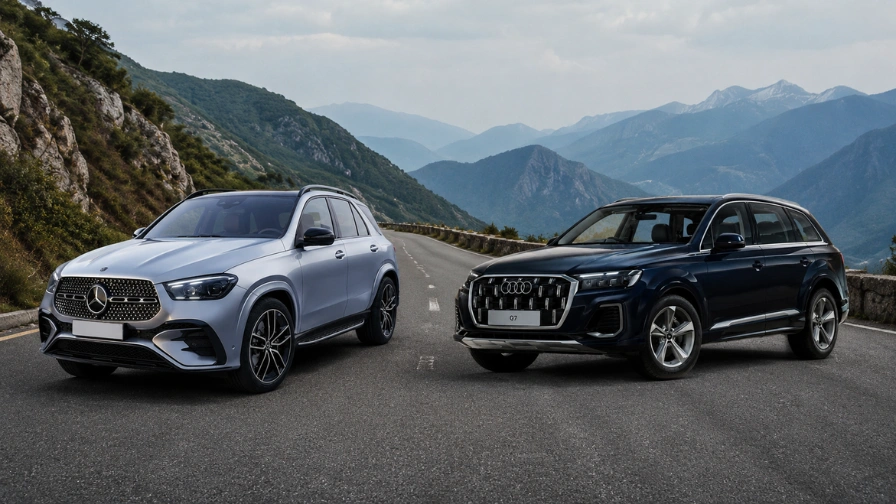
If you have a budget of roughly ₹85 lakh to ₹1.2 crore and you're shopping for a full-size luxury SUV, you've almost certainly landed on these two names: the Audi Q7 and the Mercedes-Benz GLE. Both wear German badges, both promise refinement and performance, but they take genuinely different approaches — one leans into seven-seat practicality with a punchy petrol V6, the other leans into diesel-torque cruising and five-seat spaciousness. Here's a detailed, honest comparison to help you decide.
Audi Q7 vs Mercedes-Benz GLE – Quick Comparison
|
Parameter |
Audi Q7 |
Mercedes-Benz GLE |
|
Starting Price (ex-showroom) |
₹87.17L - ₹97.8L |
₹97.85L - ₹1.15Cr |
|
Top Variant Price |
₹97.8 lakh |
₹1.12 - 1.4 crore |
|
Engine |
3.0L V6 TFSI Petrol (mild-hybrid) |
2.0L/3.0L Diesel & 3.0L Petrol options |
|
Power Output |
335 bhp / 500 Nm |
Up to ~362 bhp (450d), varies by variant |
|
Seating |
7 seats |
5 seats (India lineup) |
|
Drivetrain |
Quattro AWD |
4MATIC AWD |
|
Mileage (claimed) |
11.2 kmpl |
9.7 - 11 kmpl |
|
Ground Clearance |
Comparable SUV clearance |
215 mm |
|
Boot Space |
Versatile with 3rd row folding |
630 litres |
|
Key Rivals |
Mercedes GLE, BMW X5, Volvo XC90 |
Audi Q7, BMW X5, Range Rover |
Audi Q7 vs Mercedes-Benz GLE Price Comparison
The Q7 has a clear entry-price advantage. It starts at around ₹87.62 lakh for the base Premium Plus variant and tops out near ₹96.15 lakh for the Technology trim, ex-showroom, with a Bold Edition variant priced close to ₹97.84 lakh.
The GLE, by contrast, starts higher and stretches further upward. Depending on the source, its India starting price sits around ₹96.14 lakhs for the base variant, extending up to roughly ₹1.12 crore for the top-end trim, though some listings peg the starting ex-showroom price at ₹1.00 crore, with on-road prices ranging from ₹1.19 crore to ₹1.39 crore depending on city and variant. Higher-spec diesel and hybrid trims can push GLE pricing as high as ₹1.1 to ₹1.4 crore.
Bottom line: The Q7 undercuts the GLE by roughly ₹8-13 lakh at entry level, and the gap widens further at the top end. If price sensitivity within the luxury SUV bracket matters to you, the Q7 offers a meaningfully lower cost of entry into this segment.
Engine & Performance Comparison
This is where the two cars diverge philosophically.
Audi Q7: Runs a single, well-sorted 3.0-litre V6 TFSI petrol engine with a 48V mild-hybrid system, producing 335 bhp and 500 Nm of torque, capable of a 0-100 kmph sprint in about 5.6 seconds. It's a petrol-first strategy, favoring smoothness and immediate response over long-haul torque.
Mercedes-Benz GLE: Offers a broader spread of powertrains — the GLE 300d, GLE 350d, GLE 400d, and the petrol-powered GLE 450 AMG Line — giving buyers a genuine diesel-vs-petrol choice. The range-topping diesel variant is notably powerful, with output figures around 362 bhp from its 2989cc turbo-diesel six-cylinder engine. Mercedes has also woven in 4MATIC all-wheel drive and mild-hybrid tech across the updated lineup, improving both efficiency and drivability.
Verdict: If you want strong, linear diesel torque for long highway drives, the GLE's 400d/450d variants have an edge. If you prefer petrol refinement, quicker throttle response, and don't want the ownership complexities sometimes associated with diesel emissions systems, the Q7's V6 TFSI is the more straightforward choice.
Dimensions & Road Presence Comparison
Both SUVs command attention, but their road presence stems from different design languages.
The Q7 carries Audi's Single frame octagonal grille, Matrix LED headlights, and 20-inch alloy wheels, giving it a wide, imposing, and unmistakably Germanic front fascia. Its design isn't flashy, but it has genuine road-hogging presence, especially in darker colorways.
The GLE, especially post-facelift, gets tweaked front and rear bumpers, new LED head lamps and tail lamps and a fresh alloy wheel design, giving it a slightly sportier, more sculpted stance than the outgoing model. The GLE's proportions feel a touch more athletic, while the Q7 leans into boxier, more traditional SUV volume.
Verdict: This one comes down to personal taste — the Q7 projects understated German solidity, while the GLE projects a sportier, more aggressive luxury SUV identity.
Interior & Comfort Comparison
Audi Q7: The cabin is modern and upmarket, with high-quality materials and seating for up to 7 occupants, plus split-folding rear seats and multiple storage options with well-contoured leather seats. Reviewers note the Q7's biggest interior strength is refinement — the cabin stays quiet even in heavy traffic, and the driving position feels planted and confidence-inspiring even in dense city conditions.
Mercedes-Benz GLE: Built around comfort and technology-forward design, with an S-Class-inspired multifunction steering wheel and an updated MBUX infotainment interface as recent additions. The GLE typically comes as a strict 5-seater in the India lineup, which translates into a genuinely larger and more usable boot — 630 litres of cargo space — compared to what a 7-seat Q7 offers with all rows in use.
Verdict: If you regularly need a third row for kids, extended family, or occasional extra passengers, the Q7 wins outright — the GLE simply doesn't offer that flexibility in India. If you prioritize outright cargo space and don't need a third row, the GLE's 630-litre boot is a genuine practical advantage.
Features Comparison
Audi Q7 highlights: Adaptive air suspension, multiple drive/terrain modes, a panoramic sunroof, powered third-row seats, and four-zone climate control come standard across most trims, along with a 19-speaker Bang & Olufsen Premium 3D Sound System and individually customizable drive settings for steering, transmission, suspension, and powertrain behavior.
Mercedes-Benz GLE highlights: The updated GLE brings the new MB.OS software with AI-based features and a slicker overall interface, alongside adaptive cruise control, automatic parking, heated seats, a sunroof, and a comprehensive suite of driver-assist tech. Mercedes has generally positioned the GLE as the more tech-forward of the two in terms of software and digital cabin experience.
Verdict: The Q7 edges ahead on physical luxury touches (sound system, air suspension breadth), while the GLE edges ahead on software sophistication and digital interface polish, especially post-facelift.
Safety Features Comparison
Both SUVs come from manufacturers with strong global safety reputations and typically include a comprehensive suite of active and passive safety systems as standard at this price point — multiple airbags (the Q7's Premium Plus alone gets eight airbags), electronic stability control, and driver-assist packages.
The GLE's international specification includes blind spot monitoring, lane departure warning, brake assist, and a full security system, reflecting Mercedes' broader push toward semi-autonomous safety tech across its SUV range.
Practical advice: Since exact safety equipment can vary by market and variant, always verify the specific safety feature list for the exact trim and model year you're considering — don't assume international specification automatically carries over to the Indian-spec car. Ask your dealership for the official specification sheet during your test drive.
Mileage & Running Cost Comparison
Fuel efficiency claims vary by source and driving conditions, but broadly:
● Audi Q7: Rated around 11.2 kmpl, consistent across most sources for the petrol V6.
● Mercedes-Benz GLE: Owner-reported and claimed mileage sits around 9.7 kmpl on some listings, though official claimed figures across the lineup range from 9 kmpl to 16 kmpl depending on whether you're looking at diesel or petrol variants, with real-world owner reports around 11 kmpl.
On running costs, service pricing is broadly comparable at this luxury tier — the approximate 5-year service cost for the GLE sits in the range of roughly ₹38,956 as per the manufacturer's service cost estimator, though actual costs vary by usage, city, and whether extended warranty packages are purchased.
Verdict: If outright fuel efficiency matters, the Q7's petrol V6 is fairly consistent at ~11 kmpl. The GLE's efficiency swings more widely depending on whether you choose a diesel or petrol variant — the diesel options (300d, 350d) generally sip less fuel on highway runs than the Q7, but city mileage tends to even out.
Ride Quality & Driving Experience
This is genuinely where personal preference matters most.
The Q7 is described by long-term reviewers as remarkably city-friendly for its size: the steering is light enough at low speeds, the engine feels smooth and almost effortless, and even small throttle inputs move the SUV without strain — though in tight spaces, the length becomes noticeable, and parking in older, narrower areas requires some planning.
The GLE, particularly in its 450/450d guise, is generally regarded as the more comfort-biased, cruiser-like SUV. Expert reviewers summarizing the segment note that the Mercedes-Benz GLE 450 delivers power in a very linear, smooth manner, prioritizing comfort and luxury over outright sportiness — a description that captures the GLE's overall character well.
Independent comparisons of this luxury SUV segment as a whole conclude that rivals in this bracket are generally spacious, well-equipped, comfortable, and good to drive, with the differentiation coming down more to brand character and specific trim choice than any dramatic gap in driving dynamics.
Verdict: Both SUVs are refined, quiet, and confidence-inspiring on the highway. The Q7 feels marginally more nimble and responsive in city driving thanks to its petrol V6's eager throttle response; the GLE feels like the more effortless long-distance cruiser, especially in diesel guise.
Pros & Cons
Audi Q7 Pros & Cons
Pros:
● Lower starting price, better value entry point into the luxury SUV segment
● Genuine 7-seat practicality — a rarity in this price bracket
● Smooth, refined petrol V6 with strong low-speed manageability
● Quiet, well-insulated cabin even in heavy traffic
● Strong sound system and comprehensive drive-mode customization
Cons:
● Third-row space is compromise-heavy for adults on longer trips
● Length makes tight parking and narrow-lane maneuvering trickier
● Petrol-only strategy limits options for buyers who specifically want diesel torque
● Boot space with all three rows in use is limited
Mercedes-Benz GLE Pros & Cons
Pros:
● Broader engine choice — diesel and petrol, multiple states of tune
● More generous cargo space (630 litres) thanks to 5-seat-only layout
● More tech-forward cabin with updated MBUX/MB.OS software
● Strong highway cruising comfort, especially in diesel variants
● Sportier, more contemporary exterior design post-facelift
Cons:
● Meaningfully higher starting and top-end price than the Q7
● No genuine 7-seat option in the India lineup, unlike the Q7
● Claimed mileage on some variants trails the Q7 in real-world reports
● Higher-spec trims push well past ₹1.2 crore, narrowing its value proposition
Who Should Buy the Audi Q7?
The Q7 makes the most sense if you:
● Need a genuine third row for occasional extra passengers, kids, or extended family
● Want to enter the full-size luxury SUV segment at the lowest possible price point
● Prefer a smooth, responsive petrol engine over diesel torque and complexity
● Prioritize a quiet, refined cabin experience for daily city commuting
● Value Audi's understated design language over a sportier, more overt aesthetic
Who Should Buy the Mercedes-Benz GLE?
The GLE makes more sense if you:
● Don't need a third row and prioritize maximum cargo and rear-seat space instead
● Want the flexibility to choose between diesel and petrol powertrains
● Frequently drive long highway distances and value diesel-like cruising comfort
● Want the latest in-cabin technology and software experience from Mercedes
● Have a higher budget and want a sportier, more contemporary luxury SUV silhouette
Audi Q7 vs Mercedes-Benz GLE – Which Luxury SUV Offers Better Value?
On pure price-to-features math, the Audi Q7 offers stronger value at entry level — a lower starting price, standard air suspension, four-zone climate control, and genuine 7-seat capability that the GLE simply doesn't match in its India lineup.
The Mercedes-Benz GLE justifies its higher price through powertrain choice, more advanced in-cabin software, and a more spacious cargo area for buyers who don't need the extra row. If your budget stretches comfortably past ₹1 crore and you specifically want diesel torque or the latest MBUX tech, the GLE's premium becomes easier to justify.
For most buyers weighing value against price, the Q7 edges ahead — but the GLE remains the stronger pick for a narrower set of specific priorities (diesel preference, maximum cargo space, tech-forward cabin).
Conclusion
Neither SUV is objectively "better" in isolation, the right choice depends entirely on what you actually need day to day. If seven-seat practicality and a lower entry price matter most, the Audi Q7 is the clear pick. If you want powertrain flexibility, a more spacious five-seat cabin, and the latest in-car technology, and your budget can stretch further, the Mercedes-Benz GLE deserves serious consideration. The smartest move either way: book test drives for both, drive your actual daily commute route in each, and let real-world feel — not just the spec sheet — make the final call.
FAQs
Q1: Which is cheaper, the Audi Q7 or the Mercedes-Benz GLE?
The Audi Q7 is cheaper at both entry and top-end pricing, starting around ₹87.6 lakh versus the GLE's roughly ₹96 lakh-₹1 crore starting price.
Q2: Does the Mercedes-Benz GLE come with 7 seats in India?
No, the GLE is sold as a 5-seater in the India lineup, unlike the Audi Q7, which offers a genuine 7-seat configuration.
Q3: Which SUV has better fuel efficiency, the Q7 or the GLE?
The Audi Q7's petrol V6 is fairly consistent at around 11.2 kmpl. The GLE's efficiency varies more widely by variant, generally ranging between 9 and 16 kmpl depending on the diesel or petrol option chosen.
Q4: Is the Mercedes-Benz GLE available with a diesel engine?
Yes, the GLE offers diesel variants including the 300d, 350d, and 400d/450d, alongside the petrol-powered 450 AMG Line, giving buyers more powertrain choice than the petrol-only Audi Q7.
Q5: Which SUV is better for families needing a third row?
The Audi Q7 is the better choice for families needing occasional third-row seating, since the GLE doesn't offer a 7-seat option in India.
Q6: Which SUV has more boot space?
The Mercedes-Benz GLE offers around 630 litres of cargo space as a dedicated 5-seater, generally more usable day-to-day than the Q7's boot space when its third row is in use.
Q7: Which SUV is better to drive in the city?
The Audi Q7 is often described as more manageable in city traffic thanks to its light steering and smooth, responsive petrol V6, though its length still requires care in tight parking spots.
Q8: Should I test drive both before deciding?
Yes — given the meaningful differences in seating configuration, powertrain philosophy, and price, a test drive of both the Q7 and GLE on your typical routes is strongly recommended before making a final decision.