Most people sell a car the way they sell a phone. Agree a price, hand over the keys, count the money, done. The difference is that a phone can't run a red light in Faridabad eighteen months later and have the ticket arrive at your address.
Selling a car in India is two separate jobs. One is getting a fair price, which is mostly preparation. The other is getting your name off the vehicle, which is paperwork, and which protects you from things most sellers have never thought about. This guide covers both, in the order you should do them.
The Short Answer
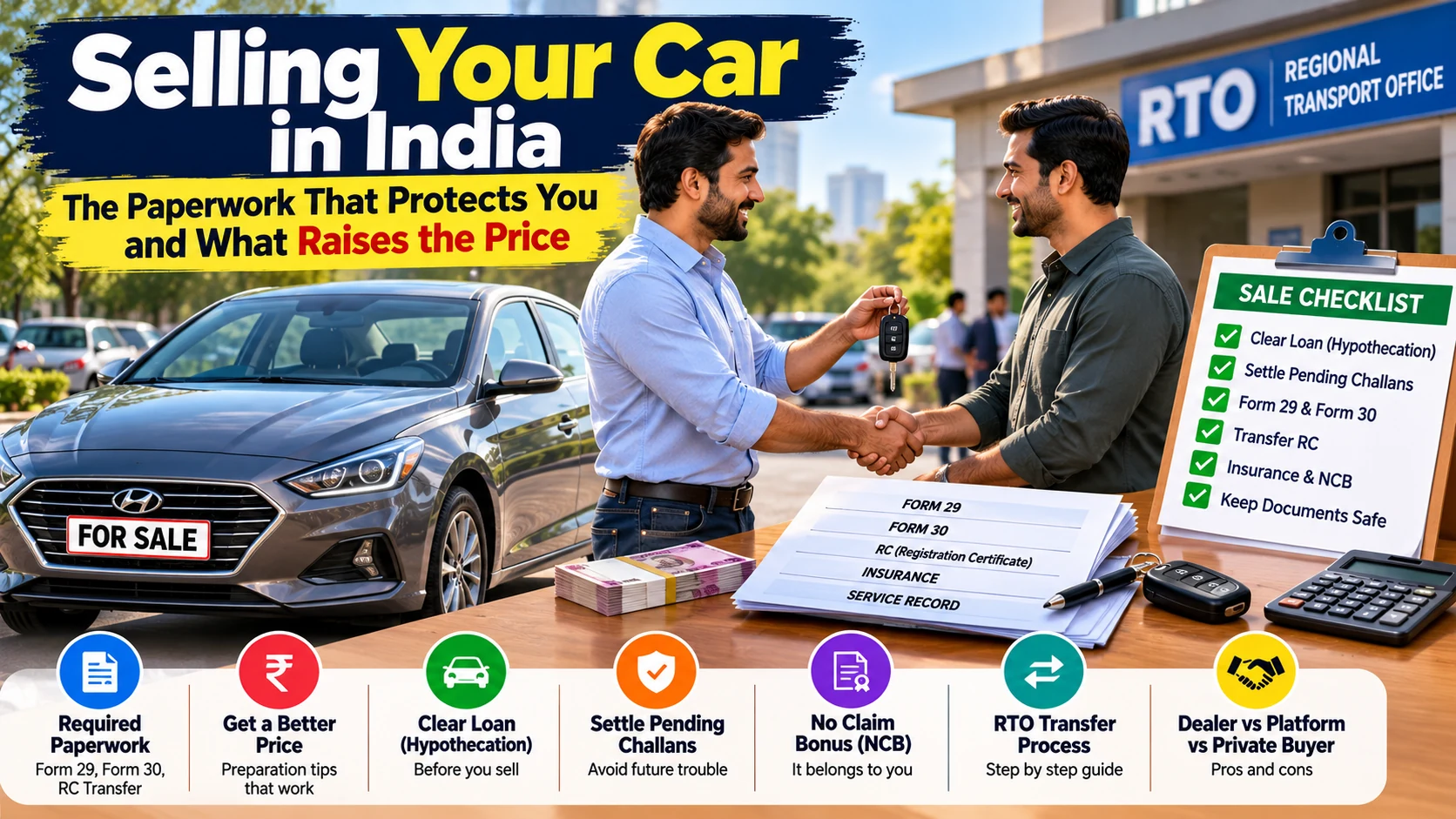
Until the transfer is recorded at the RTO, you are still the registered owner, and that matters for far more than challans. File Form 29 within 14 days of the sale, make sure the buyer files Form 30, and keep proof of both. Before you advertise, clear the hypothecation if the car was financed, settle pending challans and keep the service record together, because those three things are what buyers and dealers actually pay for. And ask your insurer for a no-claim bonus certificate before the policy goes with the car, because that discount belongs to you and carries to your next car.
The Risk Most Sellers Have Never Heard Of
Under motor vehicle law, the owner of a car is the person in whose name it is registered. Not whoever paid for it, not whoever's driving it, and not whoever has the keys. The person named on the registration certificate.
So if you sell your car and the transfer is never completed at the RTO, the record still says the car is yours. If that car is involved in an accident that injures someone, a third-party claim can be laid at the registered owner's door, which is to say yours. That isn't a technicality that gets waved away. It has been the settled position in Indian law for over two decades, and the Supreme Court reaffirmed it as recently as August 2025, in a case where a seller who had not reported the transfer was held to be the owner and his insurer made to pay the third-party claim.
The everyday version is less frightening and more common. Speeding tickets and red-light challans are issued against the registration number and reach the registered owner. So do pollution notices and, in some states, letters about the vehicle's age. Sellers find out months later, usually when a challan turns up for a road they haven't driven on.
None of which is a reason to avoid selling a car. It's a reason to treat the transfer as part of the sale, not as homework the buyer will get around to. Don't hand over the keys against a promise to do the paperwork later.
The Paperwork, and Who Files What
Four forms matter, and only two of them apply to every sale. Here is who does what and by when.
| Form | What it does | Who files it | When |
|---|---|---|---|
| Form 29 | Tells the RTO the car has been sold | Seller, in duplicate | Within 14 days of the sale |
| Form 30 | Applies to record the buyer as owner | Buyer, with your signed Form 29 | Within 14 days, or 45 days if the car moves state |
| Form 28 | No-objection certificate to leave the state | Seller applies at the original RTO | Only for an inter-state sale |
| Form 35 | Removes the lender's name from the RC | Owner, with the lender's no-objection certificate | Before the sale, if the car was financed |
The transfer fee itself is small, a few hundred rupees, and it varies by state along with smart card and service charges. Check your own state transport website rather than relying on a figure you read anywhere, including here.
Two practical habits make the difference between a clean sale and a loose end:
- Keep a photocopy of everything you hand over: The signed Form 29, the registration certificate, the sale receipt and the buyer's identity proof with a contact number that you have actually dialled once.
- Verify the transfer went through, don't assume: Filing a form isn't the same as the record changing. Check the vehicle's status online two to four weeks later. If your name is still on it after about a month, go back to the RTO with the acknowledgement rather than waiting.
For an inter-state sale, the sequence is slower and the clock still runs. The no-objection certificate usually takes a few weeks at the original RTO, and the buyer then has several months to register in the new state. Your own 14-day window for Form 29 starts from the date of sale, not from the date the certificate is issued.
What to Do If the Buyer Never Transfers It
Say you've done your part and months later the car is still showing in your name. You aren't stuck, but you do have to act rather than wait, because the record won't correct itself.
- Start with the buyer, in writing: A call is easy to ignore and leaves nothing behind. A message or email asking for the transfer status creates a record and often works on its own.
- Take your proof to the RTO: Your Form 29 acknowledgement, the sale receipt and the delivery letter together establish when the car left your hands. The office can note the intimation against the vehicle, which is exactly what you want on file.
- Report the sale formally if the buyer is unreachable: An intimation of sale, supported by your documents, is what separates a seller who sold a car from a registered owner who still has one.
- Take legal advice if a claim or a serious offence is involved: A notice from a lawyer carries weight a message doesn't, and if something has already happened you want advice specific to your case.
All of this is far easier if you kept the paperwork from the start. A seller holding a signed Form 29, a dated receipt and a delivery letter is in a completely different position from one holding a memory of a handshake.
Three Things to Clear Before You Advertise
Each of these costs you money or time if a buyer finds it first, and each one's easy to deal with in advance.
- Remove the hypothecation if the car was financed: While a loan is live, the lender's name sits on the registration certificate, and the car isn't cleanly sellable until it comes off. You need a no-objection certificate from the lender and Form 35, which is worth asking about when you take the loan rather than when you sell. Ask your lender how long the whole process takes before you list the car.
- Settle every pending challan: Buyers and dealers check this now, it takes a minute, and an unpaid ticket discovered during negotiation costs you more in lost credibility than the ticket itself.
- Get the pollution certificate renewed: It must be valid for the transfer, it's cheap, and an expired one makes the car look neglected whatever its condition.
Do these before the first photograph goes up. A seller who produces clean paperwork on request is a seller who gets asked for fewer discounts.
Your No-Claim Bonus Is Yours, Not the Car's
This is the single most commonly forfeited piece of money in a used car sale, and it costs nothing to keep.
The no-claim bonus you have built up is a discount on the own-damage part of your insurance premium, rising to 50 percent after five claim-free years. It belongs to you as the policyholder, not to the vehicle. When you sell the car, the insurance policy may transfer to the buyer, but the bonus does not go with it. You carry it to your next car.
What you need is a retention letter, sometimes called a bonus certificate, from your current insurer. Without it, the new insurer has nothing to apply the discount against, and plenty of sellers simply start from zero on the next car because nobody mentioned it. On an own-damage premium of ₹12,000, a 50 percent bonus is ₹6,000 in the first year alone, and more over the years that follow.
My advice: ask for that certificate in the same week you agree the sale, not after the policy has moved.
The policy itself has its own deadline, and it catches out buyers and sellers alike. When a car changes hands, the third-party cover carries over to the new owner, and the buyer is expected to apply to have the policy put in their name within 14 days. That part is settled and nobody argues about it.
The own-damage half is messier, and it is worth being straight about why. Whether that half of the policy passes to the buyer automatically on sale, or only once the endorsement is done, has been the subject of conflicting Supreme Court rulings, and the question was referred to a larger bench in 2024. As of October 2026 it has not been resolved. In practice insurers work on the basis that a damage claim is not payable until the policy carries the new owner's name, so a buyer who has an accident in week two with no endorsement is usually paying for that repair out of their own pocket, whatever the law eventually settles.
Which makes the practical advice the same either way. Tell your insurer in writing that the car has been sold, and tell the buyer plainly that the endorsement is on their clock and should be done in days, not weeks. It takes one phone call, and it is the kind of detail that turns an awkward conversation three weeks later into no conversation at all.
What Actually Moves the Price
Buyers and valuers don't weigh every feature equally. A handful of things move the number materially, and several things sellers spend money on don't move it at all.
- A complete service history: The most valuable document you own, and the easiest to lose. Stamped records from authorised workshops reassure a buyer more than any amount of polish, and their absence invites a discount.
- The manufacturing date, not just the registration year: Two cars registered in the same year can be built months apart, and the build date follows the car into every valuation it ever faces.
- Tyres and brakes: Visible, expensive and immediate. A buyer who sees four worn tyres is mentally subtracting the cost of four new ones, usually generously.
- Original paint and panel alignment: Repainted panels and uneven gaps suggest an accident whether or not there was one. Matching paint across the car is worth more than fresh paint on one panel.
- Number of previous owners: Fewer is better, and a first owner selling with full records is in the strongest position in the market.
- A clean, dry, odour-free cabin: Cheap to achieve and disproportionately persuasive. Smoke and damp smells are the two that cost real money.
What rarely pays for itself is big cosmetic work just before a sale. A full repaint usually returns less than it costs and makes a careful buyer suspicious. Fixing a broken air-conditioner or a failed sensor is different, because a buyer can see the fault and will subtract far more than the repair costs.
There's a timing point worth a thought before you list. A car's value steps down sharply in its first three years and then flattens, so waiting for a better month rarely pays. Spending a weekend assembling the service file almost always does.
One more thing sellers underestimate: photographs. Most listings are shot in a dark basement at an angle that hides half the car. Take them outside in morning or evening light, clean, from the four corners plus the interior, the odometer and the engine bay, and include an honest photo of any damage you've described. A listing that shows the scratch gets fewer messages and far better ones, because the people who call have already accepted it.
Dealer, Online Platform or Private Buyer?
Three routes, and the right one depends on how much time you are willing to trade for money.
| Route | Typically pays | Effort and risk | Best when |
|---|---|---|---|
| Exchange at a dealership | Least | Lowest, handled with the new car purchase | You are buying a new car and want one transaction |
| Online buying platform | Middle | Low, inspection and paperwork usually handled | You want speed and a predictable process |
| Private buyer | Most | Highest, you manage viewings and paperwork | You have time and the car is in demand |
The honest trade-off is that convenience costs money and the gap is usually real. A private sale generally fetches the most because there is no business taking a margin in between, and it also asks the most of you: strangers at your address, test drives, negotiation and the transfer paperwork handled yourself.
Whichever route you take, one rule doesn't change. The transfer is your responsibility to see through. A dealership or platform that promises to handle it still needs to actually do it, so ask for the acknowledgement and check the record yourself a few weeks later.
Taking the Money Safely
The handover is the one moment in the sale where things go wrong quickly, and the fixes are simple.
- Take the full payment before the keys: Not a screenshot, not an SMS, not a pending screen. The money has to be credited and available in your account. Part payment against a promise of the rest after delivery is how you end up chasing a stranger.
- Prefer a traceable transfer: A bank transfer or demand draft leaves a record that cash doesn't. If a buyer insists on cash for a large amount, treat it as a reason to slow down rather than speed up.
- Write a delivery receipt and keep a copy: Date, time, price, odometer reading, both parties' details and signatures. One page, and it is the document that settles any dispute about when the car stopped being yours.
- Hand over the car and the forms together: The signed Form 29 and the registration certificate go at the same moment as the keys, not before, not later.
- Never sign a blank or half-filled form: Every field is completed before your signature goes on it. A signed blank Form 29 in a stranger's hands is a document you no longer control.
- List what you handed over, including the keys: Both sets, the registration certificate, the insurance papers and the service file. A missing second key is a real deduction, and an undocumented handover is an argument waiting to happen.
The Seller's Checklist, in One Place
Worth keeping open on your phone the day you hand the car over.
- Before you advertise: Loan closed and hypothecation removed, challans settled, pollution certificate valid, service file assembled, both keys found.
- While you negotiate: Price agreed in writing, buyer's identity proof collected, a contact number you have actually dialled.
- Before the keys move: Full payment credited and available in your account, delivery receipt written with date, time, odometer reading and both signatures.
- At handover: Signed Form 29 and the registration certificate given together with the keys, nothing signed blank, photocopies kept of everything.
- Within the week: Insurer told in writing that the car is sold, no-claim bonus certificate requested, buyer reminded that the policy endorsement is on a 14-day clock.
- Two to four weeks later: Check the vehicle record online and confirm your name is off it. That confirmation, not the payment, is what actually ends the sale.
Conclusion
Selling a car well is mostly about sequence. Clear the loan and the challans before you advertise, gather the service records, ask your insurer for the bonus certificate, agree the price, take the money in full, hand over the keys and the signed forms together, then check a few weeks later that the record actually changed.
That last step is the one almost everyone skips and the one that matters most. The sale isn't finished when the money arrives. It is finished when the car is no longer in your name, and until then the law still thinks the car is yours.
Selling because you are ready for the next one? Shortlist by budget and body type, then book a test drive and we will connect you with your nearest authorised dealer.
FAQs
1. What documents do I need to sell my car in India?
The original registration certificate, Form 29 signed by you in duplicate, Form 30 signed by both parties, a valid insurance certificate, a valid pollution certificate, and your identity and address proof. If the car was financed you also need Form 35 and a no-objection certificate from the lender.
2. What is Form 29 and Form 30?
Form 29 is the seller's notice to the RTO that the car has been sold, filed in duplicate within 14 days. Form 30 is the buyer's application to record the transfer, filed with your signed Form 29. Both are needed for the ownership to actually change.
3. Am I liable if I sell my car and the buyer never transfers it?
Potentially yes. In motor vehicle law the owner is the person in whose name the car is registered, so until the transfer is recorded, challans and third-party accident claims can come to you. This has been the settled position for over two decades and the Supreme Court reaffirmed it in August 2025, which is why the transfer should be completed as part of the sale rather than left to the buyer.
4. How long does car ownership transfer take?
Processing usually takes one to two weeks for a transfer within the same state and can take up to about a month, with inter-state transfers taking longer because a no-objection certificate is needed first. Check the vehicle's status online two to four weeks after filing rather than assuming it is done.
5. Can I sell a car that still has a loan on it?
Not cleanly. While the loan is live the lender's name is on the registration certificate, so you need to close the loan, obtain a no-objection certificate from the lender and file Form 35 to have the hypothecation removed. Deal with it before you advertise, because nothing stalls a sale at the last minute as reliably as a financier's name still sitting on the registration certificate.
6. Does my no claim bonus transfer with the car when I sell it?
No, and that is good news. The bonus belongs to you as the policyholder, not to the vehicle, so it carries to your next car. Ask your insurer for a no-claim bonus certificate around the time of the sale, because without it the discount is usually lost. The policy itself is separate: third-party cover carries over and the buyer should apply for the endorsement within 14 days. Whether the own-damage half passes automatically is unsettled and before a larger Supreme Court bench, and insurers in practice decline damage claims until the policy carries the new owner's name, so tell the buyer to get it done at once.
7. What increases the resale value of a car the most?
A complete service history, honest original paint with even panel gaps, healthy tyres and brakes, fewer previous owners and a clean cabin. A full repaint shortly before a sale rarely returns its cost and often makes careful buyers suspicious.
8. Should I sell my car to a dealer, an online platform or a private buyer?
A private buyer usually pays the most but asks the most of your time, a dealership exchange is the least effort and typically pays the least, and an online platform sits in between. Whichever you choose, the ownership transfer remains your responsibility to verify.