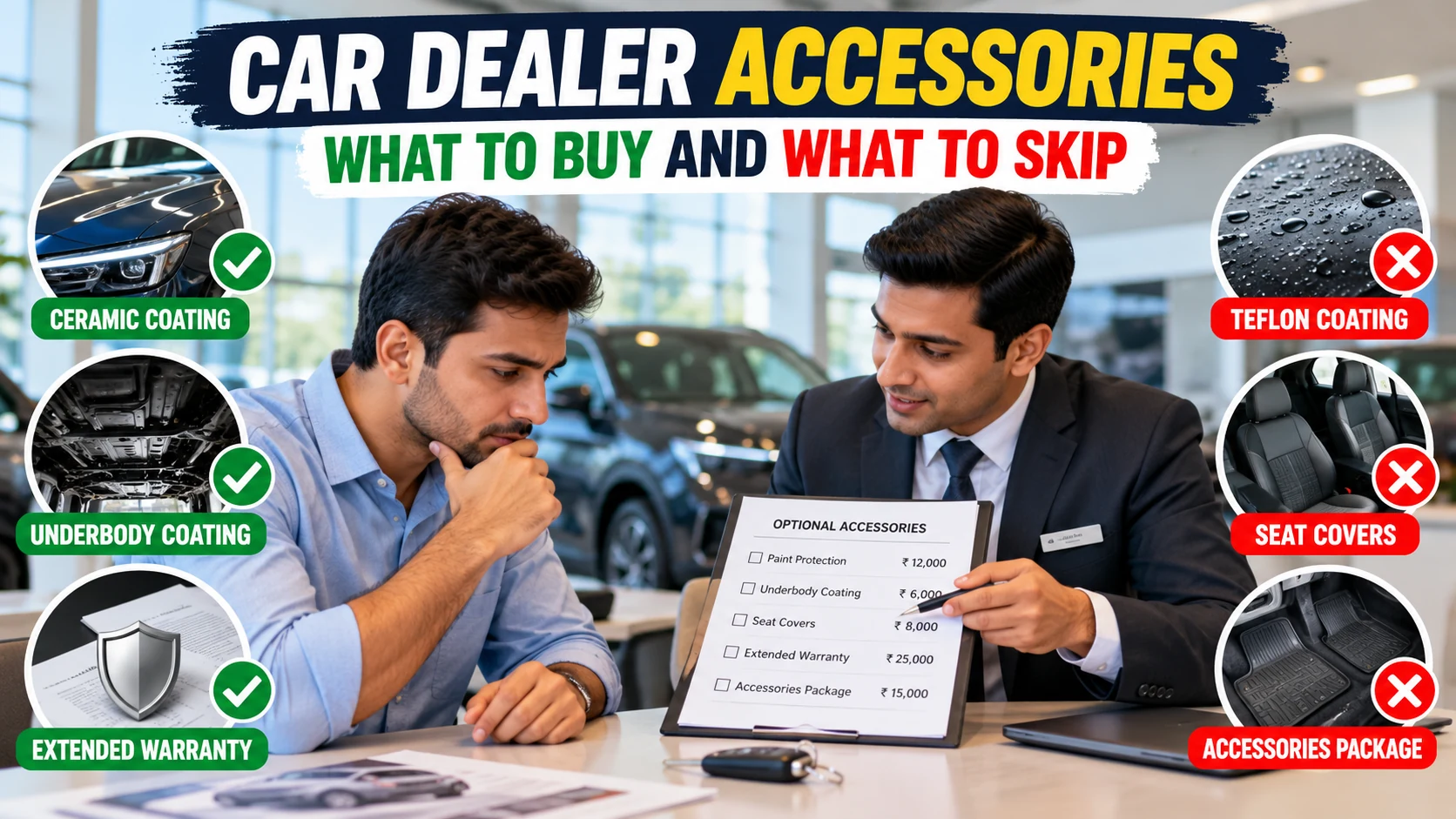
You have negotiated hard, settled on the car, agreed the discount, and then the salesperson slides a second sheet across the desk. Paint protection. Underbody coating. An accessories package. Extended warranty. Each one sounds sensible, none of them costs very much on its own, and by the time you have nodded along the total has quietly gone up by ₹60,000.
None of this is a scam. Some of these add-ons are worth buying, one of them is worth buying every time, and a few are worth exactly nothing. The problem isn't the products, it's the moment they are sold to you, bundled so you cannot see the individual prices and marked up against what the same work costs two kilometres down the road. This guide puts a real number on each one.
What Each Add-On Actually Costs
Here's the list you are most likely to be offered, with what dealers typically charge and what the same thing costs outside. Figures vary by city, car size and how much the dealer wants your signature that day, so treat them as the range to negotiate inside rather than fixed rates.
| Add-on | Typical dealer price | Outside price | Worth it? |
|---|---|---|---|
| Teflon or PTFE coating | ₹4,000 to ₹10,000 | ₹2,500 to ₹8,000 | Rarely |
| Ceramic coating | ₹10,000 upwards | ₹8,000 to ₹15,000 | Sometimes |
| Paint protection film | Usually not offered | ₹30,000 upwards | If you keep cars long |
| Underbody anti-rust coating | ₹4,000 to ₹8,000 | ₹2,500 to ₹5,000 | Depends where you live |
| Seat covers and mats | ₹8,000 to ₹20,000 | ₹3,000 to ₹10,000 | Buy outside |
| Extended warranty | ₹4,000 to ₹40,000 by model | Only from the brand | Usually yes |
These sit on top of the on-road price, so work them into the same budget you used when you worked out what the car costs to run. The pattern in that table is the same one you will see at every brand. The dealer isn't inventing services, it's reselling them with a margin on top, and the margin is largest on the cosmetic items where you have the least idea what the fair price should be.
Paint Protection: Teflon, Ceramic or Film?
This is where most of the money goes and where most of the confusion lives, because three completely different products get sold under the same promise of protecting your paint.
- Teflon or PTFE coating: A sealant that goes on top of the paint and makes it easier to clean. It lasts roughly four to six months in normal Indian conditions, and closer to three or four in humid coastal cities. It gives you no scratch protection at all.
- Ceramic coating: A harder chemical layer that bonds to the paint and lasts somewhere between two and five years depending on the grade and how the car is washed. Far better value per month than Teflon, though it still will not stop a stone chip.
- Paint protection film: A clear physical film applied over the paint. It is the only one of the three that actually absorbs stone chips and light scratches, lasts five to ten years, and costs several times more.
Here is the arithmetic that settles the Teflon question, and it's worth working through once. Take a coating that costs around ₹6,800 at a dealership and lasts five months. That's roughly ₹1,360 a month. A ceramic coating at ₹12,000 that lasts three years works out to about ₹333 a month. The cheaper-sounding option is four times more expensive to keep up. Treat both numbers as an illustration of the gap rather than a quote, because prices and durability both move with the grade of product and the car's size.
My take: skip the dealer Teflon. If you care about how the paint looks in five years, go to a detailing studio a few weeks after delivery and get ceramic done properly, with the car clayed and polished first. That preparation is what makes the coating last, and it's exactly the step a dealership doing twelve cars a day doesn't have time for.
Is Underbody Anti-Rust Coating Worth It?
This one really does depend on where you live, which is why a flat yes or no answer from anyone should make you suspicious.
Modern cars already leave the factory with galvanised panels and a factory-applied underbody sealant. For a car that lives in Delhi, Bengaluru or Pune and sees normal roads, an extra coating adds very little that the car does not already have.
The picture changes near the coast. Salt-laden air in Mumbai, Chennai, Kochi or Goa works on exposed metal in a way that inland air does not, and regular monsoon flooding pushes water into places the factory sealant was never meant to hold out. In those cities an underbody coating is a reasonable ₹3,000 to buy yourself a quieter decade.
Two things worth knowing before you say yes. A coating applied over a dirty or damp underbody traps moisture instead of keeping it out, which is worse than no coating at all, so the car has to be properly washed and dried first. And the job is almost always cheaper and more carefully done at a specialist than at a dealership bundling it into your invoice.
Extended Warranty: The One Add-On Usually Worth Buying
If you take only one thing from this guide, make it this one. Most Indian cars come with two or three years of standard warranty. An extended warranty picks up where that stops, and it is the only add-on on the list that protects you from a bill large enough to hurt.
What it costs varies enormously by model, which tells you something about how the brands price risk. A small hatchback can be a few thousand rupees. A mid-size sedan for four years sits somewhere around ₹8,000 to ₹13,000. A large diesel SUV for five years can cross ₹20,000, and premium European models go far higher.
What you are buying is coverage for engine and electrical failures and the labour to fix them. What you are not buying matters just as much:
- Wear-and-tear items: Brake pads, clutch plates, suspension bushes and anything else expected to wear out are excluded.
- Cosmetic damage: Paint, rust and upholstery are not covered.
- Work done elsewhere: Repairs outside approved workshops, aftermarket accessories and electrical modifications can void the cover.
- Accident and act of nature: Collision damage, flooding and rodent damage belong to your insurance policy, not your warranty.
It also sits in the same bucket as the rest of your running costs, and what two similar SUVs cost to maintain over five years is a useful sense check on how much that cover is really worth. The case for buying it is simple. Failures cluster after year three, which is exactly when the standard warranty runs out, and a single electronic control unit or gearbox repair on a modern car can cost more than five years of extended cover.
Two practical points. Buy it at the time of purchase, because it is cheaper then and most brands impose a deadline after which you cannot add it at all. And check whether the cover is transferable to the next owner, because a car still under warranty sells faster and for more.
One condition comes with it that people forget until it matters. Extended warranties almost always require servicing at authorised workshops within the stated intervals, with the records to prove it. Miss two services or get major work done at a local garage and the insurer handling the policy has a straightforward reason to reject the claim you were counting on. If you already plan to move the car to your trusted mechanic after the third year, the warranty is worth less to you than the price tag suggests, and that's a legitimate reason to skip it.
Why the Accessories Package Is Priced the Way It Is
Dealers rarely quote these items one by one. They arrive as a package, usually with a name like Comfort, Protect or Premium, at one round figure. That bundling is not laziness, it is the entire point.
A single number hides three things at once. You cannot see which item carries the fattest margin, you cannot refuse the two you do not want, and you cannot compare the package against outside prices because nothing outside is sold in that exact combination.
So break it apart. Ask for the package itemised, with a price against each line. A dealer who will not do that is telling you something useful. When you do get the list, you will usually find one or two items you actually want sitting next to three you would never have bought on their own.
The other half of the trick is timing, and it is the same instinct that makes people accept a December build date without checking, which is worth reading about separately. These sheets come out after the discount has been agreed, when you are tired and the deal feels done. A ₹40,000 package feels small next to a ₹12 lakh car, which is exactly the comparison you are meant to make. Compare it instead against what the same items cost separately, where ₹40,000 suddenly looks like what it is.
The Charges on the Invoice That Are Not Accessories At All
Two items turn up on the same second sheet that aren't accessories, and they're worth separating out because the rules around them are different.
The first is handling or logistics charges, a few thousand rupees for bringing the car from the stockyard to the showroom. Consumer forums in several states have held this to be an unfair trade practice and ordered dealers to refund it, sometimes with compensation on top. That is not the same as a nationwide ban, and as of October 2026 plenty of dealers still print the line on the invoice and will argue about it. What it does mean is that you're on solid ground asking for the charge to be removed, and that a refusal is a negotiating position rather than a rule.
The second is insurance. You're free to buy your car insurance from whoever you like, and the dealer's policy is one quote among many, usually a convenient one with a commission built in. Get two outside quotes for the same insured value and the same add-ons before you accept it. If the dealer is cheaper, take it. If it isn't, say you'll arrange your own cover and ask for the delivery date in writing, because an insurance policy is not something the sale can be made conditional on.
Keep both of these out of the accessories conversation. Mixing them up is how a package discount ends up being funded by a charge you could have had removed anyway.
What to Say at the Desk
You do not need to be rude about any of this. Four sentences handle most of it.
- Ask for the itemised list: Say you are happy to consider the package but need each item priced separately before you decide. This alone removes most of the margin.
- Separate the warranty from the rest: Tell them you want to discuss the extended warranty on its own, because that is the one you are likely to buy and you do not want it used to justify the others.
- Ask what happens if you decline: The answer is nothing. The car, the price and the delivery date do not change. If you are told otherwise, ask for that in writing and watch it disappear.
- Ask for the add-ons as a discount instead: If the dealer will not drop the package price, ask them to take the equivalent off the car. Many will, because the discount comes from a different budget than the accessories margin.
One more habit worth building. Whatever you do agree to, make sure it appears on the invoice with its own line and price rather than inside a lump sum. If a coating is never applied or an accessory never fitted, an itemised invoice is the only thing that gets it sorted.
And check the work at delivery, not a week later. Open the boot and count what's actually in the car against what you paid for, look along the panels in daylight for the uneven patches a rushed coating leaves behind, and run a hand under the sills if you've paid for underbody work. Anything missing is an easy conversation on the day you collect the car and a difficult one after you've driven it home.
Which Ones to Take and Which to Refuse
Sorted by how often the answer is yes. If you have not settled on the car itself yet, start by narrowing the list by budget and body type.
- Take the extended warranty: Nearly always worth it if you plan to keep the car past the standard cover. Buy it on day one and ask whether it transfers on resale.
- Take the underbody coating if you live near the coast: Worth doing, but have it done properly at a specialist on a clean, dry underbody rather than rushed at delivery.
- Consider ceramic coating, but not from the dealer: Better value than Teflon by a wide margin, and far better when a detailing studio preps the paint first.
- Refuse the Teflon coating: Four to six months of easier washing is not worth dealership pricing, and it protects against nothing.
- Buy mats, seat covers and cosmetic accessories outside: The same products cost a fraction of the dealer price, and you get to choose what you actually like.
- Think hard about paint protection film: Expensive and worth it only if you keep cars for many years or drive on roads that chip paint, but it is the only option that physically protects anything.
Conclusion
The add-ons sheet is not something to be afraid of, it is simply the part of the sale where the margin lives. Once you know which items carry it, the conversation becomes short. Buy the warranty, skip the Teflon, take the coating work to someone who will do it properly, and buy your floor mats anywhere else.
Before you sign anything, ask for the package itemised and take ten minutes to look up what two of those items cost elsewhere. That's usually enough to save more than the discount you spent an hour negotiating.
Still choosing between cars? Book a test drive and we will put you in touch with your nearest authorised dealer.
FAQs
1. Are dealer accessories more expensive than buying outside?
Usually, yes. Cosmetic items like seat covers, mats and coatings often cost a good deal more at a dealership than at a specialist, because the dealer is reselling the same work with a margin added.
2. Is Teflon coating worth it for a new car?
Rarely. It lasts about four to six months in Indian conditions, less in coastal cities, and offers no protection against scratches. A ceramic coating costs more upfront but works out cheaper per month and lasts years.
3. Should I buy an extended warranty with my new car?
If you plan to keep the car beyond the standard two or three year warranty, usually yes. Failures cluster after year three, and a single major electrical or gearbox repair can cost more than the whole policy.
4. Can I buy an extended warranty later?
Often, but not indefinitely. Most brands set a deadline tied to the car's age or kilometres, and the price is higher than at the time of purchase. Ask for that cut-off before you decide to wait.
5. Is underbody anti-rust coating necessary in India?
It depends on your city. Modern cars already have factory rust protection, so inland owners gain little. Near the coast, where salt air and flooding are regular, it is worth doing on a properly cleaned underbody.
6. Can the dealer refuse to sell me the car if I decline the accessories?
No. The car, the agreed price and your delivery slot do not depend on the add-ons. If you are told they do, ask for it in writing.
7. What should I do if the accessories come as one package price?
Ask for it itemised with a price against each line. Bundling exists to hide which items carry the margin, and an itemised list usually reveals one or two things worth keeping and several worth dropping.
8. Does an extended warranty cover everything that goes wrong?
No. It covers mechanical and electrical failures and the labour to fix them. Wear items like brake pads and clutch plates, paint and rust, accident damage and work done outside approved workshops are excluded.