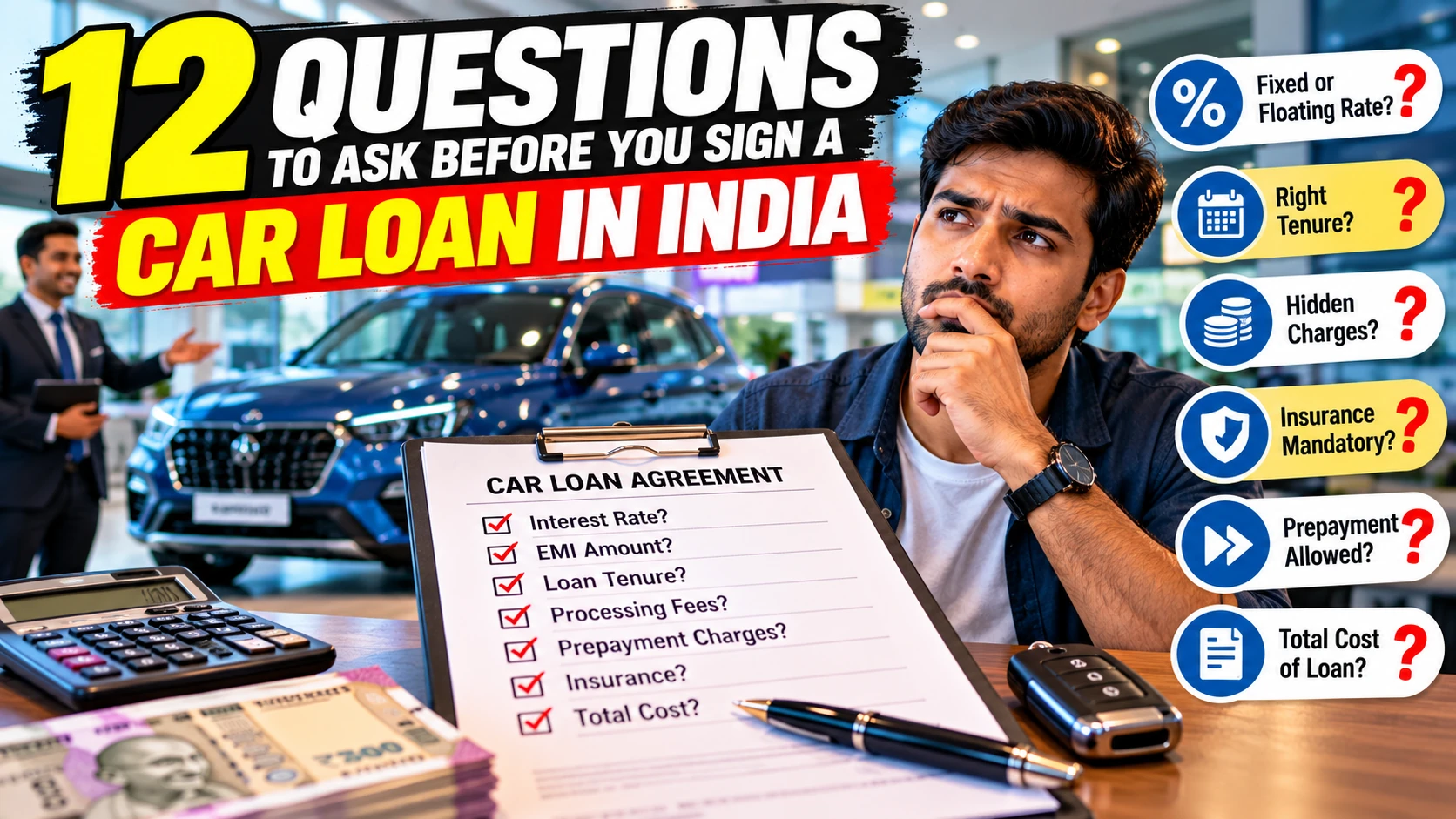
Most people spend three weekends choosing a car and eleven minutes choosing the loan that pays for it. The loan is the part that follows you around for the next five years, and the difference between a good one and a careless one on a ₹10 lakh borrowing runs well past a lakh of rupees.
The good news is that the rules changed in your favour this year, and most buyers haven't caught up. There are twelve questions worth asking before you sign, and three of them are ones the person across the desk is hoping you won't.
1. Is My Rate Fixed or Floating?
Ask this first, because it now decides more than the rate itself does.
From 1 January 2026, new directions from the Reserve Bank of India stop lenders charging you anything to prepay or foreclose a floating-rate loan taken by an individual for a non-business purpose. No penalty on part payments, no penalty on closing the loan early, no lock-in period, and it makes no difference where the money came from. That applies to loans sanctioned or renewed on or after that date, and it covers vehicle loans.
Here's the catch almost nobody mentions. Many car loans in India are written at a fixed rate, and the protection as described follows floating-rate borrowing. So a fixed-rate car loan can still carry a foreclosure charge, usually a percentage of the outstanding amount.
That single question changes how you compare two offers. A fixed loan at a slightly lower rate that charges you to get out of it can easily be the worse deal than a floating loan a few basis points higher that you can close for free the moment you get a bonus. Ask which one you're being offered, get the answer in writing, and if it's fixed, ask what foreclosure will cost in year two.
Legal and regulatory positions do move, so treat this as the position as of October 2026 and ask your lender to show you the clause rather than taking anyone's word for it, including mine.
2. What Is the Rate, and Is It Linked to Anything?
A floating rate is not a number, it's a formula: a benchmark plus a spread. When the benchmark moves, your EMI or your tenure moves with it. Ask which benchmark your loan is tied to and what spread has been added on top, because the spread is the part the lender chose and the part you can sometimes argue about.
Rates as of October 2026 open somewhere around the figures below for salaried borrowers with clean credit. Treat them as a starting point for conversation, not a quote, since what you're actually offered depends on your credit score, your relationship with the bank, the car and the tenure.
| Lender type | Typical starting rate | Worth knowing |
|---|---|---|
| Public sector banks | About 7.45 to 8.80 percent | Often the lowest rates, slowest paperwork |
| Large private banks | About 8.15 to 8.40 percent | Faster approval, pre-approved offers for existing customers |
| Other private banks | About 8.90 to 9.00 percent | Flexible on eligibility, pricier |
| Dealer-arranged finance | Varies widely | Convenient, and the one to compare hardest |
One quiet point in that table. Some lenders price electric cars lower than petrol or diesel ones, by a quarter to half a percent, as a green lending incentive. If an EV is on your shortlist, ask about it directly, because it rarely gets volunteered.
3. What Will This Loan Cost Me in Total, Not Per Month?
Every conversation at a dealership happens in EMIs, because a monthly figure is small and comforting. Ask for the total instead: the sum of every EMI you'll pay, minus the amount you borrowed. That's the real price of the loan, and it's the number that makes tenure decisions obvious.
Insist on seeing it on paper, along with an amortisation schedule showing how much of each EMI goes to interest in the first year. On most car loans the early EMIs are mostly interest, which is exactly why prepaying in year one or two saves far more than prepaying in year five.
4. What Is the Shortest Tenure I Can Comfortably Manage?
Tenures of up to eight years are available, and they're sold as affordability. What they really do is move money from you to the lender. Here's what the same ₹10 lakh looks like at 8.5 percent over three different tenures. This is an illustration to show the shape of the trade-off, not a quote.
| Tenure | Monthly EMI | Total interest paid |
|---|---|---|
| 3 years | About ₹31,568 | About ₹1.36 lakh |
| 5 years | About ₹20,517 | About ₹2.31 lakh |
| 7 years | About ₹15,836 | About ₹3.30 lakh |
Stretching that loan from three years to seven drops the EMI by about ₹15,700 a month, which is real relief if the shorter EMI would break your budget. It also costs about ₹1.94 lakh more in interest, which is a used hatchback's worth of money for the privilege of paying slowly.
The EMI is also only part of what the car costs you every month, so build it alongside what the fuel or charging will cost and what servicing looks like over five years before deciding what you can carry. There's a second problem with long tenures that the table doesn't show. A car loses value faster than a seven or eight year loan pays itself down, so for the first several years you owe more than the car is worth. If it's written off or stolen in year three, your insurance pays what the car is worth and you're left making EMIs on the gap.
My advice: pick the shortest tenure where the EMI still leaves you breathing room, then use your new freedom to prepay to shorten it further whenever money arrives.
5. What Are the Processing and Documentation Charges?
Processing fees are usually a small percentage of the loan with a cap, and sometimes a flat figure. The fee itself is rarely the problem. The problem is the list of smaller charges that live alongside it and never get mentioned together:
- Documentation and stamping charges: Small individually, worth knowing before they appear on the disbursement statement.
- Hypothecation and registration charges: The cost of recording the lender's name on your registration certificate.
- Loan cancellation charges: What it costs if the car deal falls through after the loan is sanctioned.
- Cheque or mandate dishonour charges: Levied per bounced instruction, and higher than most people expect.
Ask for every one of them as a single written list. If a lender will waive the processing fee for an existing customer, they will usually only do it when asked, and festive periods are when they're most willing.
6. What Will It Cost Me to Close This Loan Early?
This is question one asked again from the other direction, and it deserves its own answer in writing. For a floating-rate loan sanctioned from January 2026 onwards, the answer should be nothing. For a fixed-rate loan, expect a percentage of the outstanding principal, and ask whether part prepayments are allowed at all, how many a year, and whether there's a minimum amount.
Ask one more thing while you're there: when you prepay, does the lender reduce your EMI or your tenure? Reducing the tenure saves far more interest. Many lenders default to reducing the EMI unless you specifically ask otherwise, and some charge a fee to switch.
7. Is Insurance Bundled Into This Loan?
Two different things get bundled here and they deserve different answers.
The first is your car insurance, folded into the loan amount so you finance it. You're free to buy cover from any insurer, so get two outside quotes for the same insured value and the same add-ons before accepting the one on offer. Financing an insurance premium also means paying interest on it for the whole tenure.
The second is loan protection or credit life insurance, a policy that repays the loan if something happens to you. It can be a sensible product. What it should never be is a silent addition to your principal that you discover on the disbursement statement. Ask whether one has been added, what it costs, and whether the loan is approved without it. If the answer to the last part is no, that's worth pushing back on.
8. What Happens If I Miss an EMI?
Nobody plans to, and the terms still matter. Ask for the penal charge on a late payment, how many days of grace you get, and at what point the lender reports the miss to the credit bureaus, because a single late payment on the record can cost you a better rate on your next loan.
Ask the harder question too: at what point can the lender repossess the car? The answer is set out in the loan agreement, and the document you want is the recovery and repossession policy. You're entitled to read it before you sign, and almost no one does.
9. How Do I Get the Hypothecation Removed When I'm Done?
While a car loan is live, the lender's name sits on your registration certificate as the hypothecating party. When you close the loan, that entry has to come off, and the car isn't fully yours to sell cleanly until it does.
Ask now what the process will look like later. You'll need a no-objection certificate and a form from the lender, and then a visit to the regional transport office or an online application in states that allow it. Ask how long the lender takes to issue those documents and whether they charge for them. Buyers who skip this step discover it three years later, with a buyer waiting and a sale stalling.
If you're ever on the other side of that transaction, the registration certificate is also where the original ownership details and the dates worth checking live.
10. How Much Am I Putting Down?
Lenders will often fund most of the car's value and sometimes stretch towards the whole on-road price. Just because you can borrow it doesn't mean the arithmetic favours it.
On a ₹10 lakh car over five years at 8.5 percent, paying 20 percent down instead of 10 percent cuts the total interest from roughly ₹2.08 lakh to about ₹1.85 lakh, and takes about ₹2,000 off every month's EMI. Again, an illustration rather than a quote, but the direction never changes.
A larger down payment also solves the negative equity problem from question four, because you start out owing less than the car is worth instead of more.
11. Are There Charges You Haven't Shown Me?
Ask for the Key Facts Statement. It's a standardised summary of your loan, and every charge that applies to you is supposed to appear in it along with the sanction letter and the loan agreement.
The point of asking isn't the document itself, it's the protection that comes with it. Under the same January 2026 directions, a charge that wasn't disclosed in those documents can't be collected from you later. So the Key Facts Statement is the single most useful piece of paper in the entire file, and it's the one most buyers never request.
Read it before you sign, not after. Compare the rate, the tenure, the total interest and the prepayment clause against what you were told verbally. If they differ, the paper wins, which is exactly why you want to see it first.
12. Who Is Actually Lending Me This Money?
Dealer-arranged finance is convenient, and sometimes properly competitive during a promotion. What it is not is neutral. The desk arranging it earns on the placement, which means the offer in front of you is the one that worked best for someone else's economics as well as yours.
So do two things. Get a pre-approved offer from your own bank before you walk in, because an existing relationship is often worth a rate concession, and it gives you a number to negotiate against. Then ask the dealership to beat it in writing. Sometimes they will, and you've gained. Sometimes they can't, and you've still gained, because you now know what you're being offered is not the best available.
One practical note. Multiple loan enquiries in a short window are treated more kindly by credit scoring than enquiries spread over months, so do your comparing within a week or two rather than drifting through it.
The Short Version to Carry With You
If you remember nothing else from this, remember these five.
- Ask whether the rate is fixed or floating: It decides whether you can walk away from the loan for free.
- Ask for the total interest, not the EMI: Then pick the shortest tenure you can actually live with.
- Ask for the Key Facts Statement before signing: An undisclosed charge can't be collected later.
- Get a pre-approved offer from your own bank first: It is the only way to know whether the dealer's offer is good.
- Ask what prepayment does to your tenure: Shortening the tenure saves more than shrinking the EMI.
Conclusion
A car loan is the second-biggest decision in a car purchase and it usually gets a fraction of the attention the colour does. The twelve questions above take about twenty minutes to ask and the answers are all things you're entitled to see in writing before you commit.
If you do only one thing differently, ask whether the loan is fixed or floating and ask for the Key Facts Statement. Those two questions between them cover the rule change most buyers don't yet know about, and they're the two that have quietly become the most valuable things you can say at a finance desk this year.
Still deciding which car the loan is for? Compare options by budget and body type, then book a test drive and we will connect you with your nearest authorised dealer.
FAQs
1. Can I prepay or foreclose my car loan without any charges in 2026?
If the loan is a floating-rate loan taken by an individual for a non-business purpose and was sanctioned or renewed on or after 1 January 2026, prepayment and foreclosure should carry no charge, with no lock-in period and no questions about where the funds came from. Fixed-rate car loans are a different matter and can still carry a foreclosure charge, so confirm which type you have.
2. Is a fixed or floating rate better for a car loan?
Floating gives you the freedom to close the loan early at no cost and moves with the benchmark, up or down. Fixed gives you a predictable EMI but can tie you in with a foreclosure charge. If you expect to prepay from a bonus or a sale, floating usually wins even at a slightly higher starting rate.
3. What car loan interest rate can I expect in India right now?
As of October 2026, starting rates for salaried borrowers with good credit begin at roughly 7.45 to 9.00 percent depending on the lender, with public sector banks generally at the lower end. What you are actually offered depends on your credit score, income, the car and the tenure.
4. What is the ideal tenure for a car loan?
The shortest one whose EMI still leaves you comfortable. On ₹10 lakh at 8.5 percent, moving from three years to seven cuts the EMI by about ₹15,700 but adds roughly ₹1.94 lakh in interest, and leaves you owing more than the car is worth for several years.
5. Should I take the dealership's finance or go to my own bank?
Compare both. Get a pre-approved offer from your own bank before you visit the showroom, then ask the dealership to beat it in writing. Dealer finance is sometimes competitive during promotions, but the desk arranging it earns on the placement, so it is never a neutral recommendation.
6. What is a Key Facts Statement and why should I ask for it?
It is a standardised summary of your loan showing the rate, charges and prepayment terms. It matters because a charge that was not disclosed in the Key Facts Statement, sanction letter or loan agreement cannot be collected from you later. Ask for it before you sign, not after.
7. How much down payment should I make on a car?
More than the minimum the lender will accept. On a ₹10 lakh car over five years, putting down 20 percent instead of 10 percent saves roughly ₹23,000 in interest and takes about ₹2,000 off the monthly EMI, and it keeps you from owing more than the car is worth.
8. How do I remove the lender's name from my registration certificate after closing the loan?
You will need a no-objection certificate and the relevant form from your lender, then an application to the regional transport office, which can be done online in some states. Ask the lender at the outset how long they take to issue those documents, since the car cannot be sold cleanly until the entry is removed.