While Ford, GM, Stellantis, and even Honda itself have been pulling the plug on electric vehicle programs across the United States, one small Honda EV is quietly powering ahead — and it's headed straight for India. The Honda 0 α (Alpha) is proof that the "EV winter" narrative dominating headlines in 2026 isn't a global story. It's a very specific, market-dependent one — and Honda's decision to keep building the 0 Alpha while axing three other EVs tells you almost everything you need to know about where the real electric vehicle demand is shifting.
Quick Overview of Honda 0 Alpha SUV
|
Detail |
Information |
|
Segment |
Compact/mid-size electric SUV |
|
Position in lineup |
Entry-level "gateway model" of Honda's 0 Series |
|
Unveiled as |
Prototype at Japan Mobility Show 2025 (October 2025) |
|
Markets |
India and Japan (primary); no US, Europe, or Australia launch |
|
Manufacturing |
Locally built in India |
|
Expected India launch |
Early-to-mid 2027 |
|
Expected battery |
60–75 kWh, LFP chemistry (multiple pack options likely) |
|
Expected range |
400–500+ km on a full charge |
|
Expected price in India |
Roughly ₹17–25 lakh (ex-showroom, estimates vary by source) |
|
Key rivals |
Maruti Suzuki e Vitara, Hyundai Creta Electric, Mahindra BE 6, Tata Curvv EV, MG ZS EV, Toyota Urban Cruiser EBELLA |
What Is Honda's 0 Alpha SUV?
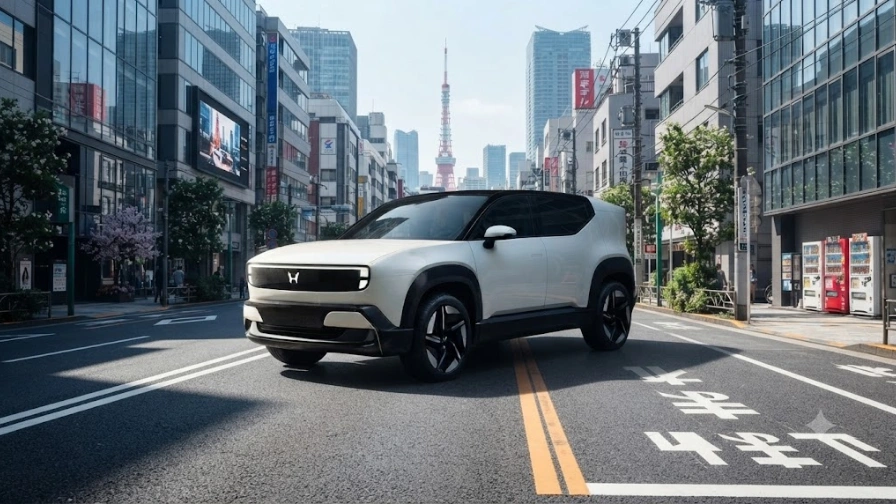
The Honda 0 Alpha is the third member of Honda's all-new 0 Series electric vehicle family, joining the previously revealed 0 Saloon and 0 SUV that debuted at CES 2025. Where those two models were positioned as flagship, tech-forward EVs, the 0 Alpha is Honda's "gateway model" — smaller, more affordable, and designed specifically to bring first-time buyers into the 0 Series ecosystem.
Built on a dedicated EV-only platform under Honda's "Thin, Light, and Wise" design philosophy, the 0 Alpha uses a low-height body without sacrificing ground clearance, giving it a stance that's part urban crossover, part rugged SUV. Honda has confirmed it belongs to roughly the same size class as the previous-generation HR-V/Vezel, with a wheelbase about 100mm longer than the Elevate and a track around 20mm wider — putting it squarely in the compact SUV segment that dominates Indian car sales charts.
Unlike its bigger 0-Series siblings, which leaned into futuristic camera-based mirrors and heavy screen use, the 0 Alpha is expected to keep things comparatively conventional — regular side mirrors, a more accessible cabin layout, and styling tuned for mass-market appeal rather than flagship theatre.
Why Are Automakers Cancelling EV Projects?
To understand why the 0 Alpha's survival is genuinely newsworthy, it helps to look at just how brutal 2026 has been for global EV programs. Several forces have combined to trigger what analysts are now calling an "EV winter":
· The end of US tax incentives: Since the federal $7,500 EV tax credit expired in September 2025, American EV demand has fallen sharply, with some months showing sales drops of over 40% year-on-year.
· Tariff pressure: New US tariff policies have made both EV production and the broader gasoline/hybrid business less profitable for global automakers, squeezing margins across the board.
· Massive write-downs: Ford, GM, and Stellantis have collectively recorded more than $53 billion in EV-related write-downs and charges in 2026 alone, as they abandon or delay all-electric truck and SUV programs.
· Chinese competition: Automakers cite an inability to keep pace with cheaper, faster-iterating Chinese EV makers, especially in markets like China itself, where buyer preferences have shifted rapidly toward software-defined vehicles.
· Overbuilt expectations: Many of these programs were greenlit years ago when 100% EV adoption looked closer than it turned out to be. As demand growth slowed, automakers found themselves with expensive dedicated EV factories and platforms built for a market that hadn't fully materialized.
Honda itself is a textbook example. In March 2026, the company cancelled three US-bound electric vehicles — the 0 Series Saloon, 0 Series SUV, and the Acura RSX — all of which were slated for production in Ohio. Honda cited a combination of tariff pressure, weakening US EV demand, and increased competitive pressure in Asia, and said it expected total losses of up to 2.5 trillion yen (roughly $15.7 billion) tied to the reassessment. The company also flagged a likely operating loss for the fiscal year — its first in nearly 70 years.
Why Honda Is Still Moving Forward with the 0 Alpha SUV
Given all of that, the obvious question is: why is the 0 Alpha still alive? The answer comes down to geography and market fundamentals, not sentimentality.
1. It was never designed for the US market. Honda has been explicit that the 0 Alpha is aimed "mainly" at Japan and India — markets that don't carry the same tariff exposure or subsidy dependency that sank the US-bound 0 Series Saloon, 0 Series SUV, and Acura RSX. The cancelled models were all slated for Ohio production and US-specific business economics; the 0 Alpha sits entirely outside that equation.
2. India's EV market is still growing, not shrinking. While US EV sales have been falling, India's electric passenger vehicle segment just posted its strongest month ever, crossing 31,000 units in June 2026 — up nearly 20% month-on-month and more than doubling year-on-year. That's the opposite trend line from what's driving cancellations in North America, and it makes India one of the few large markets where launching a new EV in 2027 still looks like a reasonable bet.
3. Local manufacturing changes the cost math. Unlike the cancelled US models, the 0 Alpha will be built locally in India rather than imported, insulating it from the tariff dynamics that made the American 0 Series financially unworkable.
4. It fills a genuine white space in Honda's India lineup. Honda currently has no mainstream electric passenger vehicle on sale in India, while rivals like Maruti Suzuki, Hyundai, Mahindra, and Tata have all rolled out competitive EVs. The 0 Alpha isn't a moonshot flagship — it's a necessary product to keep Honda relevant as the Indian market electrifies.
5. Honda hasn't abandoned EVs, it's recalibrating where it builds them. The company's own statements make clear this is a reassessment of resource allocation, not a wholesale retreat from electrification. Emerging markets with rising EV penetration, like India, are exactly where that recalibrated strategy is being pointed.
Honda 0 Alpha SUV Expected Features
While Honda hasn't confirmed a full features list yet, reports based on the prototype and ongoing India road-testing point to:
· A flat cabin floor enabled by the "Thin" battery-and-motor packaging approach
· A hexagonal steering wheel with paddle shifters, reportedly used to manage regenerative braking levels
· Advanced connected-car technology and an updated infotainment experience in line with Honda's newer software push
· A front-mounted charging port for easier access in typical parking situations
· Pillar-concealed rear door handles for a cleaner side profile
· A suite of driver-assistance and safety technology expected to be more comprehensive than Honda's current India lineup
· Multiple exterior colour options, with white, black, and silver already spotted on test mules
Full confirmation of features will likely come closer to the car's global and India unveiling, expected sometime around 2027.
Expected Powertrain, Battery & Range
Honda has kept official powertrain specifications under wraps, but a fairly consistent picture has emerged from testing mules and industry sourcing:
· Drive layout: Single electric motor, front-wheel drive configuration at launch
· Battery chemistry: LFP (Lithium Iron Phosphate), chosen for its durability, safety, and lower cost versus NMC alternatives
· Battery capacity: Estimates vary across reports, generally clustering between 60 kWh and 75 kWh, with the possibility of two pack sizes offered
· Range: Real-world estimates range from roughly 400 km up to 500+ km per charge, depending on the battery variant
· Fast charging: Expected to support rapid DC charging, with some reports suggesting a 15–80% top-up in well under 15 minutes
If these figures hold at production, the 0 Alpha would sit comfortably in the upper-mid tier of range performance for its price bracket in India — competitive with, and in some cases ahead of, several existing rivals.
Honda 0 Alpha SUV Design Highlights
The 0 Alpha's design borrows heavily from its larger 0 SUV sibling but scales things down and softens a few details for a more mainstream, approachable look:
· Low, wide stance: True to Honda's "Thin" philosophy, the SUV achieves a lower roofline than typical compact SUVs without compromising ground clearance — a genuinely useful trait for Indian road conditions.
· Distinctive lighting signature: A full-width light bar at the front connects to the illuminated Honda emblem and charging door, while a U-shaped lighting element wraps the rear, bordering an upright windshield-like tailgate glass.
· Minimalist detailing: Compared to the flagship 0 SUV's pixel-matrix headlamps and camera-based mirrors, the Alpha opts for simpler, more production-friendly elements — a sign Honda is prioritizing manufacturability and cost control for this volume model.
· Distinctive proportions: A thick C-pillar and tall rear roofline give the 0 Alpha an almost minivan-like silhouette from certain angles, hinting at generous boot space and rear headroom — practical touches Indian family buyers tend to value highly.
· 19-inch wheels: Smaller than the 21-inch units on the flagship 0 SUV, in keeping with the Alpha's more affordable positioning.
Honda 0 Alpha SUV vs Rival Electric SUVs
The 0 Alpha is entering one of the most contested corners of the Indian EV market. Here's how it's shaping up against the competition it's expected to face at launch:
|
Model |
Estimated Battery/Range |
Positioning |
|
Honda 0 Alpha |
60–75 kWh, ~400–500+ km |
New entrant; dedicated EV platform, local production |
|
Maruti Suzuki e Vitara |
Multiple battery options |
Backed by Maruti's dealer network and India's largest sales reach |
|
Hyundai Creta Electric |
Established midsize EV platform |
Leverages the hugely popular Creta nameplate and brand trust |
|
Mahindra BE 6 |
Born-electric platform |
Positioned as a design-forward, performance-oriented EV |
|
Tata Curvv EV |
Established India-built EV |
Backed by Tata's market-leading EV ecosystem and charging network |
|
MG ZS EV |
Established India EV |
One of the earlier mainstream EV SUVs in India |
|
Toyota Urban Cruiser EBELLA |
New EV entrant |
Toyota's fresh push into India's EV retail segment |
Honda's advantage here isn't going to come from being first — it's arriving in a segment where Tata, Mahindra, and Maruti already have entrenched positions and loyal buyers. Its edge will need to come from range competitiveness, Honda's reliability reputation, and pricing discipline given the wide ₹17–25 lakh estimate currently floating around.
Honda's Global EV Strategy Explained
Honda's 2026 playbook reveals a company deliberately splitting its EV strategy by region rather than applying a single global template:
· United States: Retreat and reallocation. The cancellation of the 0 Series Saloon, 0 Series SUV, and Acura RSX signals Honda is prioritizing hybrid technology in North America — including updates to the Civic Hybrid and a new V6 hybrid powertrain for models like the Passport, Pilot, and Acura MDX — rather than fighting for EV share in a market where demand has cooled and tariffs bite hardest.
· Emerging markets (India, and to an extent broader Asia): Continued, targeted investment. The 0 Alpha's local manufacturing commitment and India-first launch plan show Honda still believes in EVs — just not everywhere, and not at the same pace it once promised.
· Japan: A parallel home-market launch alongside India, likely leveraging shared platform economics between the two markets to keep development and production costs manageable.
This is a meaningful shift from Honda's 2024 ambition of seven 0-Series models rolling out globally before the end of the decade. What's left of that plan is now concentrated on markets where EV growth curves are still pointing up — and India is currently near the top of that list.
Why the Honda 0 Alpha SUV Matters for the Indian EV Industry
For India's EV ecosystem, the 0 Alpha's survival — while its US siblings got cancelled — carries a few important signals:
1. India is increasingly treated as a primary EV market, not an afterthought. Honda choosing India as one of only two launch markets, complete with local manufacturing, reflects growing confidence in the country's EV trajectory rather than a cautious wait-and-watch approach.
2. It validates India's EV growth story at a moment of global doubt. With India's electric passenger vehicle sales just posting a record month, Honda's bet lines up with real market momentum, not just optimism.
3. More competition benefits Indian buyers. A crowded compact EV SUV segment — spanning Tata, Mahindra, Hyundai, Maruti, MG, Toyota, and soon Honda — should sharpen pricing, accelerate feature upgrades, and pressure automakers to keep improving range and charging speed.
4. It signals Japanese automakers are recommitting to India's EV race. Honda joins Toyota (with the Urban Cruiser EBELLA) in bringing genuine EV competition to a segment that, until recently, was dominated by domestic and Korean players.
5. Local production could stabilize pricing. Manufacturing the 0 Alpha in India, rather than importing it, should help Honda avoid the cost pressures that made its US EVs commercially unviable — a good sign for keeping the eventual sticker price competitive.
Conclusion
The Honda 0 Alpha SUV is a rare bright spot in a year defined by EV retrenchment. While Honda wrote off billions of dollars cancelling its US-bound 0 Series Saloon, 0 Series SUV, and Acura RSX, it chose to keep building the smaller, more affordable Alpha specifically for India and Japan — markets where EV demand is still climbing rather than collapsing. That decision says as much about where the global EV industry's centre of gravity is shifting as it does about the car itself. With an expected 2027 India launch, a genuinely competitive range target, and local manufacturing to keep pricing in check, the 0 Alpha won't just be another EV launch — it'll be a real test of whether Honda can translate its hybrid-era reputation for reliability into electric vehicle credibility in one of the world's fastest-growing car markets.
FAQs
Q1. What is the Honda 0 Alpha SUV?
The Honda 0 Alpha (styled 0 α) is Honda's entry-level electric SUV in its new 0 Series lineup, first shown as a prototype at the Japan Mobility Show 2025. It's positioned as the "gateway model" to Honda's electric vehicle range.
Q2. When will the Honda 0 Alpha launch in India?
The 0 Alpha is expected to launch in India around 2027, with reports pointing toward early-to-mid 2027 as the likely window. It will be manufactured locally in India.
Q3. What is the expected price of the Honda 0 Alpha in India?
Estimates vary by source, but most place the expected ex-showroom price somewhere between ₹17 lakh and ₹25 lakh, with a few reports suggesting it could stretch closer to ₹30 lakh depending on the top variant.
Q4. What range can the Honda 0 Alpha deliver?
Based on currently reported battery options (roughly 60–75 kWh, LFP chemistry), the 0 Alpha is expected to offer a real-world range of approximately 400 to 500+ km on a full charge, though official figures haven't been confirmed yet.
Q5. Why did Honda cancel other EVs but keep the 0 Alpha?
Honda cancelled the 0 Series Saloon, 0 Series SUV, and Acura RSX because they were built for the US market, where tariffs and falling EV demand made them financially unviable. The 0 Alpha, by contrast, is built for India and Japan — markets where EV demand is still growing — and will be manufactured locally, avoiding the cost pressures that sank its US counterparts.
Q6. Which cars will the Honda 0 Alpha compete against in India?
Expected rivals include the Maruti Suzuki e Vitara, Hyundai Creta Electric, Mahindra BE 6, Tata Curvv EV, MG ZS EV, and the Toyota Urban Cruiser EBELLA.