India's electric passenger vehicle segment continued its strong momentum in July 2026, registering retail sales of more than 30,000 units for the second consecutive month. Following June's all-time high of 33,307 units, the market recorded 32,609 retail registrations in July, reflecting an impressive 83 percent year-on-year growth, according to Vahan data. The month also proved significant for leading manufacturers, with Tata Motors achieving its highest-ever monthly EV sales, while Mahindra and Maruti Suzuki registered their second-best monthly performances.
Although different industry trackers estimate the annual growth rate between approximately 73 percent and 83 percent due to differences in retail registration, wholesale dispatch and brokerage methodologies, the overall conclusion remains the same. India's EV passenger vehicle market delivered one of its strongest performances so far, with market leadership increasingly concentrating around a handful of major players.
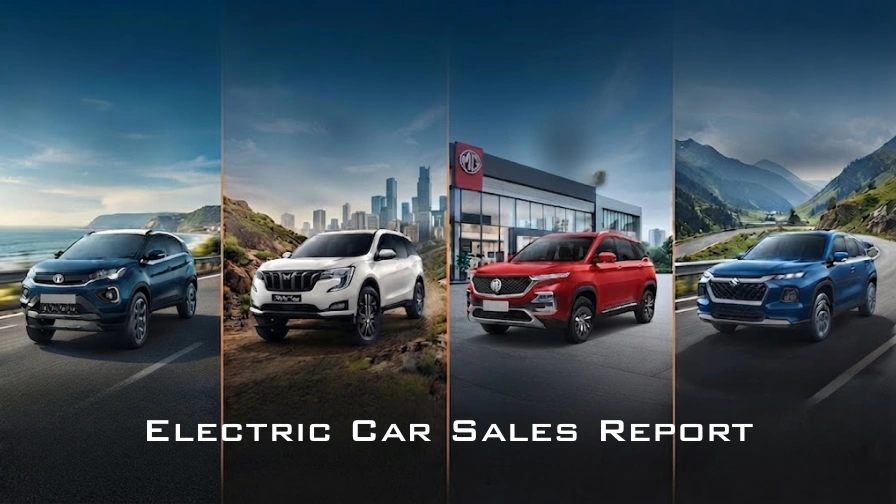
Electric Car Sales Report July 2026
Based on Vahan retail registration data, the July sales rankings are as follows:
|
Rank |
Brand |
July 2026 Sales |
Market Share |
YoY Growth |
|
1 |
Tata Motors |
13,578 units |
Crossed 40% |
+102% |
|
2 |
Mahindra |
7,677 units |
22% |
+125% |
|
3 |
JSW MG Motor |
5,642 units |
16% |
-4% |
|
4 |
Maruti Suzuki |
1,500 units |
4.8% |
— |
|
5 |
VinFast |
1,478 units |
4% |
Record high |
|
6 |
BYD |
742 units |
— |
+47% |
|
— |
Kia |
464 units (wholesale) |
— |
+614% |
Despite the sharp jump in retail volumes, electric passenger vehicles maintained a 7.7 percent share of the overall passenger vehicle market in July, unchanged from June, according to a Nuvama report. This indicates that EV demand is expanding alongside the broader passenger vehicle market rather than increasing its overall market penetration at a faster pace.
Tata Motors Strengthens Its Leadership
Tata Motors further reinforced its dominance in the electric passenger vehicle segment during July. The company recorded its highest-ever monthly retail EV sales by delivering 13,578 units, representing a 102 percent increase over July 2025 and a 6 percent improvement compared to June 2026. With this performance, Tata also moved beyond the 40 percent market share mark after a considerable gap.
The company has now sold over 12,000 electric vehicles for two consecutive months, following 12,756 units in June. Between April and July, Tata Motors accumulated total EV sales of 46,697 units, registering a strong 108 percent year-on-year increase.
The Nexon EV remained Tata's highest-selling electric model during the month. At the same time, the refreshed Tiago EV and Punch EV continued attracting a significant number of first-time EV buyers. By offering products across multiple price segments—from hatchbacks to micro SUVs and midsize SUVs—Tata has successfully expanded its customer base while maintaining a comfortable lead over its competitors.
Mahindra Continues Its Rapid Growth
Mahindra remained India's second-largest electric passenger vehicle manufacturer in July and continued its remarkable growth trajectory. The company sold 7,677 electric SUVs during the month, marking a 125 percent increase over July 2025. Although this was 498 units lower than its June total, Mahindra comfortably crossed the 7,000-unit milestone for the second consecutive month. Its market share also improved to 22 percent, compared to 19 percent during the same period last year.
Demand remained healthy for both the BE 6 and XEV 9e, while the recently introduced XEV 9S further expanded Mahindra's SUV portfolio. Unlike Tata Motors, which caters to multiple vehicle categories, Mahindra has focused exclusively on purpose-built electric SUVs, allowing the company to establish a strong presence in one of India's fastest-growing vehicle segments.
According to Nuvama, the Indian EV market is becoming increasingly concentrated around Tata Motors and Mahindra. Together, the two manufacturers contributed more than 65 percent of all electric passenger vehicle registrations in July 2026. Compared to roughly 57 percent a year earlier, their combined market share has increased substantially, highlighting the growing dominance of these two brands in India's EV landscape.
MG Motor, Maruti Suzuki and Other EV Brands
While Tata Motors and Mahindra dominated the headlines, the performance of the remaining manufacturers painted a more varied picture.
JSW MG Motor India retailed 5,642 electric passenger vehicles in July 2026, registering a 4 percent decline compared to the 5,900 units sold in July 2025. Sales were also 9 percent lower than June's 6,180 units, bringing the brand's market share down to 16 percent from 33 percent a year ago. Despite this decline in EV market share, MG's overall business remained healthy as the company achieved another record month in combined vehicle sales, with electric vehicles contributing more than 80 percent of its total volumes. The Windsor EV continued to lead the company's lineup, supported by models such as the Comet EV, ZS EV, Cyberster and M9 MPV. The slower growth simply reflects that competitors like Tata Motors and Mahindra expanded much faster, reducing MG's share in a rapidly growing market.
Other manufacturers also recorded notable performances during the month:
● VinFast registered its strongest-ever monthly performance by retailing 1,478 units, surpassing its previous record of 1,448 units achieved in June. The company secured around 4 percent market share, with the VF Limo Green, designed primarily for commercial applications, contributing 46 percent of its Q1 FY2027 wholesale volumes.
● BYD sold 742 electric vehicles in July, representing a 47 percent year-on-year increase. However, volumes were 20 percent lower than June, which still remains the company's best monthly performance. BYD had also implemented its second price increase of the year on July 1 after revising prices earlier in May.
● Kia recorded the highest percentage growth among all manufacturers. Sales jumped from just 65 units in July 2025 to 464 units in July 2026, reflecting a remarkable 614 percent increase, largely supported by the recently introduced Syros EV. Even so, Kia's overall market presence remains relatively small compared to the segment leaders.
● Maruti Suzuki, despite entering the electric vehicle space only recently with the e Vitara, has already climbed into the list of the country's top five EV manufacturers within a short period.
Top 10 Best-Selling Electric Cars in July 2026
Looking at model-level trends and overall brand performance, the following electric cars remained among India's strongest performers during July 2026:
- Tata Nexon EV – Tata's confirmed EV volume driver; Tata sold 15,055–15,217 EVs total in July (~41–47% market share), Nexon EV leading that mix.
- MG Windsor EV – MG's confirmed best-selling model; part of MG's 5,642–6,585 EV units in July.
- Tata Punch EV – Along with Tiago EV, drew a large share of first-time EV buyers within Tata's EV total.
- Mahindra BE 6 – Contributed to Mahindra's 6,473–7,677 electric SUV units; BE 6 and XEV 9e both cited as "continuing strong demand."
- Mahindra XEV 9e – Sustaining demand alongside BE 6.
- Mahindra XEV 9S – Mahindra's new three-row born-electric SUV, adding further depth to the lineup.
- Tata Tiago EV – Updated version continues drawing new EV buyers.
- VinFast Limo Green – VinFast's confirmed highest-selling model (fleet-focused); VinFast sold 2,426 units total in July.
- Tata Curvv EV – Part of Tata's EV spread; Tata's overall Curvv (ICE+EV) posted 1,697 units in July.
- MG ZS EV / Comet EV – Cited alongside Windsor EV as MG's other EV contributors.

Note: Most industry reports published only brand-wise sales figures for July 2026, without releasing exact model-level registration numbers. Therefore, the ranking above is based on each model's contribution to its respective brand's overall performance during the month. Prefer watching over reading? Hit play on this detailed video breakdown by Abhishek Moto below to catch all the major highlights and updates from this month's electric car sales report!
https://youtu.be/laDql7hDuOo?si=zaT1BbINfh9yEJW6
Electric Car Market Share in July 2026
The latest market share data clearly highlights how India's electric passenger vehicle market is increasingly becoming concentrated among a few leading manufacturers.
● Tata Motors: Crossed the 40 percent market share mark.
● Mahindra: Increased its share to 22 percent from 19 percent a year earlier.
● MG Motor: Declined to 16 percent from 33 percent in July 2025.
● Maruti Suzuki: Approximately 4.8 percent.
● VinFast: Around 4 percent.
● Others (BYD, Kia, Tesla, Toyota, BMW and Mercedes-Benz): Shared the remaining single-digit portion of the market.
Together, Tata Motors and Mahindra contributed more than 65 percent of all electric passenger vehicle registrations during July 2026. In simple terms, nearly two out of every three electric cars sold in India during the month came from these two manufacturers alone, underlining their growing dominance in the country's EV segment.
July 2026 vs July 2025: EV Sales Comparison
India's electric passenger vehicle market witnessed a significant jump in July 2026 compared with the same month last year. Retail registrations climbed to 32,609 units, representing an 83 percent year-on-year increase, reflecting the growing acceptance of electric mobility across the country.
Tata Motors retained its leadership position with 13,578 units, recording a 102 percent rise over July 2025. Mahindra emerged as the fastest-growing among the major manufacturers, posting 7,677 units and an impressive 125 percent year-on-year growth. MG Motor, on the other hand, remained among the top three brands despite witnessing a 4 percent decline in retail sales.
Several newer players also strengthened their presence. VinFast achieved its highest-ever monthly retail volume, while BYD continued to expand with a 47 percent increase over the previous year. Kia registered the sharpest percentage growth, with sales surging 614 percent following the launch of the Syros EV. Maruti Suzuki also established itself among the country's leading EV manufacturers within a short period of entering the segment.
The comparison clearly shows that the Indian EV market is no longer dependent on a single manufacturer. Multiple automakers are now contributing to the segment's expansion, giving buyers a wider range of electric vehicles across different price points and body styles.
What's Driving India's EV Growth?
Several industry developments have contributed to the strong growth seen in July 2026.
One of the biggest factors has been the continuous expansion of model choices. Buyers today can select from compact hatchbacks, SUVs, premium electric vehicles and commercial-focused models, making EV ownership suitable for a much wider audience.
Automakers have also been introducing attractive discounts, exchange bonuses and financing schemes, encouraging more customers to switch from conventional petrol and diesel vehicles.
At the same time, improvements in charging infrastructure and increasing awareness about lower running costs have boosted consumer confidence. With battery technology improving and public charging networks expanding steadily, range anxiety is gradually becoming less of a concern.
Another key trend is the arrival of new manufacturers such as VinFast and the growing participation of brands like Maruti Suzuki, creating stronger competition and expanding customer options across multiple segments.
Industry Outlook
The July 2026 performance indicates that India's electric passenger vehicle market continues to move on a strong growth trajectory. Crossing the 30,000-unit mark for the second consecutive month demonstrates that demand is becoming more consistent rather than being driven by one-off factors.
Tata Motors remains the clear market leader, while Mahindra is steadily closing the gap with sustained momentum. Although MG Motor's market share has declined, the company continues to maintain healthy EV volumes. Meanwhile, Maruti Suzuki, VinFast, BYD and Kia are gradually strengthening their positions, making the competitive landscape far more dynamic than before.
With several upcoming electric vehicle launches, expanding charging infrastructure and rising consumer acceptance, industry momentum is expected to remain positive in the coming months.
Conclusion
July 2026 proved to be another milestone month for India's electric passenger vehicle industry. Retail sales crossed 32,000 units once again, reflecting the segment's continued expansion and stronger customer adoption.
Tata Motors achieved its highest-ever monthly EV sales, Mahindra continued its rapid upward trajectory, while newer entrants such as VinFast and Maruti Suzuki added fresh competition to the market. At the same time, brands including BYD and Kia also delivered encouraging performances, highlighting the increasing diversity within India's EV ecosystem.
As more manufacturers introduce new electric models and infrastructure continues to improve, India's transition towards electric mobility is expected to accelerate further, setting the stage for even stronger growth in the months ahead.
Source: https://vahan.parivahan.gov.in/ , https://pulseenergy.io/sales-tracker, YouTube Chanel : Abhishek Moto, https://www.iea.org/news/quarterly-sales-of-electric-cars-break-records-in-several-key-markets-amid-energy-crisis
FAQs: Electric Car Sales Report July 2026
1. How many electric cars were sold in India in July 2026?
India recorded more than 32,000 electric passenger vehicle sales in July 2026, making it the second consecutive month in which monthly EV retail sales crossed the 30,000-unit mark.
2. Which company sold the most electric cars in July 2026?
Tata Motors remained the leading electric passenger vehicle manufacturer in India in July 2026, maintaining its position at the top of the EV sales chart.
3. What was Tata Motors' EV sales in July 2026?
Tata Motors recorded strong electric vehicle sales in July 2026, with industry registration data putting its EV volume at around 13,700 units.
4. How much did electric car sales grow in July 2026?
India's electric passenger vehicle market registered strong year-on-year growth in July 2026, with sales increasing by more than 80% compared with July 2025.
5. Which EV brands were the top performers in July 2026?
Tata Motors led the market, followed by Mahindra and JSW MG Motor among the leading electric passenger vehicle brands in July 2026.
6. Did Tata Motors retain its EV market leadership in July 2026?
Yes. Tata Motors retained its leadership position in India's electric passenger vehicle market in July 2026, supported by its broad EV portfolio and strong monthly volumes.
7. Did electric car sales cross 30,000 units in July 2026?
Yes. Electric passenger vehicle retail sales crossed the 30,000-unit mark for the second consecutive month in July 2026.
8. What does the July 2026 EV sales report indicate about India's electric car market?
The July figures indicate that demand for electric passenger vehicles is continuing to strengthen in India, with monthly volumes remaining above 30,000 units and several manufacturers recording significant growth.