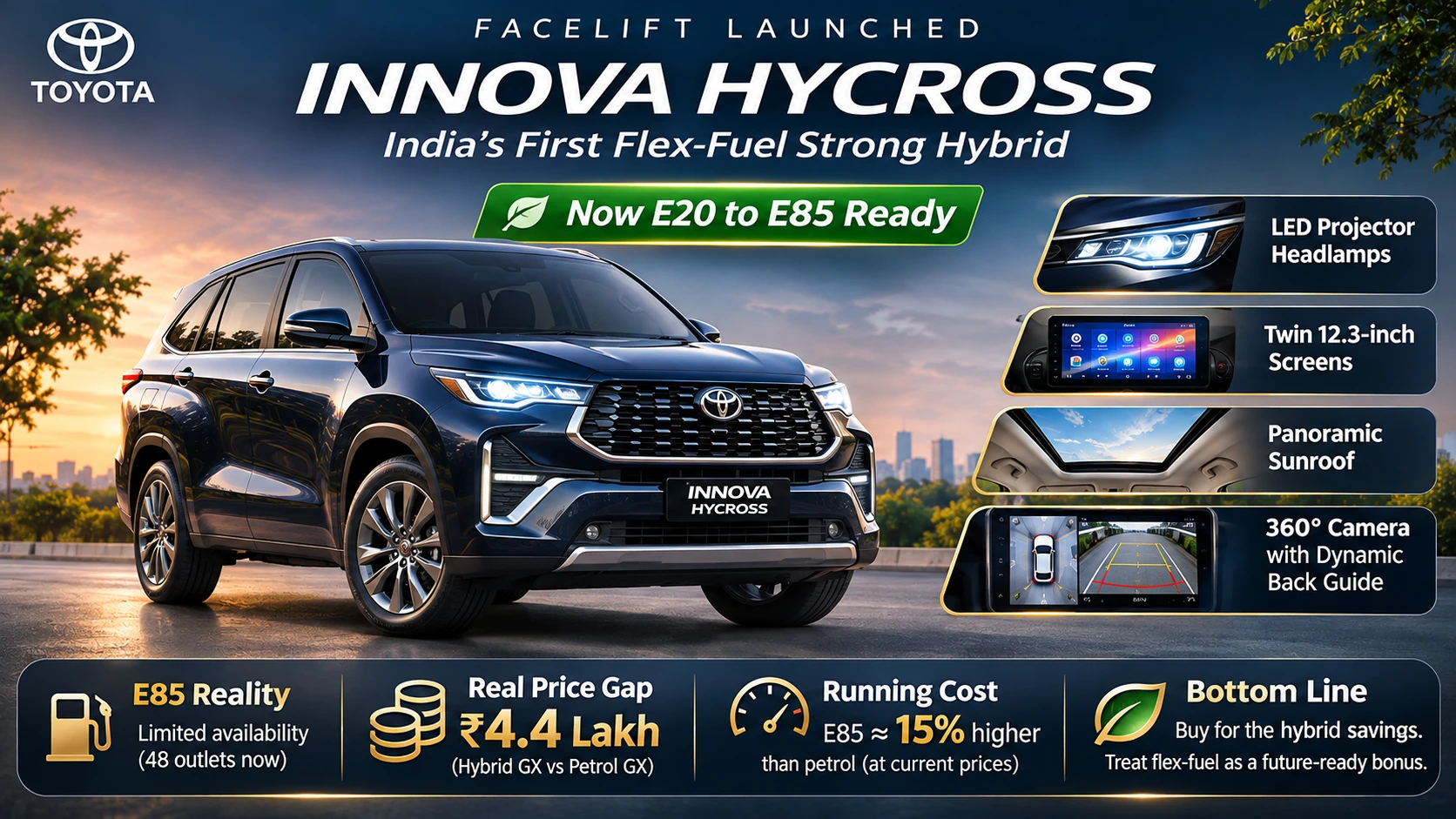
Toyota launched the facelifted Innova Hycross on 25 November, and the headline writes itself: India's first flex-fuel strong hybrid, able to run on anything from E20 petrol up to E85.
The interesting part isn't the badge. It's that almost nobody has worked out what E85 costs to run, and the answer isn't what the pump price suggests. There's also a price comparison doing the rounds that is off by about four lakh rupees.
The Short Answer
The facelift brings new bumpers, LED projector headlamps, a 12.3-inch infotainment screen alongside a 12.3-inch TFT multi-information display, a panoramic sunroof and Toyota's Panoramic View Monitor with Dynamic Back Guide, and the hybrid is now flex-fuel capable from E20 to E85. Prices run from ₹19.59 lakh for the petrol GX to ₹31.99 lakh for the hybrid ZX, introductory and ex-showroom. The flex-fuel ability is close to useless for most buyers today, because E85 is sold at a few dozen outlets in one corridor. And on current prices E85 would cost you more per kilometre than petrol, not less. Buy this car for the hybrid system, which is a genuine saving, and treat the flex badge as a free option for later.
What Launched on 25 November
| Variant | Powertrain | Seats | Price, ex-showroom |
|---|---|---|---|
| GX Gasoline | 2.0 petrol. The earlier model, carried over. Not flex-fuel | 7 or 8 | ₹19.59 lakh / ₹19.64 lakh |
| G Hybrid | 2.0 flex hybrid | 7 or 8, same price | ₹19.99 lakh |
| GX Hybrid | 2.0 flex hybrid | 7 or 8 | ₹23.99 lakh / ₹24.04 lakh |
| VX Hybrid | 2.0 flex hybrid | 7 or 8 | ₹28.79 lakh / ₹28.84 lakh |
| ZX Hybrid | 2.0 flex hybrid | 7 only | ₹31.99 lakh |
Worth reading that table carefully, because the seating premium is not uniform. On the GX and VX hybrids the eight-seater costs ₹5,000 more, on the G Hybrid both layouts are the same price, and the ZX comes as a seven-seater only. Flex-fuel runs across all four hybrid grades. The GX Gasoline is a different thing: Toyota lists it separately as the earlier model continuing on sale, not as part of the new line-up, and it is not flex-fuel. That matters for the comparison people are making below.
Toyota quotes the hybrid at a combined 147 kW, about 197hp, and claims 22.58 km/l on E20. The petrol's claim on the outgoing car was 16.13 kmpl.
The ₹40,000 That Is Really ₹4.4 Lakh
Here's the comparison you'll see repeated: petrol from ₹19.59 lakh, flex hybrid from ₹19.99 lakh, so the hybrid costs ₹40,000 more. That reading is wrong, and it's wrong by a lot.
Those two prices are different trim levels. The petrol is sold only as a GX. The ₹19.99 lakh hybrid is a G, which sits below it. Line up the same trim against itself, seven-seater against seven-seater, and the petrol GX at ₹19.59 lakh faces the hybrid GX at ₹23.99 lakh. The real premium for the hybrid powertrain is ₹4.4 lakh, eleven times the headline figure.
My advice: whenever a price list has one powertrain in a single trim and the other across four, assume the headline gap is an artefact of the trim ladder and go find the like-for-like pair yourself. It takes thirty seconds and it is the difference between a sensible decision and a badly wrong one.
Can You Even Buy E85 Yet?
This is the question the launch coverage mostly skips. The petroleum ministry launched E85 on 5 June 2026 at 48 public-sector retail outlets nationwide, with the early network clustered around Delhi-NCR, Mumbai, Pune and Nagpur.
The ministry's own expansion plan is 500 outlets by December 2026 and about 5,000 by December 2027. Those are targets rather than pumps in the ground, and even 5,000 would be a small fraction of India's filling stations.
So unless you live and drive inside that corridor, the flex capability is theoretical for now. The saving grace is that it costs you nothing: the car runs on ordinary E20 petrol everywhere, exactly like any other Hycross hybrid. It's an option you may be able to use in a few years, not a constraint you take on today.
The Sum Nobody Is Doing
E85 is cheaper at the pump, so it must be cheaper to run. That is the assumption, and it doesn't survive contact with the arithmetic.
Ethanol holds roughly 30 percent less energy per litre than petrol. A litre of E85 therefore moves your car about 70 percent as far as a litre of petrol does. So the fuel has to be around 30 percent cheaper just to break even, before it saves you a single rupee. Everything that follows is approximate: the energy gap is a round figure, pump prices differ by city and change often, and your own driving moves the result. The shape of the answer is what matters, not the decimals.
- The break-even rule, worth remembering: E85 needs to cost roughly 70 paise for every rupee of petrol. Much above that and you're paying more per kilometre despite the lower pump price.
- What that means right now, as a rough illustration: Delhi petrol was ₹102.12 a litre in late November, so break-even for E85 is somewhere near ₹71. The petroleum ministry put E85 at about ₹20 a litre below petrol, which lands around ₹82. On those numbers it works out roughly 15 percent more expensive per kilometre, not cheaper.
- What would change it: A deeper discount, around ₹30 a litre off rather than ₹20, or a tax break on flex-fuel vehicles. A flex engine can also run more aggressive ignition timing on high-ethanol fuel and claw back part of the energy penalty, but not all of it.
None of this is an argument against the car. It's an argument against buying it for the E85. Check both prices on the board at the pump and apply the 70 paise rule before you fill up. It is the same arithmetic that decides petrol against diesel, CNG and electric when you are picking a fuel in the first place.
Why This Car, and Why Now
The timing isn't an accident, and it connects to something I've written about before. The new corporate average fuel economy norms take effect from April 2027, and they don't treat all powertrains alike.
Under those rules a manufacturer counts a flex-fuel strong hybrid with a multiplier of 2.5, against 1.6 for an ordinary strong hybrid. Ethanol also carries a carbon neutrality factor, so the fuel itself is scored more kindly. One flex hybrid does considerably more for a carmaker's fleet average than one regular hybrid does.
That's worth knowing as a buyer, because it tells you this technology is going to spread whether or not the pumps arrive, and that more flex-fuel models are coming from more brands over the next two years.
Who Should Actually Buy It
- Buy it if you wanted the Hycross hybrid anyway: The hybrid system is where the real economy is, and the flex capability arrives at no cost to you. This is most buyers.
- Buy it if you're inside the E85 corridor and do high mileage: Even then, run the 70 paise check first, because today's gap doesn't clear it.
- Don't pay a premium chasing the flex badge: If a dealer frames the flex hybrid as a fuel-saving upgrade worth extra, that isn't supported by what E85 costs today.
- Think twice before taking the petrol GX to save money: The ₹4.4 lakh like-for-like gap is real, but so is a claimed efficiency difference of about 40 percent, and the petrol is the carried-over car rather than part of the new line-up. On a vehicle that usually does high mileage, work out your own payback before defaulting to the cheaper sticker.
Conclusion
The facelift is a solid update to a car that already sells well, and the flex hybrid is a genuine first for India. Just be clear about which part of it is doing the work. The hybrid drivetrain saves you money today. The flex-fuel ability saves you nothing today, costs you nothing either, and may become useful when the pumps and the pricing catch up. Buy the car on the first of those, and treat the second as a bonus that has not arrived yet.
Want to see whether the hybrid GX justifies its ₹4.4 lakh over the petrol? Book a test drive and we will connect you with your nearest authorised dealer.
FAQs
1. What is the Innova Hycross flex hybrid price in India?
Introductory ex-showroom prices run from ₹19.99 lakh for the flex hybrid G to ₹31.99 lakh for the ZX, with the GX hybrid at ₹23.99 lakh and the VX at ₹28.79 lakh. The eight-seat GX and VX cost ₹5,000 more, the G is the same price either way, and the ZX is a seven-seater only. A petrol GX, which is the earlier model continuing on sale and is not flex-fuel, sits at ₹19.59 lakh.
2. Is the hybrid really only ₹40,000 more than the petrol?
No. Those are different trims. The petrol is sold only as a GX at ₹19.59 lakh, and the ₹19.99 lakh hybrid is a lower G grade. Compared like for like, the hybrid GX is ₹23.99 lakh, so the powertrain premium is ₹4.4 lakh rather than ₹40,000.
3. What fuel can the Innova Hycross flex hybrid run on?
Anything from E20 petrol, which is the normal pump fuel in India, up to E85, which is 85 percent ethanol. You don't have to use E85, and the car behaves like a regular Hycross hybrid on ordinary petrol.
4. Where can I buy E85 fuel in India?
The petroleum ministry launched E85 on 5 June 2026 at 48 public-sector outlets nationwide, with the early network around Delhi-NCR, Mumbai, Pune and Nagpur. Its expansion plan is 500 outlets by December 2026 and about 5,000 by December 2027, but those are targets rather than pumps already open.
5. Is E85 cheaper to run than petrol?
Not at today's pricing, on an approximate calculation. Ethanol carries roughly 30 percent less energy per litre, so E85 has to be around 30 percent cheaper than petrol simply to break even. A discount of about ₹20 a litre against petrol at ₹102 leaves it costing a little more per kilometre, not less. Check both prices on the board, since they vary by city and change often.
6. Does running on E85 damage the engine?
Not in a vehicle built for it. Ethanol is more corrosive than petrol, so flex-fuel cars use upgraded fuel system materials and sensors that detect the blend and adjust the engine. A car not built for high-ethanol fuel should not be filled with E85.
7. Why is Toyota launching a flex-fuel hybrid now?
The fuel economy norms starting April 2027 count a flex-fuel strong hybrid with a multiplier of 2.5 against 1.6 for a standard strong hybrid, and ethanol gets a carbon neutrality factor on top. One flex hybrid does much more for a maker's fleet average than one regular hybrid.
8. Should I wait for more flex-fuel cars before buying?
Only if E85 specifically matters to you. More flex-fuel models are coming because the norms reward them, but the fuel network and the pricing are the slow part. If you want a Hycross hybrid, the flex capability costs you nothing to have now.