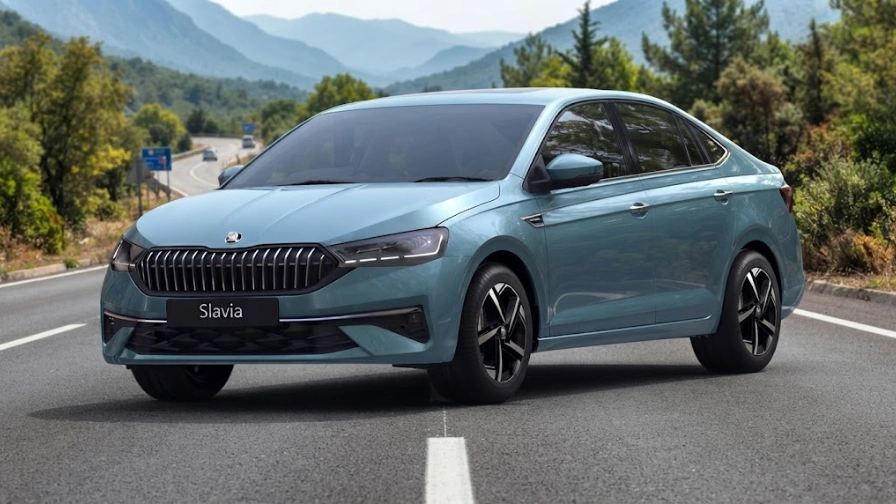
Skoda Auto India pulled the covers off the 2026 Slavia facelift on August 18, 2026, giving the midsize sedan its first proper mid-life update since it launched under the "India 2.0" strategy. Skoda has not yet announced official prices, and pre-bookings have opened at ₹15,000, so anyone quoting a firm variant-wise price list right now is working off estimates, not Skoda's own numbers.
That said, the direction of the update is clear. This isn't a cosmetic refresh alone — the update brings a new 8-speed automatic gearbox, a 360-degree camera, a larger 10.25-inch digital instrument cluster and a rear-seat massage function, on top of styling tweaks front and rear. The car itself measures 4541mm in length, 1752mm in width and 1507mm in height, riding on a 2651mm wheelbase — essentially unchanged from the outgoing model, so don't expect a dramatically different cabin or boot.
For context on where pricing is likely to land: the outgoing Slavia was priced from ₹10 lakh to ₹18.19 lakh (ex-showroom) as of August 2026. Industry estimates for the facelift sit in a similar-to-slightly-higher band given the added equipment, though the final figures will only be confirmed at the commercial launch.
What's New in the Skoda Slavia Facelift?
The facelift addresses what was arguably the Slavia's weakest point against newer rivals — its comparatively modest feature list. Here's what's genuinely changed:
Exterior: The front fascia retains Skoda's signature butterfly grille but with reworked chrome accents and internal geometric detailing, paired with a redesigned lower bumper with piano-black trim and sharper fog lamp housings. Updated LED headlamps with L-shaped DRLs sit up front, while the rear gets new LED tail lamps with sequential turn indicators. There are also new diamond-cut alloy wheels, a fresh garnish on the front fender, and brushed aluminium treatment around the windows.
Interior & tech: This is where the bulk of the upgrade lives. The Signature and Sportline variants, which previously made do with an analogue instrument cluster and a small 3.5-inch TFT display, now get an 8-inch digital instrument cluster — a feature earlier reserved for the Prestige and Monte Carlo. The Prestige and Monte Carlo, in turn, move up to a larger 10-inch digital cockpit. Touchscreen sizes also step up depending on variant — lower trims get a 17.7cm unit while higher trims get a larger 25.6cm screen, and the Virtual Cockpit itself scales from 20.32cm on mid variants to 26.03cm on the top-spec cars. Skoda has also added an AI-based assistant and expanded connectivity features across the range.
Comfort: Automatic climate control is now standard across the entire range — previously, the base variant made do with a manual AC unit. Depending on the variant, buyers can also get a sunroof, electrically adjustable front seats, ventilated seats and a rear-seat massage function.
Safety: A 360-degree camera is now offered on the Sportline, Prestige and Monte Carlo, while the Signature continues with just a rear parking camera, and the Classic and Classic Plus miss out on any camera altogether. Six airbags remain standard across the range, alongside 25 other safety features, building on the outgoing car's five-star Global NCAP rating.
Powertrain: The single biggest mechanical change is under the hood — more on that below.
Colours: Two new paint options join the palette — Arctic Silver and Cappuccino Beige — though deliveries in Cappuccino Beige won't begin until December 2026. The rest of the colour lineup carries over: Shimla Green, Brilliant Silver, Candy White, Carbon Steel, Steel Grey, Lava Blue, Deep Black and Cherry Red.
Skoda Slavia Facelift Variants Explained: Which One Should You Buy?
The facelifted Slavia continues in six variants: Classic, Classic+, Signature, Sportline, Prestige and Monte Carlo.
Classic is the fleet/entry option — it sticks with 15-inch steel wheels with wheel covers and misses out on the camera-based safety kit and the bigger digital cluster. Good if you just want a well-built, safe sedan with no frills, but most retail buyers will find it too bare.
Classic+ adds a step of convenience and tech over the base car, and per one report, this is actually where retail sales are expected to start in earnest, since it's the most affordable variant with the 1.0 TSI automatic option.
Signature is the sweet-spot value trim for many buyers — it now gets the 8-inch digital instrument cluster and continues with a rear parking camera, silver alloy wheels, and the newly-standard automatic climate control.
Sportline leans into a sportier visual identity — it keeps the same black alloy wheel design as before — while gaining the 360-degree camera and the bigger 8-inch cluster. If you like the way the car looks but don't need Prestige-level luxury kit, this is worth cross-shopping against Signature.
Prestige is the loaded, non-sporty flagship — it gets a dual-tone finish and revised 16-inch alloy wheels, the 10-inch digital cockpit, 360-degree camera, and the full comfort suite including the massage seats and sunroof.
Monte Carlo is the styling-focused range-topper — it gets red exterior accents, special badging, and a beige or tan-coloured interior, and is the only variant offered with dual-tone exterior paint. It rides on all-black alloy wheels with contrasting red brake calipers.
Practical recommendation: If budget is tight, Classic+ with the manual gearbox covers the essentials. For most buyers, Signature or Sportline will likely offer the best value-to-features ratio once official pricing lands, since they now inherit tech that used to be exclusive to the top two trims. Reserve Prestige and Monte Carlo for buyers who specifically want the massage seats, biggest screens, and full ADAS-adjacent camera suite.
Which Skoda Slavia Facelift Engine Should You Choose?
The Slavia facelift continues with the same two engines as before, but the way you can pair them has changed meaningfully.
The 1.0-litre turbo-petrol engine continues to produce 114bhp and 178Nm, and while a six-speed manual remains standard, the old six-speed torque-converter automatic has been replaced by a new eight-speed unit — the same 8-speed gearbox that first appeared on the Kushaq facelift earlier in 2026. This is a significant change for buyers who want a smooth, relaxed automatic for city and highway use, since the extra ratios should improve refinement and cruising efficiency over the outgoing 6-speed unit.
The larger 1.5-litre TSI engine makes 148bhp and 250Nm, and continues to send power to the front wheels exclusively through a seven-speed DSG gearbox. Skoda claims this 1.5 TSI-with-7-speed-DSG combination is a first-in-segment pairing, and it remains the enthusiast's choice — quicker, punchier, and with the dual-clutch's sharper shifts, though DSGs can feel slightly less smooth than a torque converter in stop-start traffic.
Which to pick:
-
Daily city driving, budget-conscious: 1.0 TSI manual — light, efficient, and the cheapest way into the range.
-
City + highway, want an automatic without sportiness: 1.0 TSI with the new 8-speed torque converter — likely to be the best all-rounder for most buyers.
-
Want performance and don't mind DSG traits: 1.5 TSI DSG — the quickest, most engaging Slavia you can buy.
Note: none of the current reporting indicates any change to fuel type — the Slavia facelift remains petrol-only, with no diesel or strong-hybrid option, unlike some rivals.
How to Book a Skoda Slavia Facelift Test Drive
-
Book online first. Visit Skoda India's official website and use the "Book a Test Drive" or dealer-locator section, enter your city and contact details, and a dealership will confirm a slot.
-
Or call/visit your nearest Skoda dealership directly. Since pre-bookings for the facelift have already opened at ₹15,000, dealers are actively taking test-drive interest alongside bookings — ask specifically for the facelift model, since outgoing pre-facelift stock may still be on the floor during the transition period.
-
Specify the variant and engine you want to drive. Because the 1.0 TSI automatic now uses a completely different 8-speed gearbox, don't assume the demo car matches what you'll eventually buy — confirm the exact powertrain (1.0 MT, 1.0 8AT, or 1.5 DSG) before your slot is booked.
-
Carry a valid driving licence and be prepared for the dealership to note your details for follow-up, as is standard practice.
-
Ask about a home test drive if offered in your city — several Skoda dealers run this for interested retail buyers, particularly around a new launch.
-
Time it around the commercial launch. Since official pricing is still pending as of this writing, demo units may be limited to metro dealerships initially before wider availability.
What Should You Check During the Skoda Slavia Facelift Test Drive?
-
Check the new 8-speed automatic gearbox: See how smoothly it changes gears, especially at low speeds and in stop-and-go traffic. Also check how quickly it responds when you suddenly accelerate.
-
Try the digital instrument cluster and infotainment system: Check whether the display is easy to read in sunlight, how quickly the menus respond, and whether Android Auto and Apple CarPlay work wirelessly or require a cable.
-
Test the 360-degree camera and blind-spot monitoring: If you are testing the Sportline, Prestige or Monte Carlo variant, check the camera's image quality and whether it gives you a clear view around the car.
-
Try the rear-seat massage function: If your test-drive car has this feature, check its different intensity levels and whether it remains comfortable and useful while the car is moving.
-
Check the ride quality on rough roads: Drive over potholes, speed breakers and uneven roads to see how comfortable the Slavia feels. Also check whether the facelift still offers the same balance between comfort and handling.
-
Listen for cabin noise: If possible, take the car on a highway and check how much road, tyre and engine noise enters the cabin at higher speeds.
-
Inspect the new interior and exterior finishes: Check the quality and fit of the new piano-black elements, brushed aluminium window surrounds and diamond-cut alloy wheels. Also see how easily the piano-black surfaces collect fingerprints or scratches.
-
Test the air conditioning: Since climate control is now available even on the base variant, check how quickly the cabin cools down, especially in hot weather.
Skoda Slavia Facelift vs Honda City vs Volkswagen Virtus
|
Aspect |
Skoda Slavia Facelift |
Honda City Facelift |
VW Virtus |
|
Price range (ex-showroom) |
Official pricing pending; outgoing model was ₹10–18.19 lakh |
₹12.1 lakh to ₹21.1 lakh |
₹11.16 lakh to ₹18.8 lakh (New Delhi) |
|
Engine options |
1.0 TSI (114bhp) MT/8AT, 1.5 TSI (148bhp) DSG |
1.5L NA petrol (119bhp) MT/CVT, plus a strong-hybrid e:HEV |
1.0 & 1.5 turbo-petrol (facelift expected with similar mechanicals) |
|
Standout strength |
European driving dynamics, now much stronger feature list |
Reliability, rear-seat space, hybrid fuel economy, vast service network |
Sharpest handling and highway stability among the three |
|
Standout weakness |
Pricing/positioning still unconfirmed at launch |
Trails on outright performance and cabin tech versus European/Korean rivals |
Ride can feel firmer for some buyers; facelift equipment update still catching up |
|
Hybrid available? |
No |
Yes (e:HEV) |
No |
If you want the most modern feature set at the mid-tier trims and genuinely enjoy driving, the Slavia facelift's new gearbox and expanded tech make a stronger case than before. If long-term reliability, resale, and a hybrid option matter more, the City remains hard to beat. If outright dynamics are your priority and you're comfortable with slightly firmer ride quality, the Virtus stays relevant, especially once its own facelift lands.
Skoda Slavia Facelift Price & Ownership Cost
Till now, Skoda has not released the official variant-wise price list, and any specific figures circulating online should be treated as estimates rather than confirmed pricing. What we do know:
-
Pre-bookings are open at ₹15,000.
-
The pre-facelift Slavia was priced from ₹10 lakh to ₹18.19 lakh (ex-showroom), which gives a reasonable floor for where the facelift will likely start, factoring in a modest premium for the added equipment.
-
Given that rivals like the Honda City facelift spans ₹12.1–21.1 lakh and the Virtus spans roughly ₹11.16–18.8 lakh, Skoda will likely price the Slavia facelift competitively within this same ₹10–19 lakh band to avoid ceding ground on value.
Ownership cost factors to budget for:
-
Fuel economy: the pre-facelift Slavia's ARAI-claimed mileage ranges from 18.73 to 20.32 kmpl depending on engine/gearbox; expect similar real-world numbers since the engines are unchanged.
-
Service costs: Skoda's after-sales network in India has historically been thinner than Honda's or Maruti's, so factor in service-centre proximity when budgeting time and cost for maintenance.
-
Insurance: Higher trims with more electronics (digital clusters, cameras, massage seats) will likely carry a marginally higher insured declared value and premium than base trims.
-
Resale value: Skoda sedans have traditionally lagged Honda and Hyundai slightly on resale in the Indian market — worth weighing if you plan to sell within 3–5 years.
Is the Skoda Slavia Facelift Worth Buying?
For most buyers, the honest answer is: wait for the official price list before deciding, since the value proposition hinges entirely on how aggressively Skoda prices the newly-loaded mid variants.
That caveat aside, the facelift genuinely fixes the previous car's biggest weakness — a comparatively thin feature list against segment rivals. The addition of a 360-degree camera, larger digital cockpit, front parking sensors and a rear massage function make the sedan substantially more competitive on equipment, while the switch to an 8-speed automatic on the 1.0 TSI should also improve everyday drivability for buyers who found the old 6-speed torque converter a little unrefined.
Buy it if: you value driving dynamics, want a European-feel cabin, and the mid-to-upper variants (Signature/Sportline/Prestige) come in at a price close to the outgoing model.
Consider alternatives if: you specifically want a hybrid powertrain (City e:HEV), you prioritise the sharpest handling in the segment above all else (Virtus), or Skoda's after-sales network isn't convenient in your city.
Conclusion
The 2026 Skoda Slavia facelift is a meaningful, feature-led update rather than a cosmetic refresh — the new 8-speed automatic, bigger digital displays, 360-degree camera and rear massage seats close much of the gap that had opened up against rivals like the Honda City and Volkswagen Virtus. The core sedan — its handling, safety credentials, and build quality — remains intact and unchanged. The one thing standing between "interesting update" and "compelling buy" is the official price list, which Skoda hasn't released yet. Book a test drive to experience the new automatic and tech firsthand, but hold off on a final decision until dealership pricing is confirmed.
Frequently Asked Questions
Q1. When was the Skoda Slavia facelift launched?
Skoda Auto India officially unveiled the 2026 Slavia facelift on August 18, 2026. Commercial launch with official prices is expected shortly after.
Q2. How many variants does the Slavia facelift come in?
Six variants: Classic, Classic+, Signature, Sportline, Prestige and Monte Carlo.
Q3. What engines are available?
A 1.0-litre turbo-petrol (114bhp/178Nm) with a 6-speed manual or new 8-speed automatic, and a 1.5-litre turbo-petrol (148bhp/250Nm) with a 7-speed DSG.
Q4. Is a diesel or hybrid version available?
No. The Slavia facelift remains petrol-only across both engine options; there is no hybrid or diesel variant.
Q5. What's the biggest mechanical change in the facelift?
The 1.0-litre turbo-petrol automatic switches from a 6-speed torque converter to a new 8-speed torque converter unit, aimed at smoother, more efficient cruising.
Q6. How much does the Skoda Slavia facelift cost?
Official prices have not been announced yet; only the ₹15,000 pre-booking amount is confirmed. Expect pricing broadly in line with, or slightly above, the outgoing model's ₹10–18.19 lakh range.
Q7. What new features does the facelift add?
A 360-degree camera, front parking sensors, a larger 10.25-inch-class digital instrument cluster on top trims, and rear-seat massage seats, along with standard automatic climate control across the range.
Q8. Does the Slavia facelift have a sunroof?
Yes, offered on select higher variants — confirm exact variant-wise availability once the full spec sheet is published at commercial launch.
Q9. How does it compare with the Honda City and VW Virtus on price?
The Honda City facelift spans ₹12.1–21.1 lakh and the VW Virtus spans roughly ₹11.16–18.8 lakh; the Slavia facelift is expected to be priced competitively within a similar band once confirmed.
Q10. Can I book a test drive now?
Yes — pre-bookings are open at ₹15,000, and dealerships are taking test-drive interest alongside bookings, though demo unit availability may vary by city until the commercial launch is complete.