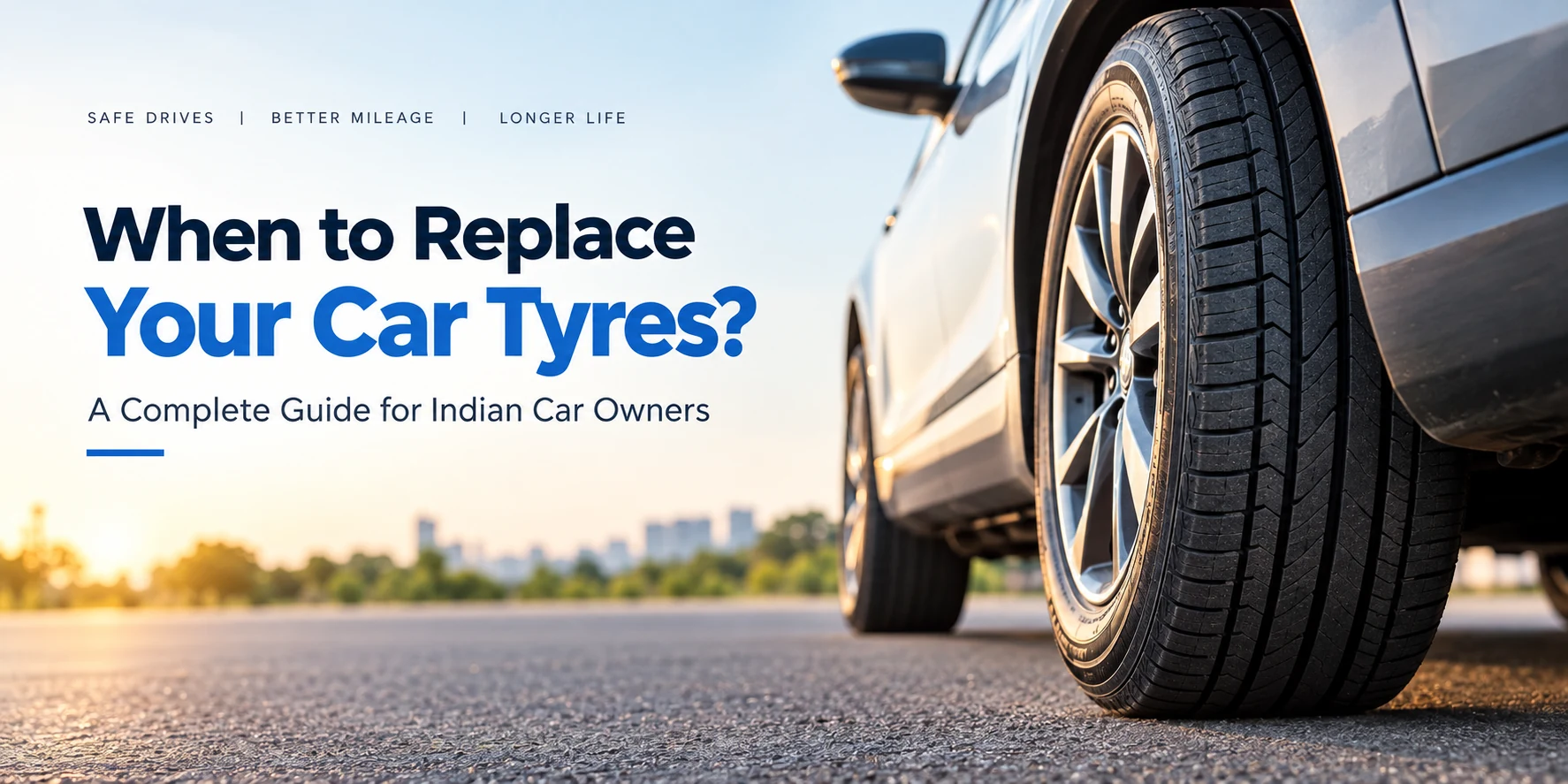
Most people replace tyres when the workshop tells them to, and the workshop is not always wrong. But it is the one component on your car where the shop's incentive and your safety point in slightly different directions, and where a four-digit code printed on the sidewall tells you more than any opinion will.
Three numbers decide whether your tyres need changing: how much tread is left, how old the rubber is, and how much damage the sidewall has taken. Here's how to read all three yourself.
The Short Answer
Replace your tyres when the tread reaches the wear indicators moulded into the grooves, which mark the legal minimum of 1.6 mm in India. Replace them on age too, even with tread left: get them professionally inspected every year once they pass five years old, and treat ten years from the manufacturing date as the hard limit. That date is stamped on the sidewall as the last four digits of the DOT code, week then year. Check it before you buy, because a tyre sold as new can already be two years old, and check your spare, because it ages on the same clock while you ignore it.
The Four Digits Most Owners Never Look At
Every tyre carries a DOT code on its sidewall, and the last four digits are a date. The first two are the week, the last two are the year. A code ending 3524 means that tyre was built in the 35th week of 2024. It takes ten seconds to find and it is the single most useful thing printed on the tyre.
This matters twice. First when you buy: tyres sit in warehouses, and a set sold as new can already be a year or two into its life. You are entitled to see the code before you pay and to ask for newer stock. Most shops swap it without argument once they see you checking.
Second when you inspect a used car. Old tyres on a low-odometer car tell you it sat unused, which is its own warning. Same habit as checking a car's manufacturing date, applied to the part that touches the road.
How Old Is Too Old? The Industry Does Not Agree
This is where most articles give you a confident number and most of them are picking a side without telling you. Here is what the people who make cars and tyres actually say.
| Who | Their position |
|---|---|
| Ford, Nissan and Mercedes-Benz | Replace six years after the production date, regardless of how much tread is left |
| Michelin and Continental | No fixed six-year rule. Professional inspection every year after five years, and replacement no later than ten years |
| The US tyre manufacturers' body | Calls the five to six year guideline an arbitrary range unsupported by data |
| US road safety regulator | Has no specific guidance on tyre ageing and leaves it to the makers |
So there is no settled answer, and anyone who gives you one without a caveat is guessing. The mechanism is not disputed though. Rubber hardens and develops fine cracks as it ages whether the tyre is used or not, and an old tyre with perfect tread can still separate at speed. Tread depth tells you about wear. It tells you nothing about age.
Two things push an Indian owner towards the earlier end of that range rather than the later one. Heat accelerates rubber ageing, and most of this country spends most of the year hot. And a car parked outside in direct sun ages its tyres faster than one that lives in a basement. If your car sleeps on the road in Delhi or Chennai, do not plan on getting ten years.
My advice: find the tyre section in your own car's owner's manual before you decide. If your carmaker specifies six years, that is the number that governs your warranty position, whatever the tyre brand says.
Tread: 1.6 mm Is the Legal Limit, Not the Safe One
The legal minimum tread depth for passenger car tyres in India is 1.6 mm. You do not need a gauge to check it. Every tyre has tread wear indicators, small raised bars sitting at the bottom of the main grooves at 1.6 mm. When the surface of the tread wears level with those bars, the tyre is finished as far as the law is concerned.
Whether you should run that far down is a different question, and tyre makers differ on it. Michelin's own guidance says changing before the indicators is premature. Plenty of workshops will push you to change well before. What nobody disputes is that wet braking gets worse as the tread gets shallower, and it gets worse gradually, long before the indicator is reached. So the honest framing is this: 1.6 mm is where it becomes illegal, not where it becomes risky.
- Check all four, in three places each: Tyres rarely wear evenly. Inner edge, centre and outer edge of each tyre, because uneven wear across one tyre is a wheel alignment problem, not a tyre problem, and replacing the tyre without fixing the alignment just ruins the new one.
- Check the pressure monthly: Underinflation wears the outer edges, raises your fuel bill and is one of the most common reasons a car starts returning worse mileage. Use the figure on the driver's door sticker, not the maximum printed on the tyre sidewall, which is a different number entirely.
- Look at the sidewall, not just the tread: Bulges, cuts and deep cracking mean replace now, whatever the tread depth or the age says. A bulge is the internal structure already failing.
What Tyres Actually Cost in India
Prices move with rubber costs and vary by city and seller, so treat these as a planning band rather than a quote, and get the shop's own figure before you commit.
| Common size | Typical car | Roughly, per tyre |
|---|---|---|
| 185/65 R15 | Baleno, i20, Glanza class | About ₹4,500 to ₹8,000 for mainstream brands, with premium touring tyres running above ₹10,000 |
| 205/65 R16 | Creta, Seltos class | About ₹5,500 to ₹9,000, with premium options higher |
Budget for the whole job rather than the sticker price. Four tyres, fitting, balancing, new valves and a wheel alignment is the realistic total, and the alignment is not optional if the old tyres wore unevenly. Buying two tyres instead of four is acceptable, but fit the new pair at the rear regardless of which end drives your car, because a car with more grip at the front and less at the back is the harder one to recover in a skid.
The Fifth Tyre Nobody Checks
Your spare is ageing on exactly the same clock as the other four, and it is the one you will need on a highway shoulder at night, which is the worst possible moment to discover it is a decade old and soft. The ten-year rule applies to it even though it has never turned a kilometre.
Two minutes, once a year: check the spare's date code, check its pressure, and check that the jack and the wheel spanner are actually in the car. On a lot of used cars one of those three has quietly gone missing, and nobody finds out until they need it.
What to Say at the Tyre Shop
- Ask to see the date code before fitting: On the actual tyres being fitted to your car, not the box or the display piece. This is the one check that saves real money, because old stock is old stock whatever discount comes with it.
- Decline the nitrogen upsell, or pay very little for it: Nitrogen holds pressure slightly more steadily than air. On a car checked monthly, the difference is small, and it is usually priced as though it were large.
- Do not mix brands or patterns across an axle: Two different tyres on the same axle behave differently under braking. Same brand, same pattern, same size on both sides is the minimum.
- Get the alignment and balancing in writing: They are often bundled as free and then quietly charged, or charged and then not done. Ask for them to appear as line items on the bill like any other dealer add-on.
- Keep the bill: It records the fitting date, which is what you will want when you are working out tyre age three years from now and the code has worn faint.
Conclusion
Tyres are the cheapest safety equipment on your car and the easiest to neglect, because they fail slowly and then all at once. Learn to read the date code, look at the wear indicators every few months, replace on age as well as on wear, and do not forget the spare. That is the whole discipline, and it costs you about five minutes a year.
Thinking of changing the car rather than the tyres? Book a test drive and we will connect you with your nearest authorised dealer.
FAQs
1. What is the legal minimum tyre tread depth in India?
1.6 mm for passenger car tyres. The tread wear indicators moulded into the bottom of the main grooves sit at exactly that depth, so when the tread wears level with them the tyre has reached the legal limit.
2. How do I check how old my tyre is?
Find the DOT code on the sidewall and read the last four digits. The first two are the week of manufacture and the last two are the year, so a code ending 3524 means the 35th week of 2024.
3. Should I replace tyres after five years even if the tread is fine?
Not automatically, but have them professionally inspected every year once they pass five. Some carmakers specify replacement at six years regardless of tread, while leading tyre makers set the limit at ten years with annual checks after five. Your own car's owner's manual is the one that governs your warranty.
4. Can a tyre be unsafe even with plenty of tread left?
Yes. Rubber hardens and develops cracks as it ages whether the tyre is used or not, and an aged tyre can separate at speed with full tread. Tread depth measures wear, not age, and the two are separate checks.
5. How much do car tyres cost in India?
For a common 185/65 R15 size, mainstream brands run roughly ₹4,500 to ₹8,000 per tyre, and a 205/65 R16 roughly ₹5,500 to ₹9,000. Premium touring tyres sit above those bands. Add fitting, balancing, valves and a wheel alignment to get the real cost of the job.
6. Should I replace all four tyres together?
Four together is ideal. If you are replacing two, fit the new pair at the rear whichever end of the car drives, because losing grip at the back is harder to recover than losing it at the front. Never mix brands or tread patterns on the same axle.
7. Does the spare tyre need replacing too?
Yes. It ages on the same clock as the others even though it is never used, and the ten-year limit applies to it. Check its date code and its pressure once a year, along with the jack and the wheel spanner.
8. Is nitrogen in tyres worth paying for?
It holds pressure slightly more steadily than ordinary air, which is a small benefit on a car whose pressures you check monthly anyway. Pay a token amount for it if it is offered, but it does not justify a large charge and it does not replace monthly pressure checks.