The extended warranty pitch arrives at the worst possible moment: a phone call in the last few months of your standard cover, from someone who knows exactly when it expires. The number sounds small next to a gearbox. The decision gets made in four minutes.
It's a reasonable product and for some owners it's clearly worth buying. But whether you're one of them depends on a calculation nobody at the dealership does with you, and it has nothing to do with how expensive a gearbox is.
The Short Answer
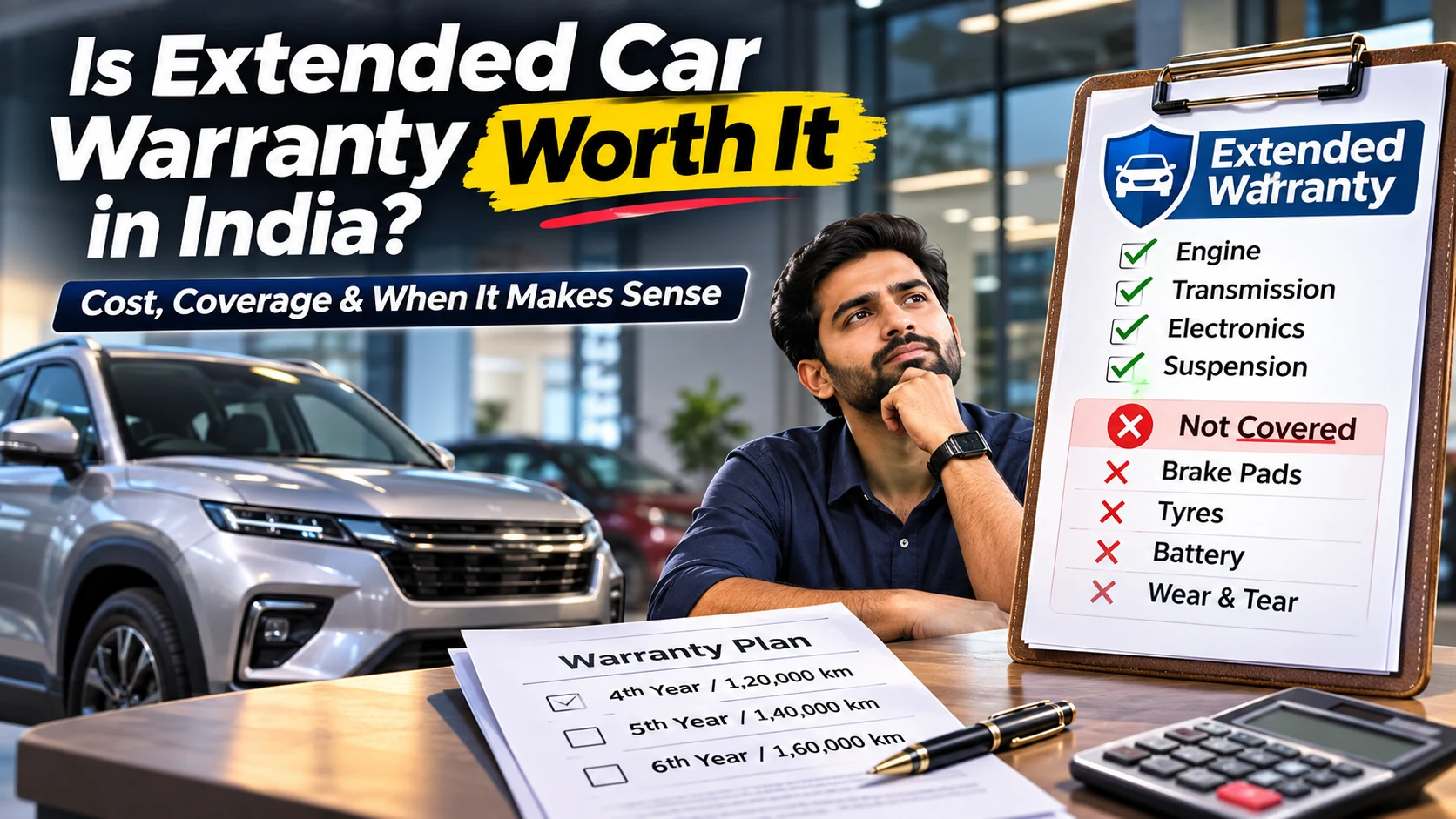
Extended warranty costs roughly ₹7,000 to ₹15,000 on an entry hatchback and ₹30,000 to ₹50,000 on a large SUV, often before GST. It covers the expensive, unpredictable things: engine, transmission, electronics. It does not cover anything that wears out, which means brake pads, clutch plates, bushes, belts, tyres and the battery are all your problem. Every plan is capped at a year limit or a kilometre limit, whichever arrives first, and working out which one binds for you is the whole decision. You usually have to buy it before the standard warranty expires, so the deadline is real even when the sales call is annoying.
First, Know What You Already Have
Standard warranty in India used to be two years on most mass-market cars. That has moved. The biggest seller in the country went to three years or one lakh kilometres as standard on all vehicles delivered from July 2024, and three years is now the common floor rather than the generous exception across most mainstream brands. A few go further as standard.
So check your own car's warranty booklet before you accept any framing from a caller. If you were told two years and you actually have three, the urgency in the pitch is manufactured.
The Calculation Nobody Does With You
Every warranty, standard or extended, is written as a year limit and a kilometre limit, whichever comes first. That second half is where the money goes.
Take the largest Indian plan as an illustration. One maker sells three tiers of extension: to the 4th year or 1,20,000 km, to the 5th year or 1,40,000 km, and to the 6th year or 1,60,000 km. Those sound like year numbers. They are not, for a lot of owners.
| If you drive | You hit 1,60,000 km at | What you actually get from a 6-year plan |
|---|---|---|
| 10,000 km a year | Year 16 | The full six years. The year limit binds |
| 20,000 km a year | Year 8 | The full six years, comfortably |
| 30,000 km a year | About year 5 and 4 months | Roughly five and a half years, not six |
| 40,000 km a year | Year 4 | Four years, from a plan sold as six |
A high-mileage driver pays for the top tier and collects most of a mid tier. That is not a scam, it's printed in the terms, but nobody reads it out on the phone. So before you choose a tier, take your current odometer reading, divide by the car's age in years, and see which limit you'll reach first. If kilometres bind, buy the cheaper tier, because the extra years you're paying for will have expired on distance anyway.
The same arithmetic runs the other way and it's the strongest case for buying. If you drive 10,000 km a year, you will never approach any kilometre cap, every rupee buys you full calendar years, and your car is also the kind that sits around, which is its own source of electrical and seal problems.
What It Covers, and What It Quietly Does Not
Extended warranty is a manufacturing-defect cover, not a maintenance plan. The distinction is the whole product.
| Generally covered | Generally not covered |
|---|---|
| Engine internals | Brake pads, clutch plate assembly, bushes, seals, gaskets |
| Transmission and gearbox | Belts, hoses, bulbs, fuses, relays, wiper blades |
| Electricals and electronic modules | Tyres and battery, which carry their own separate warranties |
| Steering, suspension and axle components | AC gas refills, and bearings in several plans |
| Fuel and cooling system parts | Oils, fluids and everything on the service schedule |
Two exclusions deserve more attention than the rest. The first is consequential damage: if a known fault is left unattended and wrecks something else, the second failure is normally not covered. Driving on with an oil leak is the textbook example. The second is that tyres and the battery are never in scope, which matters because those are the bills a car in its fourth and fifth year actually presents. A warranty that excludes wear items is excluding most of what you are likely to spend, and tyres run on a replacement clock of their own.
The Clauses That Void It
- Servicing late, or outside the authorised network: This is the most common way people lose cover without realising. Keep to the schedule and keep the invoices.
- Non-genuine accessories and poor fitment: Aftermarket electricals spliced into the loom are a standard reason for a declined electronics claim. If you are adding accessories, that is another argument for getting them itemised and fitted properly.
- A CNG or LPG kit fitted after purchase: Several makers treat this as voiding the powertrain cover unless they have confirmed otherwise in writing. Get that in writing before the kit goes in, not after.
- Unauthorised repairs or counterfeit parts: One cheap repair outside the network can cost you the remaining cover on a far more expensive component.
- Accident damage: That is an insurance matter, not a warranty one. The two products do not overlap, and neither one covers the other's territory.
So Should You Buy It?
- Buy it if you drive under about 15,000 km a year: The kilometre caps will never bind, so you collect the full calendar term you paid for.
- Buy it if you plan to keep the car past year five: That's when electronics and transmission issues start appearing, and those are exactly the repairs the cover is for.
- Buy it if the car is electronics-heavy: A large touchscreen, driver assistance, powered seats and an electronic parking brake are the parts whose replacement cost is wildly out of proportion to their size.
- Think harder if you drive over 25,000 km a year: Work out which limit binds before choosing a tier, and expect your kilometres to end the cover early.
- Think harder if you plan to sell before year four: Check whether the plan transfers to the next owner and whether the buyer values it. If it doesn't transfer, you are paying for cover you will not use.
My advice: ask for the terms as a document, not a description, and read two things in it. Which limits apply to your tier, and whether it is transferable on resale. Those two answers decide this more than the price does. If the caller will not send the document, that itself is your answer.
Conclusion
Extended warranty is neither a scam nor a must-buy. It is a bet on an expensive, low-probability failure in years four to six, and whether it pays depends mostly on how far you drive and how long you keep the car. Low mileage and a long hold make it a reasonable purchase. High mileage and an early sale make it an expensive one. Do the kilometre arithmetic first and the decision makes itself.
Looking at a newer car instead of extending cover on this one? Book a test drive and we will connect you with your nearest authorised dealer.
FAQs
1. How much does an extended car warranty cost in India?
Roughly ₹7,000 to ₹15,000 on an entry hatchback, ₹15,000 to ₹25,000 on a sedan or compact SUV and ₹30,000 to ₹50,000 on a large SUV or premium model. Several makers quote these before GST, so ask whether the figure you are given includes it.
2. What is the standard car warranty in India now?
Three years is the common floor on most mainstream cars rather than the exception it used to be. The country's biggest seller moved to three years or one lakh kilometres as standard on vehicles delivered from July 2024. Check your own warranty booklet before accepting any claim about when your cover ends.
3. Does extended warranty cover tyres and the battery?
No. Both carry their own separate warranties from their own manufacturers and sit outside the car's warranty entirely. The same goes for brake pads, clutch plates, bushes, belts and wiper blades, which are treated as wear items.
4. What does whichever comes first actually mean?
Every plan has a year limit and a kilometre limit, and the cover ends the moment either one is reached. A plan sold as six years ends at four if you cover its kilometre cap in four. Divide your odometer reading by the car's age to see which limit will bind for you.
5. Can I buy extended warranty after the standard warranty has expired?
Usually not. Most makers require you to buy it while the standard cover is still running, which is why the sales calls arrive in the final months. A few brands sell later-year plans to owners who already completed an earlier extension.
6. What can void an extended warranty?
Missing scheduled servicing or servicing outside the authorised network, fitting non-genuine accessories or splicing into the wiring, unauthorised repairs or counterfeit parts, and fitting a CNG or LPG kit without written confirmation from the maker.
7. Is extended warranty transferable if I sell the car?
It depends on the maker and the plan, and it is one of the two things worth checking in the document before you buy. Where it does transfer, it is a genuine selling point for the next owner. Where it does not, buying it shortly before a sale is money spent on cover you will never use.
8. Is extended warranty the same as insurance?
No. Warranty covers manufacturing defects and failures of covered components. Insurance covers accident damage, theft and third-party liability. Neither one covers the other's territory, and you need both.