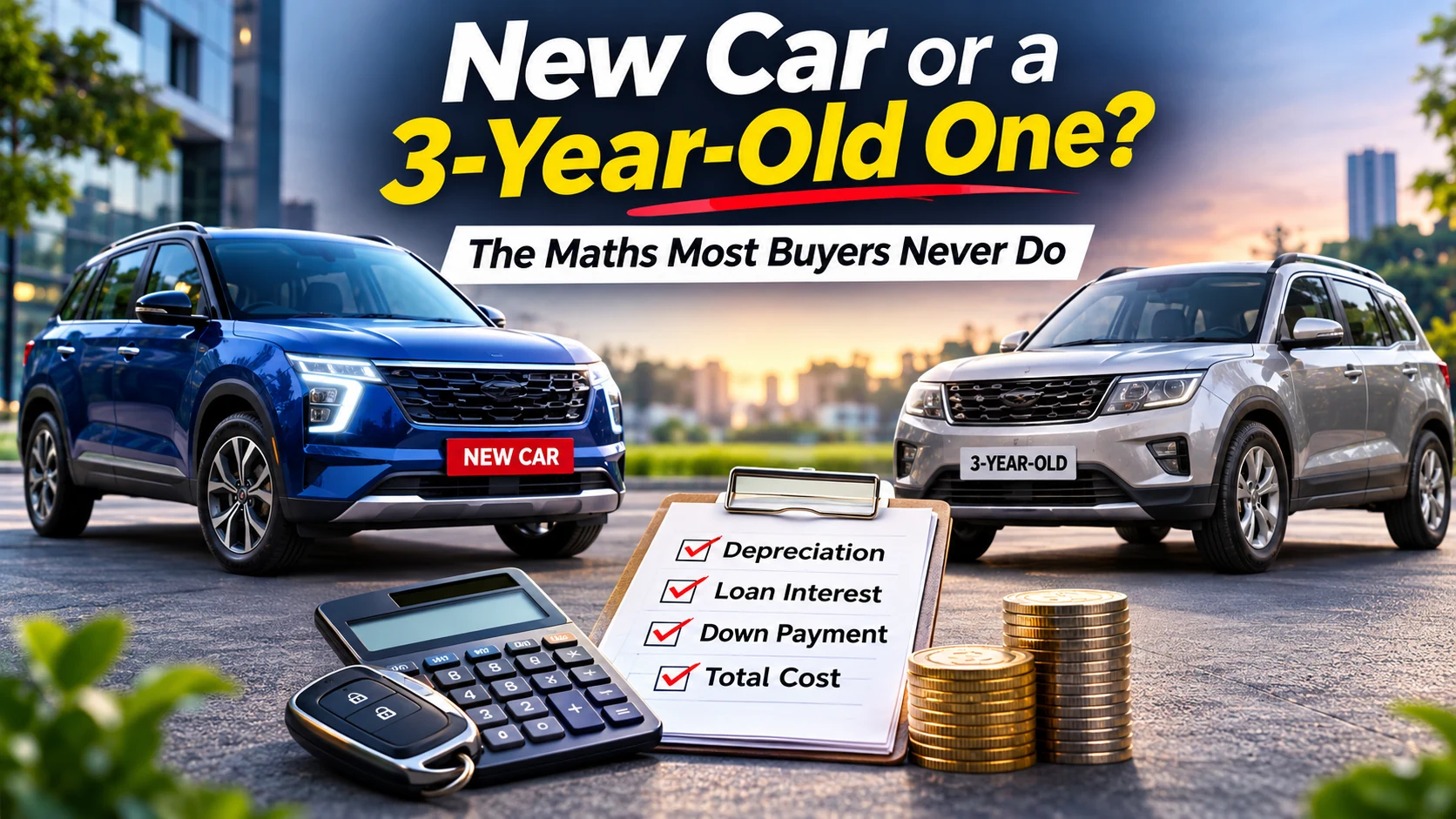
The case for buying used is always made the same way. Somebody else absorbed the depreciation, so you get most of the car for a fraction of the price. Good argument, often right.
But it's half a calculation. The half nobody shows you is that a used car is financed on worse terms, and the gap eats a real part of what you saved. Here's the whole sum.
The Short Answer
A three-year-old car has shed roughly 30 to 40 percent on the insurance regulator's depreciation schedule, which is an insurance valuation rather than a resale price, though it describes the shape of the curve well. Against that saving, a used car loan costs several percentage points more, lends you a smaller share of the price so you need a bigger down payment, and runs over a shorter term because lenders cap the car's age at maturity. The warranty is usually finished too, and the wear items arrive sooner. Buying used still wins for most people. Compare the total paid and the length of the commitment, not just the EMI.
Start With the Only Depreciation Number That Is Official
Market resale value depends on the model, the colour, the fuel type, the service history and what the used market wants this month. There's no published curve for it, and anyone quoting one to two decimals is guessing.
But there is one depreciation schedule in India that is set by regulation rather than opinion: the grid insurers use to work out your insured declared value, which is fixed in age slabs by the insurance regulator.
| Age of the car | Depreciation applied to IDV |
|---|---|
| Up to 6 months | 5 percent |
| 6 months to 1 year | 15 percent |
| 1 to 2 years | 20 percent |
| 2 to 3 years | 30 percent |
| 3 to 4 years | 40 percent |
| 4 to 5 years | 50 percent |
| Over 5 years | No fixed rate. Mutually agreed between insurer and policyholder, on condition |
Read that table for what it is. It's what your insurer pays if the car is written off, not what a buyer hands you in cash, and the two move apart on a car that's been well or badly kept. Use the grid for the shape of the curve, not as a price.
The shape is the useful part, and it is worth being exact about what it measures. Counting from new, the schedule has a car 15 percent depreciated by the end of year one, and no year after adds more than 10 points. Slab to slab the steps are smaller, 10 then 5 then 10, so the front-loading sits in the first year of ownership rather than between any two rows. By the end of year three you're 30 to 40 percent down, which is why that's the age everyone talks about. Treat it as the schedule's shape, not a measurement of the second-hand market, which has no published curve at all.
Notice where the schedule stops. It runs out at five years, and past that there's no official percentage at all, only a figure agreed with your insurer on the car's condition. So an older used car has no regulatory anchor for its value either way, which is worth knowing before you accept anyone's valuation of a seven-year-old car as though it were a standard.
Now the Half Nobody Shows You
Lenders treat a used car as a riskier asset, because it is one. That shows up in three separate ways, and all three cost you money.
- The interest rate is higher: Ranges checked on 16 November 2026, and they are ranges across lenders rather than any one bank's published rate. New car loans from the mainstream banks start around 8.4 to 9.5 percent on a strong profile; used car loans from those same banks start around 10 to 10.8 percent, and the finance companies writing most used lending run about 12 to 19 percent. Those are advertised starting rates, not offers. Rates move, so check the lender's own page on the day and get a written quote rather than working off any published range, this one included.
- The loan-to-value is lower: A new car can often be financed to 90 percent of value and sometimes higher, though full funding depends on the lender, the model and your profile rather than being there for the asking. On a used car most lenders work to 80 to 90 percent of their own valuation, which is usually below the price you negotiated. So you bring a bigger down payment to a cheaper car.
- The tenure is shorter: A new car loan commonly runs to seven years and at some banks to eight. On a used car, lenders cap the vehicle's age at maturity, commonly 10 years for banks and 12 for finance companies, so an older car gets a shorter loan and a higher EMI on a smaller amount.
A Worked Example, So the Numbers Are Not Abstract
Take a car at ₹10 lakh ex-showroom, around ₹11.5 lakh on road, at representative rates and loan-to-value for each age. These are illustrative figures, not quotes. The last column is purchase outlay only, down payment plus every EMI: insurance, transfer charges, servicing and repairs are not in it, and those are the subject of the next section.
| What you buy | Down payment | EMI and term | Total of the EMIs | Total purchase outlay |
|---|---|---|---|---|
| New, ₹11.5 lakh on road | ₹1.15 lakh | ₹16,650 for 84 months | ₹13.99 lakh | ₹15.14 lakh |
| Three years old, ₹6.5 lakh | ₹1.40 lakh | ₹11,600 for 60 months | ₹6.96 lakh | ₹8.36 lakh |
| Seven years old, ₹3.5 lakh | ₹0.50 lakh | ₹10,400 for 36 months | ₹3.74 lakh | ₹4.24 lakh |
Here is the correction to the argument you usually read, mine included. On the monthly figure the seven-year-old car looks barely worth it: ₹10,400 against ₹11,600, about ₹1,200 apart. But the EMI is the one number where it looks marginal. Look along the row instead. It finishes two years sooner, and the purchase outlay is ₹4.24 lakh against ₹8.36 lakh.
Read that for exactly what it measures, though. It compares what you hand over to buy and finance each car, nothing else: not insurance, transfer charges, servicing or repairs, and not what the car is still worth when the loan ends, which is the bigger difference of the three. After 36 months you own a ten-year-old car with very little left in it. After 84 months you own a seven-year-old one. The difference is not only what you pay, it is what you own at the end of each loan.
So the case against the seven-year-old car is not the financing, and anyone who says the EMI maths kills it is quoting one column of a table. The case against it is the car and what survives of it: no warranty, a history you cannot fully verify, wear items due rather than distant, and almost nothing left when your three years are up. The lowest outlay is not the lowest cost of owning. The three-year-old car costs roughly ₹4 lakh more across the term and buys a far better asset with it. That's the trade, and it's a judgement call rather than an arithmetic one.
What Else Changes Between New and Used
| What you are comparing | Buying new | Buying a three-year-old car |
|---|---|---|
| Purchase price | Full price | Roughly 30 to 40 percent less |
| Loan interest | From about 8.4 to 9.5 percent | From about 10 percent, often 12 to 19 percent |
| Down payment | Commonly from 10 percent, lender depending | 10 to 20 percent of the lender's valuation, not of your price |
| Maximum tenure | Up to 84 months | Limited by the car's age at maturity |
| Manufacturer warranty | Full. Commonly 3 years, but it varies by brand | Usually expired or close to it, depending on the brand's term |
| Condition and history | Known | Unknown until you verify it |
| The first year's depreciation | You pay it | Somebody else already did |
One caveat on the warranty line in that table. Three years is the common standard on most mainstream cars now rather than a rule: some models still carry two, several brands offer more, and nearly all pair the years with a kilometre cap that can end cover first. Check the booklet for the specific car. Where it is three years, a three-year-old car comes off cover exactly as you buy it, which is the age at which clutches, bushes and electronics start presenting bills you'll pay yourself.
What the Purchase Price Leaves Out
The EMI is not the only line, and these don't all point one way.
- Insurance is cheaper on the used car: Own-damage premium is calculated on the insured declared value, which falls with the car's age. Third-party cover is priced on engine capacity and does not move with age, so the saving applies mainly to the own-damage component rather than to the premium as a whole.
- Transfer costs land on the used buyer only: Ownership transfer, the no-objection certificate on an out-of-state car and the new registration entry all carry fees that vary by state. Check your own state transport department's current schedule.
- The wear items come due sooner: The one buyers consistently underestimate. Tyres run roughly ₹4,500 to ₹8,000 each in a common hatchback size and a battery ₹4,500 to ₹13,000. Both carry date codes you can read before you buy, so this is a cost you can check rather than guess at.
- Servicing is where the ages separate: Running costs barely differ between a three-year-old car and a new one of the same model. What differs is the service you walk into, because the bigger-ticket items such as brake fluid, coolant, spark plugs and belts fall due at set intervals rather than evenly. Which service those land on varies by model and by kilometres, so read the car's own schedule and its service record instead of assuming a year.
These run to tens of thousands against a depreciation saving in lakhs, so they don't reverse the verdict. The point is to walk in with the real number.
When Used Clearly Wins, and When It Clearly Doesn't
- Used wins if you're paying mostly in cash: None of the three financing disadvantages applies to you, and the depreciation saving lands in your pocket intact. This is not a close contest.
- Used wins if you keep cars a long time: Spreading the saving over eight or ten years beats a short hold, because running costs barely differ while purchase prices differ a lot.
- New wins if you're borrowing most of the money over a long tenure: The rate difference compounds across the term, and the lower down payment and longer tenure are worth real money to a stretched budget.
- New wins if you can't assess a used car properly: Service history, accident repair and odometer tampering are all checkable, but only if you check. If you won't, the discount isn't a discount, it's a risk premium you're accepting blind.
My advice: do the comparison on the EMI and the down payment, not on the sticker price. Get a written quote from a used car lender for the specific car before you fall in love with the saving, because the rate you are offered is personal to you, and there are questions worth asking before you sign whichever way you go.
Before You Buy the Used One, Check These
- The manufacturing date, not the registration year: A car registered in January may have been built the previous year, which costs you real resale value later.
- The claim history, not the no-claim bonus: This is the check most guides get wrong. A no-claim bonus belongs to the person, not the car, so the seller takes theirs with them and the buyer starts at zero regardless. It can also lapse simply because a policy was not renewed in time. So the car's bonus status tells you nothing about its accident record. Ask for the previous policy and the claim history on it instead, which is the record that actually shows what has been repaired.
Conclusion
Buying used is usually the better financial decision, and the oldest car has the lowest purchase and financing outlay, which is not the same thing as the lowest lifetime cost of ownership. What the three-year-old car buys with its extra few lakh is a better asset: warranty sometimes still running, a history you can verify, wear items not yet due, and something left to sell at the end. Compare the total paid and the length of the commitment rather than the EMI, check the car properly, and treat the expired warranty as a cost you've accepted rather than one you've escaped.
Ready to look at what is on sale? Browse cars or book a test drive at your nearest authorised dealer.
FAQs
1. How much does a car depreciate in three years in India?
Roughly 30 to 40 percent. The insurance regulator's grid applies 30 percent depreciation to a car aged two to three years and 40 percent at three to four years. That grid sets your insured declared value rather than your resale price, but it describes the shape of the curve accurately.
2. Is a used car loan more expensive than a new car loan?
Yes, and by a wide margin. Mainstream banks start new car loans around 8.4 to 9.5 percent and used car loans around 10 to 10.8 percent, while the finance companies that do most used car lending run from about 12 to 19 percent depending on your credit profile.
3. Why do I need a bigger down payment on a used car?
Lenders finance up to 90 or 100 percent of a new car's value but typically cap a used car at 80 to 90 percent of their own valuation, which is often lower than the price you agreed with the seller. The difference comes out of your pocket.
4. Why is the tenure shorter on a used car loan?
Lenders cap the vehicle's age at loan maturity, commonly 10 years for banks and 12 for finance companies. The older the car, the shorter the loan, which pushes the EMI up even though you're borrowing less.
5. Is three years the best age to buy a used car?
For most buyers, yes. The steepest depreciation is behind the car, condition is usually still good, and tenure isn't yet badly restricted. The trade-off is that the manufacturer warranty, where it ran three years, is finished at exactly that point.
6. Does the insurance IDV grid tell me what a used car is worth?
No. The grid fixes what an insurer pays if the car is stolen or written off. Resale value depends on the model, condition, service history and demand, and it can sit above or below the IDV figure.
7. Is buying new ever the better financial decision?
Yes, in two situations: when you're borrowing most of the money over a long tenure, because the rate difference compounds across the term, and when you can't properly inspect a used car's history and condition.
8. What should I check before buying a three-year-old car?
The manufacturing date rather than the registration year, the service history pulled from the brand's own record against the chassis number, the previous policy's claim history (not its no-claim bonus, which belongs to the seller and leaves with them), whether any loan on the car is cleared, and the date codes on the tyres and battery.