
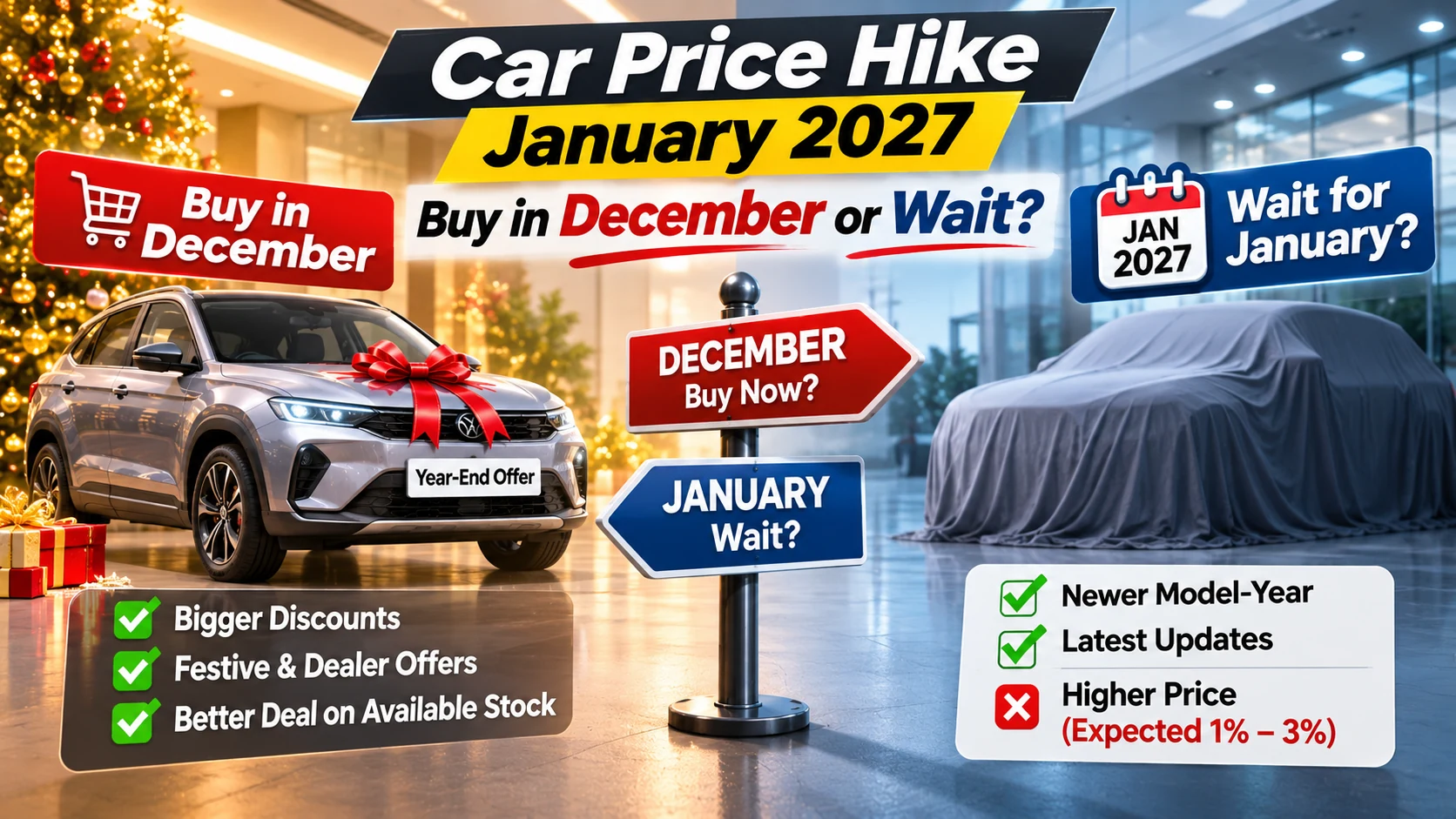
Every year the same two things happen. Carmakers raise prices in January, and dealers discount hard through December to clear the year's stock. Every year the advice is the same too: buy in December.
That advice is usually right, and this year it's come with a complication worth understanding before you sign anything. The discounts are not behaving the way they normally do, and the biggest ones on offer are attached to a car that'll cost you money later.
The Short Answer
Price increases from January are being signalled by several carmakers, but none has announced a figure yet. Going by previous Januaries, expect something in the region of 1 to 3 percent on most mass-market cars, which is ₹10,000 to ₹30,000 on a ₹10 lakh car. December discounts will almost certainly beat that. The catch is that the very largest December offers are usually on outgoing model year stock, where part of what you save comes back out of the resale value. So yes, buy in December, but get the build date first, because it decides which discount you are being offered and whether it is worth taking.
What Has Actually Been Said About January
Nothing with a number on it, and that's worth being clear about because the headlines imply otherwise.
What exists is a signal rather than an announcement. Senior executives at more than one large carmaker have said increases are coming, pointing at steel and copper costs, and one of them has already raised prices several times this year with more expected over the next few months. None of it's a published figure for January, and anyone quoting you an exact percentage today is guessing.
One thing it definitely isn't: the new fuel economy rules. Those take effect from April 2027, not January, and they are a manufacturer compliance target rather than a charge on your invoice. If a salesperson tells you to buy now because of new emission norms in January, that's a sales line, not a fact.
How Big Is a January Hike, Really?
The useful way to size this is to look at what happened last January rather than at a prediction. Across the industry, increases then ranged from about half a percent at the low end to around 4 percent at the high end, with most mainstream brands landing in the 2 to 3 percent band, and a few applying flat rupee amounts on specific models instead of a percentage. Treat that as a planning range drawn from history, not a forecast for this January.
| On a car costing | A 1 percent rise | A 2 percent rise | A 3 percent rise |
|---|---|---|---|
| ₹6 lakh | ₹6,000 | ₹12,000 | ₹18,000 |
| ₹10 lakh | ₹10,000 | ₹20,000 | ₹30,000 |
| ₹15 lakh | ₹15,000 | ₹30,000 | ₹45,000 |
| ₹25 lakh | ₹25,000 | ₹50,000 | ₹75,000 |
Put next to a December offer, which routinely runs into six figures on slower-selling models, the hike is usually the smaller number. That's the whole basis of the standard advice, and on the arithmetic it holds up.
Why This December May Not Be the Usual Bargain
Here is the part that is different this year, and it hasn't been written about much.
Discounting across the industry has been falling rather than rising. One of the largest carmakers reported its discounts dropping as a share of revenue through the year, and said it didn't expect them to go back up once the festive season ended. Strong demand means less pressure to buy volume with cash on the bonnet.
So the reasonable expectation for this December is a normal clearance on slow movers and very little on anything in demand. If you are shopping for a model with a waiting period, the January increase will probably reach you whatever you do, and no amount of December negotiating will change that. If you are shopping for something sitting in the yard, the bargaining room is still yours.
The Trap Inside the Biggest Discounts
This is the finding worth the read, and it is the reason the headline number on a December offer tells you almost nothing on its own.
The enormous year-end discounts, the ones advertised at a lakh and a half or two lakh, are overwhelmingly on outgoing model year stock. Tata's December 2024 offer sheet is the clearest illustration. The Punch carried about ₹1.5 lakh of combined benefits on its previous model year cars and ₹15,000 on the current model year version. On the Nexon the older stock ran to roughly ₹2.75 lakh against ₹10,000 to ₹30,000 on the newer. The Safari showed the same split.
Same badge, same showroom, same week, with a ten to twenty times difference in the offer. Those figures were reported consistently at the time and varied by city, dealer and stock, as year-end offers always do, so read them as the shape of the thing rather than a price list. They are also history, not a quote for this December. The shape is what repeats every year across the industry: the discount is not tracking the car, it is tracking the model year. That gap isn't generosity. It's the dealer pricing in what you're actually buying, a car already a model year behind on the day you take delivery, which will be two years behind on paper within thirteen months. Resale is where you pay it back.
- Ask for the manufacturing month and year before you discuss price: It appears on the vehicle identification plate and on the invoice, though where that plate sits varies by manufacturer, so ask the dealer to show you the VIN and manufacturing details rather than hunting for them yourself. Get it in writing, because it's what decides which of those two discounts you're being offered.
- A December build bought in January needs the sharpest pencil: That car keeps its 2026 manufacturing date whatever happens next, while its registration reads 2027. The registration year is the one most buyers glance at, so this isn't automatically a disaster, but any serious buyer checks the build date and prices the gap between the two. On top of that you're paying post-increase money for stock the dealer already wanted gone. Compare it against a genuinely 2027-built car before you accept the discount.
- Work out the resale cost, not just the saving: On the insurance regulator's depreciation schedule a car two to three years old sits about 30 percent below new, so being a model year behind is worth real money on a ₹10 lakh car. That is an illustration rather than a universal rate: actual resale depends on the model, its condition, the kilometres on it and what the used market wants at the time. Work out your own number and compare it against the extra discount before you call it a deal.
My advice: a large discount on current model year stock is a genuine win. A larger discount on last year's stock is a trade, and you should price the trade rather than celebrate the number.
So, December or January?
- Buy in December if the car is in stock and the build is current: You take the discount, you avoid the increase, and you carry no model year penalty. This is the clean outcome and it's the one to aim for.
- Buy in December with eyes open if it is old stock: Only if the discount's clearly bigger than the resale cost of being a model year behind. Make the dealer put the build date and the full discount breakup in writing, alongside the financing terms.
- January is fine if your car has a waiting period: On a model in demand you were never getting a meaningful December discount anyway, and the increase is the price of the queue.
- January is also fine if the model is being replaced soon: A facelift or a new generation arriving shortly will do more to your car's value than a 2 percent price change ever will. Wait and buy the new one, or buy the old one much cheaper after it lands. Our compare tool will show you what else sits at the same money meanwhile.
Whichever way you go, remember that the ex-showroom price is only one line. Insurance, registration and the extras added at the desk move the on-road figure far more than a 2 percent hike does, and those are the ones you can actually negotiate.
Conclusion
The standard advice survives the scrutiny: December is usually the better month to buy, because the discount beats the hike. What doesn't survive is the assumption that the biggest advertised discount is the best deal. Get the build date first, ask what the same car costs in current model year stock, and make the comparison on what you will get back when you sell rather than on the number painted on the windscreen.
Ready to go and ask? Book a test drive and we will connect you with your nearest authorised dealer.
FAQs
1. Will car prices go up in January 2027?
Several carmakers have signalled increases, pointing at steel and copper costs, but none has announced a figure. Increases at the start of the calendar year are the normal industry pattern, so expect them, but treat any specific percentage you see quoted today as a guess.
2. How much do car prices usually rise in January?
Last January the increases ran from about half a percent at the low end to around 4 percent at the high end, with most mainstream brands in the 2 to 3 percent band. On a ₹10 lakh car, 2 to 3 percent is ₹20,000 to ₹30,000.
3. Is the January hike because of the new emission rules?
No. The new fuel economy rules apply from April 2027, not January, and they set a manufacturer fleet target rather than a charge on your invoice. January increases are normally driven by commodity costs. If a salesperson tells you otherwise, that is a sales line.
4. Are December discounts bigger than the January price rise?
Usually yes, and often by a wide margin on slower-selling models. The exception is a car with a waiting period, where there is little discount to be had and the increase reaches you anyway.
5. Why are some December discounts so much larger than others on the same model?
Because the largest ones are usually on outgoing model year stock. On Tata's December 2024 offer sheet the Punch carried about ₹1.5 lakh of benefits on previous model year cars against ₹15,000 on the current model year version, and the Nexon about ₹2.75 lakh against ₹10,000 to ₹30,000. The gap prices in the resale value you give up.
6. How do I check whether a car is old stock?
Ask for the manufacturing month and year before you discuss price. It appears on the vehicle identification plate and on the invoice, but where that plate sits varies by manufacturer, so ask the dealer to show you the VIN and manufacturing details rather than hunting for them yourself. Do this first, because it's what decides which discount you are actually being offered.
7. Is it bad to register a December-built car in January?
It needs the sharpest pencil. The car keeps its 2026 manufacturing date while its registration reads 2027, and you are paying post-increase prices for stock the dealer already wanted gone. The registration year is what most buyers glance at, so it isn't automatically a bad buy, but compare it against a genuinely 2027-built car before you accept the discount.
8. Should I wait if a facelift of my car is coming?
Usually yes, or buy the outgoing car at a much steeper discount once the new one lands. A model change affects your car's value far more than a 2 percent price revision does.