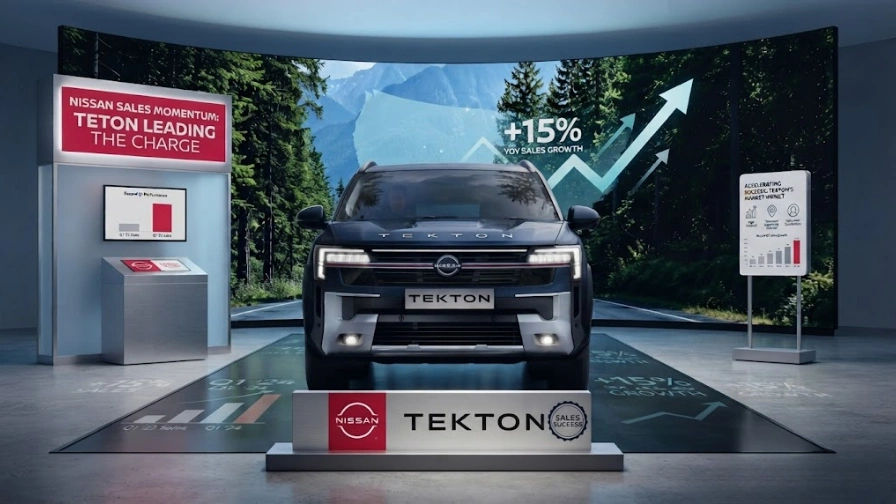
For a brand that spent the better part of a decade running on a single product, July 2026 was the kind of month that turns heads. Nissan Motor India closed the month with domestic wholesales up 218% year-on-year — by far the steepest growth rate of any carmaker in India last month — and the timing lines up perfectly with the nationwide rollout of its most important new launch in years, the Nissan Tekton.
Nissan Sales July 2026 – Key Highlights
Nissan Motor India Pvt. Ltd. (NMIPL) reported a 218% year-on-year increase in domestic wholesales for July 2026, dispatching 4,518 units to dealers across the country. Including export wholesales of 4,821 units, the company's total monthly wholesale volume came in at 9,339 units. On a sequential basis, domestic wholesales were up 50% month-on-month — a strong signal that the growth wasn't a single big billing-day spike, but a sustained pickup spread across the month.
The surge coincided directly with the start of customer deliveries for the all-new Nissan Tekton SUV, which began rolling out nationwide on July 20, 2026, following its global premiere in Mumbai on July 9, 2026.
Nissan July 2026 Sales Report
Here's the full numerical picture for the month:
|
Metric |
July 2026 |
July 2025 |
Change |
|
Domestic wholesales |
4,518 units |
1,420 units |
+218% YoY |
|
Export wholesales |
4,821 units |
4,188 units |
+15.1% YoY |
|
Total wholesales (domestic + export) |
9,339 units |
5,608 units |
+66.5% YoY |
|
Month-on-month growth (domestic) |
— |
— |
+50% MoM |
For context on how dramatic this jump is: Nissan's entire India business had been running on essentially one core model (the Magnite) for most of the last few years, with domestic wholesale volumes frequently sitting in the 1,500–2,500 unit range in recent quarters. A 218% jump against that backdrop reflects a fundamental change in the company's product story, not just a favourable comparison month.
It's worth noting the export figures tell a slightly different story than the domestic ones: while domestic wholesales more than tripled, export wholesales grew a comparatively modest 15.1% year-on-year. That's actually a meaningful data point in its own right — it confirms the 218% surge is a genuinely domestic-demand-driven story tied to the Tekton launch, rather than being inflated by stronger overseas shipments.
What Drove Nissan's 218% Sales Growth?
Several factors converged to produce July's outsized growth number:
1. Tekton deliveries beginning mid-month — customer deliveries of the newly launched SUV started on July 20, 2026, adding a genuinely new revenue stream on top of existing Magnite and Gravite volumes.
2. A three-model portfolio for the first time in years — the Tekton's arrival took Nissan's India lineup to three models (Magnite, Gravite, Tekton), compared to a single-product portfolio just a couple of years ago.
3. Pre-launch brand-building momentum — a highly publicised pre-delivery expedition helped build consumer confidence in the Tekton's engineering before it ever reached a showroom floor.
4. Network expansion — Nissan has been actively growing its dealership and service footprint to support the broader product range, which helps convert interest into actual bookings and deliveries in more cities.
5. A low year-ago base — July 2025's domestic wholesale figure of 1,421 units was itself a fairly modest number, which naturally inflates the percentage growth figure even though the absolute unit increase (roughly 3,100 additional units) is genuinely substantial in its own right.
Nissan Tekton – The Biggest Growth Driver
The Tekton is unmistakably the story of Nissan's July. Launched in India from Rs 10.49 lakh (ex-showroom), the Tekton marks the brand's most significant push into the mainstream mid-size SUV segment in over a decade — its most direct predecessor in that space, the Terrano, exited the Indian market back in May 2020.
Built on the same platform as the Renault Duster (a product of the Renault-Nissan Alliance), the Tekton is offered in 12 variants across two engine options, and carries a 5-star Bharat NCAP (BNCAP) safety rating straight out of the gate — a credential Nissan has clearly positioned as central to the car's pitch to Indian buyers. Design-wise, the Tekton draws inspiration from the legendary Nissan Patrol, and the company has framed the launch as marking "75 years of Nissan SUV excellence."
Nissan didn't launch the car quietly. Ahead of customer deliveries, a convoy of 60 Tekton SUVs completed a drive from Chandigarh to Leh via the Shinku La pass — at an altitude of 16,703 feet through the Zanskar region — earning an India Book of Records entry for the largest single-model convoy to reach the region. It's a familiar playbook in the Indian SUV market: high-altitude, high-difficulty demonstration drives are used to signal durability and off-road capability before a car reaches a single showroom, and for a brand rebuilding trust after years of a thin product range, that kind of public proof-of-concept carries real weight.
The Tekton is positioned to take on some of the segment's biggest names, including the Hyundai Creta, Tata Sierra, and Kia Seltos — genuinely large-volume rivals, which underlines just how ambitious Nissan's re-entry into this space is.
Nissan Magnite Continues to Support Sales
While the Tekton grabbed the headlines, the Magnite remains the brand's steady, dependable volume contributor. Earlier in 2026, the compact SUV was described as Nissan India's highest-selling model, contributing over 55% of the company's total monthly sales in some months, and it recently crossed a 22,253-unit sales milestone in the Indian market over a trailing 12-month period.
That said, the Magnite's own trajectory has been a mixed bag through 2025 and into 2026 — some months posted modest single-digit percentage declines year-on-year, reflecting the intensifying competition in the sub-4m SUV space from the Tata Punch, Maruti Fronx, and others. What the Magnite has consistently provided, though, is a reliable revenue and volume base that let Nissan fund the development and launch of the Gravite and now the Tekton — effectively the platform on which the brand's broader three-model strategy has been built.
Nissan Sales Trend in Last 12 Months
Nissan India's monthly domestic wholesale numbers over the past year tell a clear story of gradual rebuilding, followed by a sharp July acceleration:

The pattern is consistent with a company that spent 2025 quietly laying groundwork — expanding its dealer network, launching the Gravite, and preparing the Tekton — before that investment paid off in a single, sharp volume jump once the Tekton actually reached customers.
Nissan vs Other Car Brands – July 2026 Sales Comparison
Even with its 218% surge, Nissan's absolute volumes remain modest next to India's established leaders — but the percentage growth comparison is where Nissan genuinely stood out for the month:
|
Brand |
July 2026 Domestic Sales |
YoY Growth |
|
Maruti Suzuki |
1,96,203 units |
+42.41% |
|
Tata Motors |
62,611 units |
+58.42% |
|
Mahindra |
60,048 units |
+20.41% |
|
Hyundai |
54,210 units |
+23.30% |
|
Toyota |
30,516 units |
+4.65% |
|
Kia |
28,200 units |
+27.40% |
|
MG Motor |
8,158 units |
+22% |
|
Honda |
6,014 units |
+48.49% |
|
Nissan |
4,518 units |
+218% |
|
Renault |
3,293 units |
+27.90% |
Nissan's percentage growth rate was more than three-and-a-half times higher than the next-fastest grower among the top ten brands (Tata, at +58.42%), even though its absolute volume ranks near the bottom of the table. That's the clearest illustration of how a small base combined with a genuinely new product launch can produce headline-grabbing growth numbers.
How Nissan's Market Position Is Changing
For years, Nissan's presence in India was effectively a single-model story — the Magnite carried the company almost entirely on its own, and monthly domestic volumes rarely broke much beyond the low single-digit thousands. That's now visibly shifting.
The addition of the Gravite MPV earlier in 2026, followed by the Tekton in July, represents Nissan's first genuine multi-segment push in the Indian market in a long time — spanning a sub-4m SUV (Magnite), a compact MPV (Gravite), and now a mainstream mid-size SUV (Tekton) aimed squarely at some of the country's highest-volume nameplates. Alongside this, Nissan has been steadily expanding its dealership and service network, which matters just as much as the products themselves — a wider retail footprint is often the difference between strong launch bookings translating into actual deliveries versus getting stuck in a supply bottleneck.
It's still early days, and Nissan's absolute market share remains small compared to the top players, but the structural shift — from a one-car company to a genuine three-model portfolio competing across different segments — is the more meaningful change than any single month's percentage figure.
Can Nissan Sustain This Growth?
The honest answer is: it's too early to say definitively, but the early signs are encouraging. A few things support the case for sustained momentum:
· The 50% month-on-month growth alongside the 218% YoY figure suggests the July jump wasn't a one-off delivery-day spike but a genuine sustained pickup.
· The Tekton only began deliveries on July 20 — meaning July's numbers reflect barely ten days of actual customer deliveries. A full month of Tekton deliveries in August should, in principle, push volumes meaningfully higher still.
· Nissan's continued network expansion should help convert the Tekton's strong pre-launch buzz (the Leh convoy, the 5-star BNCAP rating) into bookings across more cities, not just metro markets.
That said, a few risks are worth flagging. The Tekton enters a genuinely brutal segment where the Hyundai Creta, Kia Seltos, and Tata's own SUV line-up already have deeply entrenched dealer networks, brand loyalty, and resale value reputations. Nissan will need to prove it can sustain production and delivery timelines at scale — a common stumbling block for brands re-entering a competitive segment after a long absence. July's growth is a strong start, but a handful of successive months of similar performance would be a far more convincing signal of a genuine turnaround than one standout month.
What's Next for Nissan India?
A few developments are worth watching in the coming months:
· Full-month Tekton deliveries in August — since July's numbers only reflect around ten days of actual deliveries, August should be the first true test of sustained retail demand.
· Further dealership network expansion — Nissan has repeatedly flagged this as an ongoing priority to support its broadened three-model lineup.
· Continued Magnite refreshes — the brand has kept the compact SUV relevant through special editions (like the KURO edition and new colour options) and CNG retrofitment expansion, which should continue supporting its base-volume role.
· Additional model plans — Nissan's broader India roadmap has previously referenced further launches planned through its alliance with Renault, meaning the Tekton likely won't be the last new nameplate the brand introduces before the end of the current product cycle.
Expert Analysis – Is Nissan Making a Comeback?
There's a reasonable case to be made that July 2026 marks a genuine inflection point for Nissan in India, even if it's premature to call it a full comeback just yet. The company's own framing — moving from a single-product portfolio to a three-model lineup — is an accurate description of what's changed operationally, and it's rare for percentage growth this steep to be entirely disconnected from real underlying product news, as it clearly is here.
What makes this different from a typical one-month sales blip is the combination of factors: a genuinely new model in an important segment, a public confidence-building exercise (the Leh convoy) ahead of launch, continued network investment, and a management team explicitly framing this as a multi-year strategy rather than a single campaign. Saurabh Vatsa's own comments — tying the growth to "building market momentum and rising customer confidence" — suggest Nissan itself sees July as the start of a longer trajectory rather than an isolated spike.
The more useful test will come over the next two to three months. If Nissan can post continued double-digit or triple-digit year-on-year growth once the Tekton is selling at full monthly capacity (rather than the roughly ten days it had in July), that would be a far stronger signal of a real comeback than this month's number alone. For now, July 2026 is best read as a promising, well-supported start — not yet a confirmed turnaround, but a genuinely meaningful one.
Conclusion
Nissan's 218% year-on-year sales jump in July 2026 is one of the standout numbers from an otherwise broadly positive month for India's auto industry — and unlike some headline growth figures that lean heavily on a low year-ago base, this one is backed by a real, tangible product story: the arrival of the Tekton, a genuinely significant new SUV aimed at one of the country's toughest and highest-volume segments. With deliveries having only begun in the final third of the month, August and the months following will be the real test of whether Nissan can convert this initial surge into sustained, meaningful market share gains. The building blocks — an expanded three-model lineup, a growing dealer network, and a brand actively trying to rebuild consumer trust — all appear to be in place. What happens next depends on execution.
Source:
Frequently Asked Questions (FAQ)
Q1. How much did Nissan's sales grow in July 2026?
Nissan Motor India's domestic wholesales grew 218% year-on-year in July 2026, rising to 4,518 units from 1,421 units in July 2025.
Q2. What caused Nissan's sales surge in July 2026?
The growth was primarily driven by the start of nationwide customer deliveries of the newly launched Nissan Tekton SUV, which began on July 20, 2026, following its July 9 global premiere in Mumbai.
Q3. What is the price of the Nissan Tekton?
The Nissan Tekton is priced from Rs 10.49 lakh (ex-showroom) and is offered in 12 variants across two engine options.
Q4. What platform is the Nissan Tekton built on?
The Tekton is built on the same platform as the Renault Duster, a product of the Renault-Nissan Alliance.
Q5. What safety rating does the Nissan Tekton have?
The Tekton carries a 5-star Bharat NCAP (BNCAP) safety rating.
Q6. Which cars does the Nissan Tekton compete with?
The Tekton is positioned to rival the Hyundai Creta, Tata Sierra, and Kia Seltos in the mid-size SUV segment.
Q7. What was Nissan's total wholesale volume in July 2026, including exports?
Total wholesales (domestic plus export) reached 9,339 units, comprising 4,518 domestic units and 4,821 export units.
Q8. Is the Nissan Magnite still relevant to the brand's sales?
Yes. The Magnite has historically contributed over half of Nissan India's monthly volumes and remains an important steady contributor even as the Tekton and Gravite expand the company's overall portfolio.
Q9. Does Nissan's 218% growth mean it's now a major player in the Indian market?
Not yet in absolute terms — Nissan's 4,518 units for the month remain far behind established leaders like Maruti Suzuki (1,96,203 units) or Tata Motors (62,611 units). The 218% figure reflects strong percentage growth off a relatively small base, driven by genuine new-product momentum, rather than Nissan overtaking established volume leaders.