Your car insurance is being restructured. Every private car policy issued from 15 December comes in four separate sections, each with its own premium printed on the schedule. That applies to a renewal on an existing car just as much as to a policy on a car you're buying.
You've probably also read that traffic challans will push your premium up, and that petrol pumps will refuse to fill an uninsured car. Those two are at the planning stage and neither has a date. Here's the difference between what's been issued and what's been floated, and what it means for the policy you actually buy.
The Short Answer
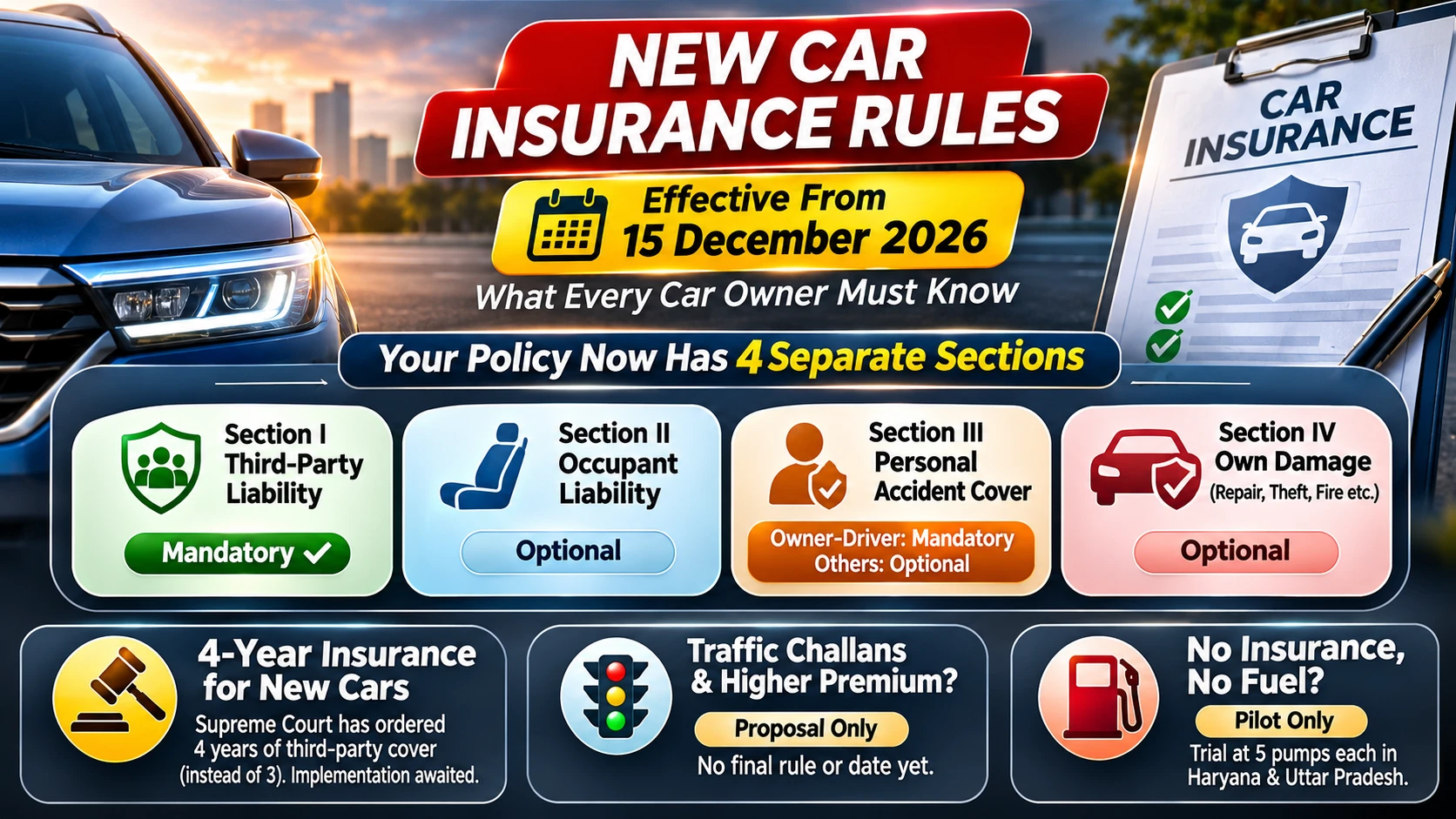
The insurance regulator issued a circular on 2 November, carrying out a Supreme Court direction, and it applies to policies issued on or after 15 December 2026. A private car policy is now split into four sections: third-party liability, which stays compulsory; occupant liability, which is optional; personal accident cover, compulsory for you as owner-driver and optional for everyone else; and own damage, which is formally optional. You'll get an option form to tick your choices and a schedule showing the premium for each section. Nothing about challans affecting premiums has been decided. And separately from all of this, the Supreme Court has directed that a new car carry four years of third-party cover at purchase rather than three, though the circular itself still carries the old period.
Confirmed or Only Proposed
| What you'll have read | Where it actually stands |
|---|---|
| A car policy splits into four sections from 15 December | Confirmed. Issued by the insurance regulator on 2 November, applying to policies issued on or after that date |
| Own damage becomes an optional section you choose | Confirmed. It is Section IV, and its premium is shown separately |
| A new car needs four years of third-party cover, not three | Ordered but not yet implemented. A Supreme Court direction of 4 August 2026 raised it from three years for cars and five for two-wheelers. This is separate from the circular, which still carries the old periods, and the regulator has yet to say how the longer ones will work |
| Traffic challans will raise your insurance premium | Proposal only. No date, and the government hasn't decided which offences count, how much premiums would move, or how insurers would get the data |
| You'll be able to buy one policy covering four years | Proposal only. A single-premium, multi-year arrangement is being discussed so cover can't lapse. Don't confuse it with the four-year third-party requirement above, which is a different thing |
| Petrol pumps will refuse fuel to uninsured vehicles | A pilot has been asked for at five pumps each in Haryana and Uttar Pradesh, using number-plate cameras. Not a national rule |
That table is the whole reason to read this before a headline. Three of those six are real and land on your next policy. The other three are ideas without dates, and treating them as settled is how people make bad decisions early.
The Four Sections, and Which Ones You Must Have
| Section | What it covers | Mandatory? |
|---|---|---|
| Section I, third-party liability | Your legal liability if your car injures or kills someone, or damages their property | Yes |
| Section II, occupant liability | Legal liability towards people in your car, including your employees | Optional |
| Section III, personal accident | Death or permanent disability. Owner-driver cover is one part, cover for others is separate | Owner-driver yes, others optional |
| Section IV, own damage | Damage to your own car from an accident, theft, fire or a natural event | Optional |
Three things come with this that are worth more than the restructuring itself. You get a customer option form at purchase, where you tick what you want, and that form becomes part of your policy. You get a customer information sheet at the point of sale. And your schedule has to show the premium charged for each section separately rather than one combined figure.
The Word to Watch Is "Optional"
Here's the part that hasn't been written about, and it matters more than anything else in the circular.
Own damage is the cover that pays to repair your own car. It's now formally Section IV, and formally optional. That's technically how it always worked, because a third-party-only policy has always been legal, but it was buried. Now it's a line item with its own price that somebody can leave unticked.
So a quote that looks unusually cheap may simply be a policy without Section IV in it. That's legal, it satisfies the law, and it leaves you paying for your own repairs. The option form and the section-wise premium exist precisely so you can see this, which only helps if you actually look.
- Read the option form before you sign it, not after: It records what you chose and becomes part of the policy, so a tick you didn't notice is still a tick you made.
- Check the schedule for a Section IV premium: If there's no amount against own damage, there's no own-damage cover. That is the single check worth doing.
- Compare quotes section by section now, not on the total: Two policies at the same price can carry completely different cover, and for the first time the paperwork lets you see where the difference is.
My advice: if your car is financed, your lender almost certainly requires own-damage cover anyway. Check the loan terms before you let anyone sell you a leaner policy to hit a price.
The Four-Year Rule Is a Separate Story
This one gets bundled into the same headlines and it shouldn't be. It has nothing to do with the 15 December restructuring.
On 4 August 2026 the Supreme Court directed that a new car carry four years of third-party cover bought upfront instead of three, and a new two-wheeler six years instead of five. The regulator was told to issue the directions that put it into practice. That hasn't clearly happened yet: the 2 November circular still carries the old three-year and five-year periods, and how the longer terms will be applied hasn't been spelled out.
So don't assume your next new car automatically costs an extra year of third-party premium, and don't assume it doesn't. Ask the dealer what tenure the quote is built on and check the certificate before you pay. If it does land, it lands on the on-road price rather than your renewal, and the upside is a policy that can't lapse for four years.
If you're comparing on-road quotes across dealers this month, make sure every quote is on the same basis. A quote built on three years of third-party cover against one built on four isn't a comparison, it's a trap.
Worth remembering that the insurance on a new car is usually sold to you at the dealership, bundled into the on-road price alongside everything else being added there. You are not obliged to take it, and from 15 December the section-wise breakup gives you something concrete to compare an outside quote against.
Should You Renew Before or After 15 December?
Short answer: it barely matters, and anyone telling you to rush is selling something.
The cover itself isn't being cut or expanded by the restructuring. What changes is how it's presented and priced out, and the regulator hasn't announced any increase or decrease. A policy issued on 14 December sits in the old format for its term, and one issued on 16 December sits in the new one. Neither is better cover.
The one small argument for waiting, if your renewal falls close to the date anyway, is that the new format makes comparison easier. That's a convenience, not a saving, and it isn't worth leaving a gap in cover for. A lapsed policy costs far more than a tidier schedule is worth.
There's also a provision for people already holding a policy. You can add occupant liability in the middle of your term by paying an additional premium, and your existing third-party policy doesn't have to be cancelled to do it. The cover starts from the date and time written on the endorsement, so ask for that endorsement in writing rather than relying on a confirmation over the phone.
What to Do at Your Next Renewal
- Ask for the section-wise premium breakup in writing: You're entitled to it on the schedule now, so there's no reason to accept a single figure.
- Ask who Section II actually covers before you decide: Occupant liability is optional and most people have never thought about it. Before you price it, ask the insurer in writing whether your own family members count as covered occupants, because that is the detail the answer turns on.
- Don't let own damage drop out quietly: Especially on an older car, where somebody may suggest trimming it to save money. Work out what the car is worth before deciding.
- Keep the option form: It's part of your contract. If a claim is ever disputed over what you chose, that form is the record.
Conclusion
The real change here is a boring one with a useful side effect: your policy becomes four priced sections instead of one number, and you have to say what you want in writing. That's better for anyone who reads it and worse for anyone who doesn't, because own damage is now something that can be left out in plain sight. The challan-linked premiums and the fuel-pump checks may yet arrive, but they haven't, and nothing in your renewal this month should be decided on them.
Buying new and want the on-road figure broken down properly before you commit? Book a test drive and we will connect you with your nearest authorised dealer.
FAQs
1. What are the new car insurance rules from 15 December 2026?
A private car policy is issued in four sections: third-party liability, occupant liability, personal accident cover and own damage. The premium for each is shown separately, and you complete an option form recording what you chose. It applies to policies issued on or after 15 December 2026.
2. Which parts of car insurance are compulsory now?
Third-party liability remains compulsory under the Motor Vehicles Act, and personal accident cover for you as the owner-driver is also mandatory, subject to the usual exemptions. Occupant liability and own damage are optional.
3. Is own damage cover no longer included?
It is optional, which is how it always worked legally, but it is now a separate section with its own premium. Check your schedule for an amount against Section IV. If there is none, your own repairs aren't covered.
4. Will traffic challans increase my insurance premium?
Not yet. Linking premiums to traffic records is at the planning stage. No date has been set, and the government has not decided which offences would count, how much premiums would change, or how insurers would receive the data.
5. Is it true that petrol pumps will refuse fuel without insurance?
A pilot has been requested at five fuel stations each in Haryana and Uttar Pradesh, using number-plate recognition cameras to spot uninsured vehicles. It is a trial rather than a national rule, and nothing applies countrywide today.
6. How many years of third-party insurance does a new car need?
A Supreme Court direction of 4 August 2026 raised it from three years to four for cars, and five to six for two-wheelers, but the regulator's November circular still carries the old periods and the implementing directions have not clearly followed. Ask the dealer what tenure your quote is built on and check the certificate. This is separate from the 15 December restructuring.
7. Should I renew my car insurance before 15 December?
There is no real advantage either way. The cover is not being reduced or expanded, and no premium change has been announced. Never leave a gap in cover to time the date, because a lapse costs far more than any convenience.
8. What is the customer option form?
A form you complete when buying the policy, online or offline, recording which sections you have chosen. It becomes part of the policy, so read it before signing and keep a copy. If a claim is ever disputed over what you selected, this is the record.