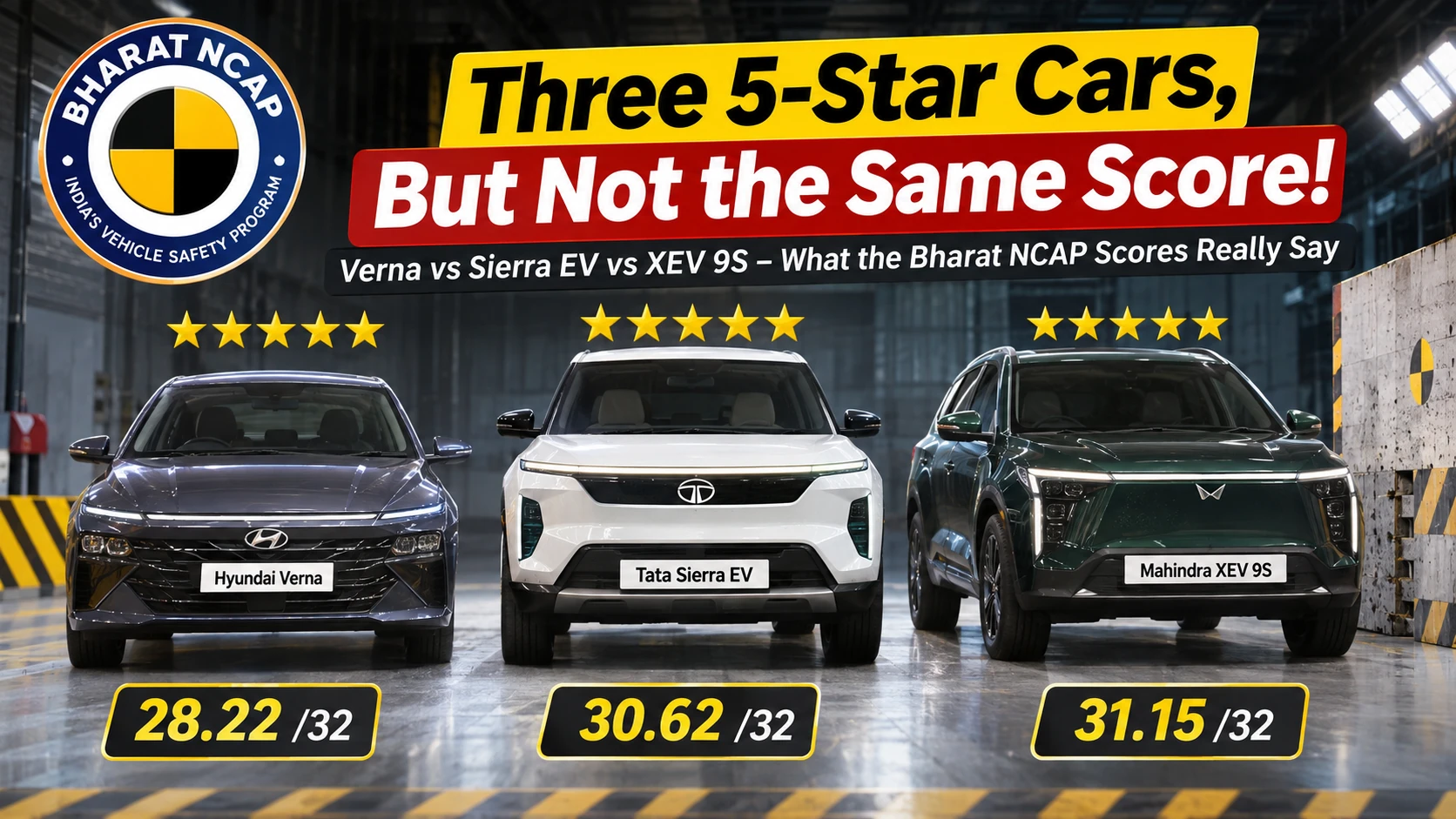
On 17 and 18 November, Bharat NCAP published five-star ratings for the Hyundai Verna, the Tata Sierra EV and the Mahindra XEV 9S. Three different cars, three different segments, the same five stars on every brochure that follows.
The scores underneath are nearly three points apart. That difference disappears the moment it is rounded into stars, and learning to read it is the most useful thing a buyer can take from a crash rating.
The Short Answer
Five stars for adult occupant protection means anything from 27 to 32 points out of 32, so the band is wide and two five-star cars can be meaningfully far apart. The Verna scored 28.22, the Sierra EV 30.62 and the XEV 9S 31.15. All three apply to every variant in their ranges, which is worth checking rather than assuming. When you compare cars on safety, use the points, not the stars, and read which variants the rating covers before you take it as a reason to buy.
What Was Published on 17 and 18 November
| Car | Adult occupant, out of 32 | Child occupant, out of 49 | Rating covers |
|---|---|---|---|
| Mahindra XEV 9S | 31.15 | 45 | All variants, confirmed by Bharat NCAP |
| Tata Sierra EV | 30.62 | 45 | All variants, both battery packs |
| Hyundai Verna | 28.22 | 44 | The entire Verna range |
All three carry five stars for adult and child occupant protection. The XEV 9S is the first seven-seat electric vehicle in India to manage it, and it posted the highest adult score of the three.
What Five Stars Actually Requires
Bharat NCAP scores adult occupant protection out of 32 and child occupant protection out of 49, then converts each into stars using bands.
| Stars | Adult occupant, out of 32 | Child occupant, out of 49 |
|---|---|---|
| 5 stars | 27 to 32 | 41 to 49 |
| 4 stars | 22 to 26 | 35 to 40 |
| 3 stars | 16 to 21 | 27 to 34 |
| 2 stars | 10 to 15 | 18 to 26 |
| 1 star | 4 to 9 | 9 to 17 |
Look at the top band. The Verna's 28.22 clears the five-star bar by 1.22 points; the XEV 9S sits 0.85 points off a perfect score. Both are safe cars and both are five-star cars, but they aren't equally protective, and only the number says so.
My advice: when two cars on your shortlist both show five stars, go and find the points. They are published for every rated car, and our compare tool will put two of them side by side on specification once you have the numbers in front of you.
How the Score Is Built
The rating comes from a frontal offset test at 64 kmph, a side impact test at 50 kmph, and a side pole impact at 29 kmph, which a car can only be put through if it has side or curtain airbags to protect the head. Pedestrian protection norms have to be met, and the fitment of safety assist technology is assessed alongside. Electronic stability control and front seat belt reminders are required for any rating of three stars or above.
Two things that score doesn't do. It doesn't tell you how the car fares against something far heavier than itself, which is common enough on Indian highways, and it says nothing about how the structure ages over ten years. Treat a five-star rating as a strong floor rather than a guarantee.
The Line Most Buyers Never Read
A crash rating belongs to the variants listed on it, not to the model name on the badge. Bharat NCAP's own rating usage guidelines are explicit about this: where only some variants or powertrains of a model have been rated, presenting the rating for the model as a whole is not permitted. For all three of these cars the rating does cover the full range, which is the good outcome rather than the guaranteed one.
It isn't always the case. The Renault Duster's five-star rating covers its turbo-petrol variants. The Strong Hybrid isn't on that applicability list, so a buyer who walks in having read about a five-star Duster and walks out with the hybrid hasn't bought the car that was tested. Nobody at the dealership is likely to correct that, because nobody's lying: the Duster does have five stars.
- Check the variant that was tested: The report names it. Where the tested variant is well above the one you're buying, ask what differs in the structure and the airbag count rather than assuming they're identical underneath.
- Count the airbags on your variant, not on the brochure cover: Six airbags as standard is now common, but knee airbags, curtain coverage and seat belt reminders for every seat still move between trims.
How to Use This When You Are Actually Buying
- Compare points, not stars, across your shortlist: A 31-point car and a 28-point car are both five-star cars. If safety is a real priority rather than a box to tick, that difference should move your decision.
- Look at the child score separately if you carry children: Adult and child protection are scored independently, and a car can be strong on one and merely adequate on the other. Two of these three scored 45 out of 49 for children, one scored 44.
- Don't let a rating settle a decision on its own: Visibility, seating position, braking and the quality of the driver assistance you'll actually use every day all matter, and none of them is in the crash score.
Conclusion
Three five-star cars in two days is good news, and the direction of travel in Indian car safety over the last few years has been encouraging. But a star is a summary, and summaries lose information. The points are published and so is the list of variants a rating covers. Both take two minutes to check, and that is two minutes well spent before you treat a badge as the end of the conversation rather than the start of it. It is also worth knowing that this scoring system is due to be replaced from October 2027, so a five-star car was rated against the bar that applied on the day it was tested.
Shortlisted two five-star cars and want to feel the difference for yourself? Book a test drive and we will connect you with your nearest authorised dealer.
FAQs
1. Which cars got 5 stars from Bharat NCAP in November 2026?
The Mahindra XEV 9S with 31.15 out of 32 for adult occupants and 45 out of 49 for children, the Tata Sierra EV with 30.62 and 45, and the Hyundai Verna with 28.22 and 44. All three carry five stars in both categories.
2. What score does a car need for 5 stars in Bharat NCAP?
27 points or more out of 32 for adult occupant protection and 41 or more out of 49 for child occupant protection. The five-star band is wide, which is why two five-star cars can be several points apart.
3. Does a 5-star rating apply to every variant of the car?
Not automatically. It applies to the variants listed on the published report, and Bharat NCAP's own usage guidelines bar a maker from applying a rating to the whole model when only some variants were rated. For all three of these cars the rating covers the full range, but there are counter-examples: the Renault Duster's five-star rating covers its turbo-petrol variants and does not list the Strong Hybrid.
4. Is Bharat NCAP changing in 2027?
Yes. The road transport minister has said a second phase takes effect from October 2027. The draft framework scores a car out of 100 rather than separately for adults and children, adds crash tests, and would need 70 points for five stars at first and 80 from 2029. The detail is not final, but the bar goes up.
5. What tests make up a Bharat NCAP score?
A frontal offset test at 64 kmph, a side impact test at 50 kmph, and a side pole impact at 29 kmph. The pole test isn't run on every car, only on those that have already done well enough in the first two. Pedestrian protection norms must be met and safety assist technology fitment is assessed alongside.
6. Is a 5-star car always safer than a 4-star car?
Usually, but not by as much as the gap in stars suggests. The bands sit next to each other, so a car at the bottom of the five-star band and one at the top of the four-star band can be a single point apart. Compare the points when the decision is close.
7. Does Bharat NCAP test the base variant?
Bharat NCAP selects the test vehicle rather than accepting one prepared by the manufacturer, and the published report names the variant tested. Check that name against the variant you are buying, because equipment and sometimes structure differ across a range.
8. Should a crash rating decide which car I buy?
It should rule cars out rather than pick one for you. Use it as a floor, then decide on visibility, driving position, braking, the driver assistance you'll actually use, and running costs, none of which appear in a crash score.